

Theor Chem Acc (2015) 134:113
1 3
which relates the rate of decay of the collective occupancy (per spin) ν l of the natural orbitals (NOs) with
the angular momentum l to the spatial part (
r 1 ,
r 2 ) of
the underlying electronic wavefunction, is of particular
interest. Unfortunately, rigorous analysis of deviations
of the collective occupancies from their asymptotic estimates given by Eq. ( 1 ), which would certainly aid in the
development in more accurate extrapolation formulae,
has not been carried out thus far. As demonstrated in the
present paper, such an analysis, which is quite diffi cult
(if not outright impossible) for fully Coulombic systems
(i.e., the helium-like species) due to the unavailability of
an explicit expression for ν l , becomes facile upon replacing the external Coulombic potential with the harmonic
one.
2 Theory
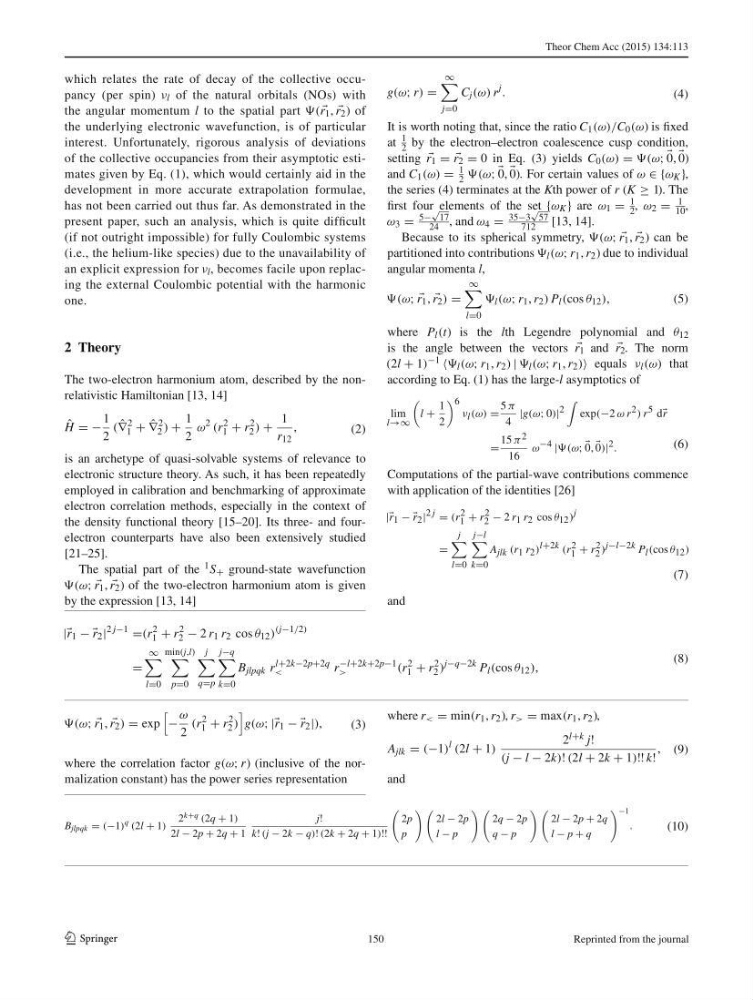
The two-electron harmonium atom, described by the nonrelativistic Hamiltonian [ 13 , 14 ]
is an archetype of quasi-solvable systems of relevance to
electronic structure theory. As such, it has been repeatedly
employed in calibration and benchmarking of approximate
electron correlation methods, especially in the context of
the density functional theory [ 15 – 20 ]. Its three- and fourelectron counterparts have also been extensively studied
[ 21 – 25 ].
The spatial part of the 1 S + ground-state wavefunction
(ω; ;
r 1 ,
r 2 ) of the two-electron harmonium atom is given
by the expression [ 13 , 14 ]
(2)
ˆ
H = −
1
2
( ˆ
∇
2
1 + ˆ
∇
2
2 ) +
1
2
ω
2
(r
2
1 + r
2
2 ) +
1
r 12
,
It is worth noting that, since the ratio C 1 (ω)/C 0 (ω) is fi xed
at
1
2 by the electron–electron coalescence cusp condition,
setting
r 1 = =
r 2 = 0 in Eq. ( 3 ) yields C 0 (ω) = (ω;
0,
0)
and C 1 (ω) =
1
2 (ω;
0,
0) . For certain values of ω ∈ {ω K } ,
the series ( 4 ) terminates at the K th power of r ( K ≥ 1 ). The
fi rst four elements of the set {ω K } are ω 1 =
1
2 , ω 2 =
1
10 ,
ω 3 =
5−
√
17
24 , and ω 4 =
35−3
√
57
712
[ 13 , 14 ].
Because to its spherical symmetry, (ω; ;
r 1 ,
r 2 ) can be
partitioned into contributions l (ω; r 1 , r 2 ) due to individual
angular momenta l ,
where P l (t) is the l th Legendre polynomial and θ 12
is the angle between the vectors
r 1 and
r 2 . The norm
(2l + 1) −1 l (ω; r 1 , r 2 ) | l (ω; r 1 , r 2 ) equals ν l (ω) that
according to Eq. ( 1 ) has the large- l asymptotics of
Computations of the partial-wave contributions commence
with application of the identities [ 26 ]
and
(4)
g(ω; r) =
∞
j=0
C j (ω) r
j .
(5)
(ω; ;
r 1 ,
r 2 ) =
∞
l=0
l (ω; r 1 , r 2 ) P l (cos θ 12 ),
(6)
lim
l→∞
l +
1
2
6
ν l (ω) =
5 π
4
|g(ω; 0)| 2
exp(−2 ω r 2 ) r 5 d r
=
15 π 2
16
ω −4 |(ω;
0,
0)| 2 .
(7)
|| r 1 − − r 2 | 2 j = (r 2
1 + r 2
2 − 2 r 1 r 2 cos θ 12 ) j
=
j
l=0
j−l
k=0
A jlk (r 1 r 2 ) l+2k (r 2
1 + r 2
2 ) j−l−2k P l (cos θ 12 )
(8)
|| r 1 − − r 2 |
2 j−1
=(r
2
1 + r
2
2 − 2 r 1 r 2 cos θ 12 )
(j−1/2)
=
∞
l=0
min(j,l)
p=0
j
q=p
j−q
k=0
B jlpqk r
l+2k−2p+2q
<
r
−l+2k+2p−1
>
(r
2
1 + r
2
2 )
j−q−2k P l (cos θ 12 ),
where the correlation factor g(ω; r) (inclusive of the normalization constant) has the power series representation
(3)
(ω; ;
r 1 ,
r 2 ) = exp
−
ω
2
(r
2
1 + r
2
2 )
g(ω; || r 1 − − r 2 |),
where r < = min(r 1 , r 2 ) , r > = max(r 1 , r 2 ) ,
and
(9)
A jlk = (−1)
l
(2l + 1)
2 l+k j!
(j − l − 2k)! (2l + 2k + 1)!! k!
,
(10)
B jlpqk = (−1)
q (2l + 1)
2 k+q (2q + 1)
2l − 2p + 2q + 1
j!
k! (j − 2k − q)! (2k + 2q + 1)!!
2p
p
2l − 2p
l − p
2q − 2p
q − p
2l − 2p + 2q
l − p + q
−1
.
150
Reprinted from the journal
1 3
which relates the rate of decay of the collective occupancy (per spin) ν l of the natural orbitals (NOs) with
the angular momentum l to the spatial part (
r 1 ,
r 2 ) of
the underlying electronic wavefunction, is of particular
interest. Unfortunately, rigorous analysis of deviations
of the collective occupancies from their asymptotic estimates given by Eq. ( 1 ), which would certainly aid in the
development in more accurate extrapolation formulae,
has not been carried out thus far. As demonstrated in the
present paper, such an analysis, which is quite diffi cult
(if not outright impossible) for fully Coulombic systems
(i.e., the helium-like species) due to the unavailability of
an explicit expression for ν l , becomes facile upon replacing the external Coulombic potential with the harmonic
one.
2 Theory
The two-electron harmonium atom, described by the nonrelativistic Hamiltonian [ 13 , 14 ]
is an archetype of quasi-solvable systems of relevance to
electronic structure theory. As such, it has been repeatedly
employed in calibration and benchmarking of approximate
electron correlation methods, especially in the context of
the density functional theory [ 15 – 20 ]. Its three- and fourelectron counterparts have also been extensively studied
[ 21 – 25 ].
The spatial part of the 1 S + ground-state wavefunction
(ω; ;
r 1 ,
r 2 ) of the two-electron harmonium atom is given
by the expression [ 13 , 14 ]
(2)
ˆ
H = −
1
2
( ˆ
∇
2
1 + ˆ
∇
2
2 ) +
1
2
ω
2
(r
2
1 + r
2
2 ) +
1
r 12
,
It is worth noting that, since the ratio C 1 (ω)/C 0 (ω) is fi xed
at
1
2 by the electron–electron coalescence cusp condition,
setting
r 1 = =
r 2 = 0 in Eq. ( 3 ) yields C 0 (ω) = (ω;
0,
0)
and C 1 (ω) =
1
2 (ω;
0,
0) . For certain values of ω ∈ {ω K } ,
the series ( 4 ) terminates at the K th power of r ( K ≥ 1 ). The
fi rst four elements of the set {ω K } are ω 1 =
1
2 , ω 2 =
1
10 ,
ω 3 =
5−
√
17
24 , and ω 4 =
35−3
√
57
712
[ 13 , 14 ].
Because to its spherical symmetry, (ω; ;
r 1 ,
r 2 ) can be
partitioned into contributions l (ω; r 1 , r 2 ) due to individual
angular momenta l ,
where P l (t) is the l th Legendre polynomial and θ 12
is the angle between the vectors
r 1 and
r 2 . The norm
(2l + 1) −1 l (ω; r 1 , r 2 ) | l (ω; r 1 , r 2 ) equals ν l (ω) that
according to Eq. ( 1 ) has the large- l asymptotics of
Computations of the partial-wave contributions commence
with application of the identities [ 26 ]
and
(4)
g(ω; r) =
∞
j=0
C j (ω) r
j .
(5)
(ω; ;
r 1 ,
r 2 ) =
∞
l=0
l (ω; r 1 , r 2 ) P l (cos θ 12 ),
(6)
lim
l→∞
l +
1
2
6
ν l (ω) =
5 π
4
|g(ω; 0)| 2
exp(−2 ω r 2 ) r 5 d r
=
15 π 2
16
ω −4 |(ω;
0,
0)| 2 .
(7)
|| r 1 − − r 2 | 2 j = (r 2
1 + r 2
2 − 2 r 1 r 2 cos θ 12 ) j
=
j
l=0
j−l
k=0
A jlk (r 1 r 2 ) l+2k (r 2
1 + r 2
2 ) j−l−2k P l (cos θ 12 )
(8)
|| r 1 − − r 2 |
2 j−1
=(r
2
1 + r
2
2 − 2 r 1 r 2 cos θ 12 )
(j−1/2)
=
∞
l=0
min(j,l)
p=0
j
q=p
j−q
k=0
B jlpqk r
l+2k−2p+2q
<
r
−l+2k+2p−1
>
(r
2
1 + r
2
2 )
j−q−2k P l (cos θ 12 ),
where the correlation factor g(ω; r) (inclusive of the normalization constant) has the power series representation
(3)
(ω; ;
r 1 ,
r 2 ) = exp
−
ω
2
(r
2
1 + r
2
2 )
g(ω; || r 1 − − r 2 |),
where r < = min(r 1 , r 2 ) , r > = max(r 1 , r 2 ) ,
and
(9)
A jlk = (−1)
l
(2l + 1)
2 l+k j!
(j − l − 2k)! (2l + 2k + 1)!! k!
,
(10)
B jlpqk = (−1)
q (2l + 1)
2 k+q (2q + 1)
2l − 2p + 2q + 1
j!
k! (j − 2k − q)! (2k + 2q + 1)!!
2p
p
2l − 2p
l − p
2q − 2p
q − p
2l − 2p + 2q
l − p + q
−1
.
150
Reprinted from the journal