

Theor Chem Acc (2015) 134:132
1 3
[ 30 ] localized which is followed by the Boughton–Pulay
algorithm [ 31 ] to select those atoms on which the orbitals
are localized.
The fi rst step of the Boughton–Pulay algorithm is that
for each localized orbital, the atoms are ranked according to their gross Mulliken population. Starting from the
atom with the largest Mulliken population, subspaces of
atoms are defi ned by adding atoms of smaller and smaller
Mulliken populations. For each subspace, the localized molecular orbital is truncated to the subspace, and
the norm of the square of the difference of the original
and the truncated function is calculated. The procedure
is terminated when the norm drops below a threshold ;
hence, the localized orbitals are assigned automatically
to atoms whose basis functions span the best subspace
for given localized orbital. In the implementation of the
HLSCF method, a 1 − = 0.985 completeness criteria
was chosen.
After assigning atoms to localized orbitals, the core
orbitals of the MMH atom and the single valence orbital
connecting the QMH and MMH atoms are selected.
SLMOs are generated and saved from selected localized
molecular orbitals by removing contributions from all
atoms except the QMH and MMH atoms.
3.2.2 Selection of the model molecule
The model molecules are generated from the list of atom pairs
defi ning those chemical bonds that connect the QM and MM
subsystems. Our task is to select a molecular graph for every
such atom pair and close their dangling bonds with hydrogens
in a way to satisfy the considerations written in the Link atom
approach section. Starting from a given atom pair, we use an
incremental, step-by-step forwarding procedure to extend the
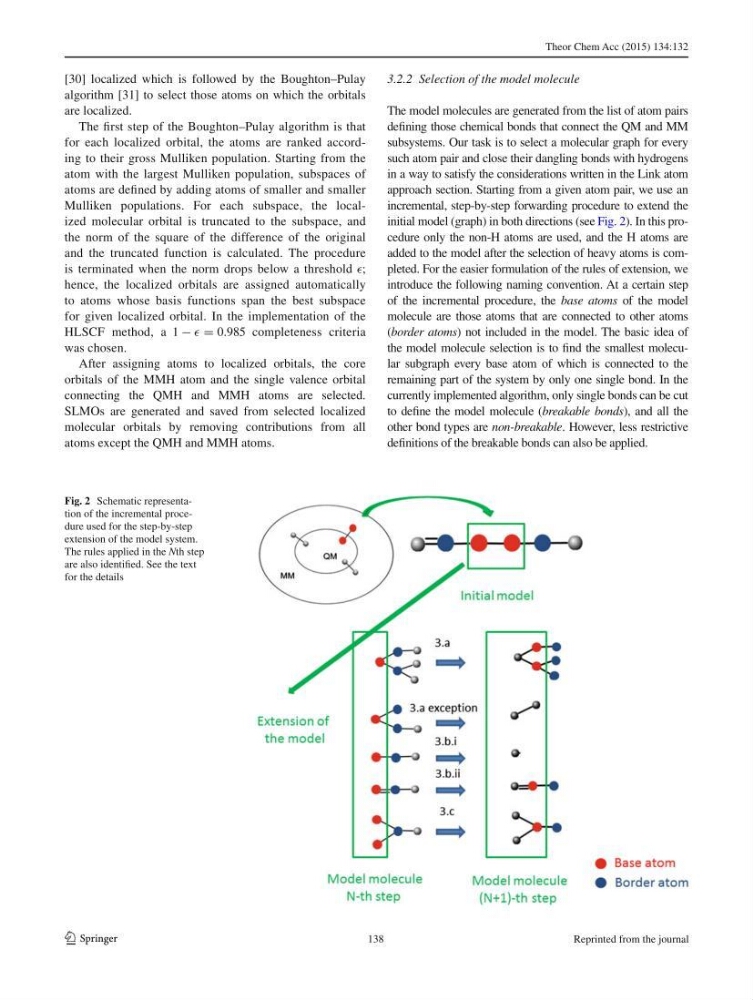
initial model (graph) in both directions (see Fig. 2 ). In this procedure only the non-H atoms are used, and the H atoms are
added to the model after the selection of heavy atoms is completed. For the easier formulation of the rules of extension, we
introduce the following naming convention. At a certain step
of the incremental procedure, the base atoms of the model
molecule are those atoms that are connected to other atoms
( border atoms ) not included in the model. The basic idea of
the model molecule selection is to fi nd the smallest molecular subgraph every base atom of which is connected to the
remaining part of the system by only one single bond. In the
currently implemented algorithm, only single bonds can be cut
to defi ne the model molecule ( breakable bonds ), and all the
other bond types are non-breakable . However, less restrictive
defi nitions of the breakable bonds can also be applied.
Fig. 2 Schematic representation of the incremental procedure used for the step-by-step
extension of the model system.
The rules applied in the N th step
are also identifi ed. See the text
for the details
138
Reprinted from the journal
1 3
[ 30 ] localized which is followed by the Boughton–Pulay
algorithm [ 31 ] to select those atoms on which the orbitals
are localized.
The fi rst step of the Boughton–Pulay algorithm is that
for each localized orbital, the atoms are ranked according to their gross Mulliken population. Starting from the
atom with the largest Mulliken population, subspaces of
atoms are defi ned by adding atoms of smaller and smaller
Mulliken populations. For each subspace, the localized molecular orbital is truncated to the subspace, and
the norm of the square of the difference of the original
and the truncated function is calculated. The procedure
is terminated when the norm drops below a threshold ;
hence, the localized orbitals are assigned automatically
to atoms whose basis functions span the best subspace
for given localized orbital. In the implementation of the
HLSCF method, a 1 − = 0.985 completeness criteria
was chosen.
After assigning atoms to localized orbitals, the core
orbitals of the MMH atom and the single valence orbital
connecting the QMH and MMH atoms are selected.
SLMOs are generated and saved from selected localized
molecular orbitals by removing contributions from all
atoms except the QMH and MMH atoms.
3.2.2 Selection of the model molecule
The model molecules are generated from the list of atom pairs
defi ning those chemical bonds that connect the QM and MM
subsystems. Our task is to select a molecular graph for every
such atom pair and close their dangling bonds with hydrogens
in a way to satisfy the considerations written in the Link atom
approach section. Starting from a given atom pair, we use an
incremental, step-by-step forwarding procedure to extend the
initial model (graph) in both directions (see Fig. 2 ). In this procedure only the non-H atoms are used, and the H atoms are
added to the model after the selection of heavy atoms is completed. For the easier formulation of the rules of extension, we
introduce the following naming convention. At a certain step
of the incremental procedure, the base atoms of the model
molecule are those atoms that are connected to other atoms
( border atoms ) not included in the model. The basic idea of
the model molecule selection is to fi nd the smallest molecular subgraph every base atom of which is connected to the
remaining part of the system by only one single bond. In the
currently implemented algorithm, only single bonds can be cut
to defi ne the model molecule ( breakable bonds ), and all the
other bond types are non-breakable . However, less restrictive
defi nitions of the breakable bonds can also be applied.
Fig. 2 Schematic representation of the incremental procedure used for the step-by-step
extension of the model system.
The rules applied in the N th step
are also identifi ed. See the text
for the details
138
Reprinted from the journal