

Theor Chem Acc (2015) 134:132
1 3
are to be used, and this requires more intensive modifi cations in the QM code. On the contrary, the adaptation of
the MM code is more straightforward, and it is without
the complications caused by the presence of extra atoms
appearing in the link atom method.
In the forthcoming discussion, we present our results in
the combination of the AMBER and MRCC codes. Both theoretical considerations and practical issues are discussed
together with the results of test calculations.
2 Theory
Our QM/MM code uses frozen strictly localized orbitals
to separate the covalently bound QM and MM subsystems.
Since this method has been described in detail in Ref. [ 13 ],
here only a summary of the most important features of the
method are recapitulated.
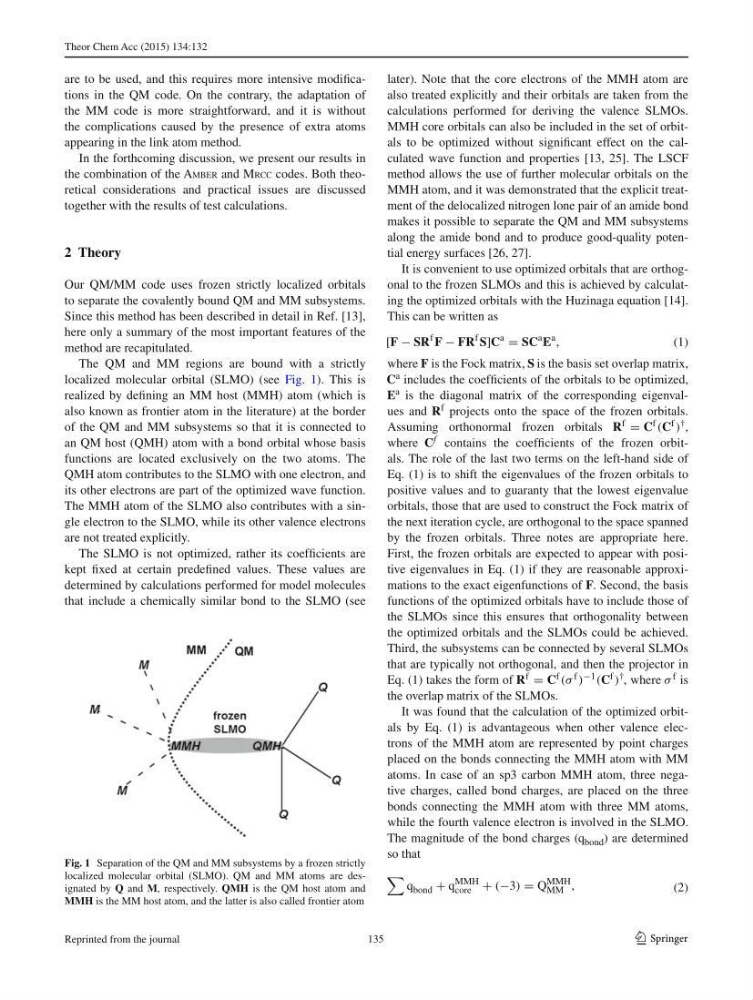
The QM and MM regions are bound with a strictly
localized molecular orbital (SLMO) (see Fig. 1 ). This is
realized by defi ning an MM host (MMH) atom (which is
also known as frontier atom in the literature) at the border
of the QM and MM subsystems so that it is connected to
an QM host (QMH) atom with a bond orbital whose basis
functions are located exclusively on the two atoms. The
QMH atom contributes to the SLMO with one electron, and
its other electrons are part of the optimized wave function.
The MMH atom of the SLMO also contributes with a single electron to the SLMO, while its other valence electrons
are not treated explicitly.
The SLMO is not optimized, rather its coeffi cients are
kept fi xed at certain predefi ned values. These values are
determined by calculations performed for model molecules
that include a chemically similar bond to the SLMO (see
later). Note that the core electrons of the MMH atom are
also treated explicitly and their orbitals are taken from the
calculations performed for deriving the valence SLMOs.
MMH core orbitals can also be included in the set of orbitals to be optimized without signifi cant effect on the calculated wave function and properties [ 13 , 25 ]. The LSCF
method allows the use of further molecular orbitals on the
MMH atom, and it was demonstrated that the explicit treatment of the delocalized nitrogen lone pair of an amide bond
makes it possible to separate the QM and MM subsystems
along the amide bond and to produce good-quality potential energy surfaces [ 26 , 27 ].
It is convenient to use optimized orbitals that are orthogonal to the frozen SLMOs and this is achieved by calculating the optimized orbitals with the Huzinaga equation [ 14 ].
This can be written as
where F is the Fock matrix, S is the basis set overlap matrix,
C a includes the coeffi cients of the orbitals to be optimized,
E a is the diagonal matrix of the corresponding eigenvalues and R f projects onto the space of the frozen orbitals.
Assuming orthonormal frozen orbitals R f = C f (C f ) † ,
where C f contains the coeffi cients of the frozen orbitals. The role of the last two terms on the left-hand side of
Eq. ( 1 ) is to shift the eigenvalues of the frozen orbitals to
positive values and to guaranty that the lowest eigenvalue
orbitals, those that are used to construct the Fock matrix of
the next iteration cycle, are orthogonal to the space spanned
by the frozen orbitals. Three notes are appropriate here.
First, the frozen orbitals are expected to appear with positive eigenvalues in Eq. ( 1 ) if they are reasonable approximations to the exact eigenfunctions of F . Second, the basis
functions of the optimized orbitals have to include those of
the SLMOs since this ensures that orthogonality between
the optimized orbitals and the SLMOs could be achieved.
Third, the subsystems can be connected by several SLMOs
that are typically not orthogonal, and then the projector in
Eq. ( 1 ) takes the form of R f = C f (σ f ) −1 (C f ) † , where σ f is
the overlap matrix of the SLMOs.
It was found that the calculation of the optimized orbitals by Eq. ( 1 ) is advantageous when other valence electrons of the MMH atom are represented by point charges
placed on the bonds connecting the MMH atom with MM
atoms. In case of an sp3 carbon MMH atom, three negative charges, called bond charges, are placed on the three
bonds connecting the MMH atom with three MM atoms,
while the fourth valence electron is involved in the SLMO.
The magnitude of the bond charges ( q bond ) are determined
so that
(1)
[F − SR
f F − FR
f S]C
a
= SC
a E
a ,
(2)
q bond + q
MMH
core + (−3) = Q
MMH
MM ,
Fig. 1 Separation of the QM and MM subsystems by a frozen strictly
localized molecular orbital (SLMO). QM and MM atoms are designated by Q and M , respectively. QMH is the QM host atom and
MMH is the MM host atom, and the latter is also called frontier atom
135
Reprinted from the journal
1 3
are to be used, and this requires more intensive modifi cations in the QM code. On the contrary, the adaptation of
the MM code is more straightforward, and it is without
the complications caused by the presence of extra atoms
appearing in the link atom method.
In the forthcoming discussion, we present our results in
the combination of the AMBER and MRCC codes. Both theoretical considerations and practical issues are discussed
together with the results of test calculations.
2 Theory
Our QM/MM code uses frozen strictly localized orbitals
to separate the covalently bound QM and MM subsystems.
Since this method has been described in detail in Ref. [ 13 ],
here only a summary of the most important features of the
method are recapitulated.
The QM and MM regions are bound with a strictly
localized molecular orbital (SLMO) (see Fig. 1 ). This is
realized by defi ning an MM host (MMH) atom (which is
also known as frontier atom in the literature) at the border
of the QM and MM subsystems so that it is connected to
an QM host (QMH) atom with a bond orbital whose basis
functions are located exclusively on the two atoms. The
QMH atom contributes to the SLMO with one electron, and
its other electrons are part of the optimized wave function.
The MMH atom of the SLMO also contributes with a single electron to the SLMO, while its other valence electrons
are not treated explicitly.
The SLMO is not optimized, rather its coeffi cients are
kept fi xed at certain predefi ned values. These values are
determined by calculations performed for model molecules
that include a chemically similar bond to the SLMO (see
later). Note that the core electrons of the MMH atom are
also treated explicitly and their orbitals are taken from the
calculations performed for deriving the valence SLMOs.
MMH core orbitals can also be included in the set of orbitals to be optimized without signifi cant effect on the calculated wave function and properties [ 13 , 25 ]. The LSCF
method allows the use of further molecular orbitals on the
MMH atom, and it was demonstrated that the explicit treatment of the delocalized nitrogen lone pair of an amide bond
makes it possible to separate the QM and MM subsystems
along the amide bond and to produce good-quality potential energy surfaces [ 26 , 27 ].
It is convenient to use optimized orbitals that are orthogonal to the frozen SLMOs and this is achieved by calculating the optimized orbitals with the Huzinaga equation [ 14 ].
This can be written as
where F is the Fock matrix, S is the basis set overlap matrix,
C a includes the coeffi cients of the orbitals to be optimized,
E a is the diagonal matrix of the corresponding eigenvalues and R f projects onto the space of the frozen orbitals.
Assuming orthonormal frozen orbitals R f = C f (C f ) † ,
where C f contains the coeffi cients of the frozen orbitals. The role of the last two terms on the left-hand side of
Eq. ( 1 ) is to shift the eigenvalues of the frozen orbitals to
positive values and to guaranty that the lowest eigenvalue
orbitals, those that are used to construct the Fock matrix of
the next iteration cycle, are orthogonal to the space spanned
by the frozen orbitals. Three notes are appropriate here.
First, the frozen orbitals are expected to appear with positive eigenvalues in Eq. ( 1 ) if they are reasonable approximations to the exact eigenfunctions of F . Second, the basis
functions of the optimized orbitals have to include those of
the SLMOs since this ensures that orthogonality between
the optimized orbitals and the SLMOs could be achieved.
Third, the subsystems can be connected by several SLMOs
that are typically not orthogonal, and then the projector in
Eq. ( 1 ) takes the form of R f = C f (σ f ) −1 (C f ) † , where σ f is
the overlap matrix of the SLMOs.
It was found that the calculation of the optimized orbitals by Eq. ( 1 ) is advantageous when other valence electrons of the MMH atom are represented by point charges
placed on the bonds connecting the MMH atom with MM
atoms. In case of an sp3 carbon MMH atom, three negative charges, called bond charges, are placed on the three
bonds connecting the MMH atom with three MM atoms,
while the fourth valence electron is involved in the SLMO.
The magnitude of the bond charges ( q bond ) are determined
so that
(1)
[F − SR
f F − FR
f S]C
a
= SC
a E
a ,
(2)
q bond + q
MMH
core + (−3) = Q
MMH
MM ,
Fig. 1 Separation of the QM and MM subsystems by a frozen strictly
localized molecular orbital (SLMO). QM and MM atoms are designated by Q and M , respectively. QMH is the QM host atom and
MMH is the MM host atom, and the latter is also called frontier atom
135
Reprinted from the journal