

Theor Chem Acc (2015) 134:148
1 3
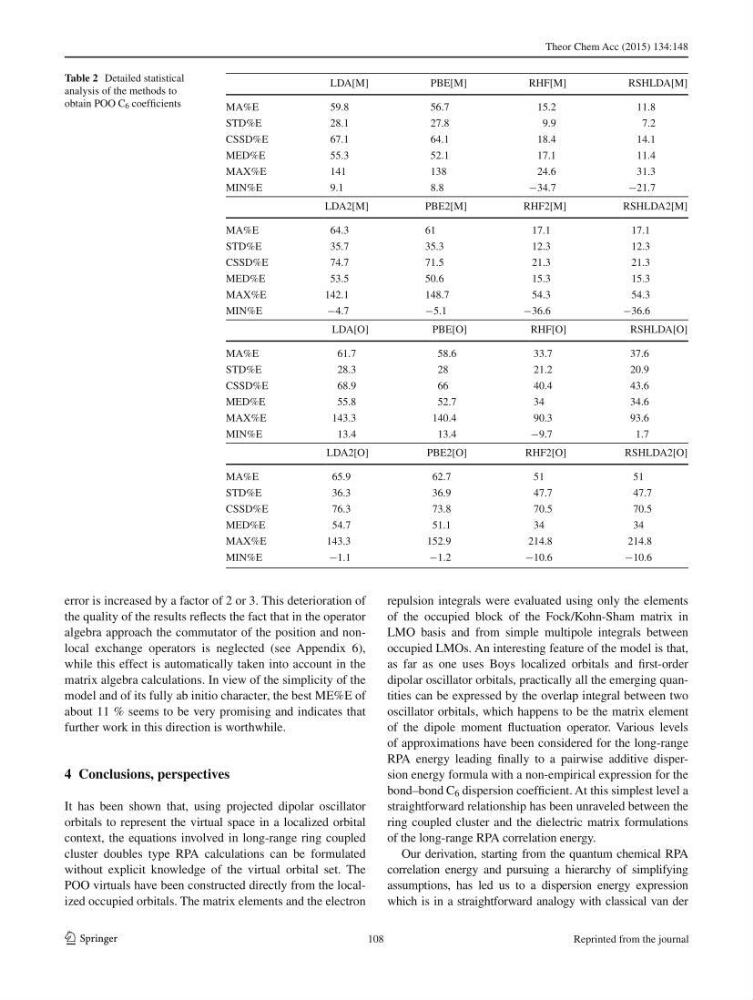
error is increased by a factor of 2 or 3. This deterioration of
the quality of the results refl ects the fact that in the operator
algebra approach the commutator of the position and nonlocal exchange operators is neglected (see Appendix 6 ),
while this effect is automatically taken into account in the
matrix algebra calculations. In view of the simplicity of the
model and of its fully ab initio character, the best ME%E of
about 11 % seems to be very promising and indicates that
further work in this direction is worthwhile.
4 Conclusions, perspectives
It has been shown that, using projected dipolar oscillator
orbitals to represent the virtual space in a localized orbital
context, the equations involved in long-range ring coupled
cluster doubles type RPA calculations can be formulated
without explicit knowledge of the virtual orbital set. The
POO virtuals have been constructed directly from the localized occupied orbitals. The matrix elements and the electron
repulsion integrals were evaluated using only the elements
of the occupied block of the Fock/Kohn-Sham matrix in
LMO basis and from simple multipole integrals between
occupied LMOs. An interesting feature of the model is that,
as far as one uses Boys localized orbitals and fi rst-order
dipolar oscillator orbitals, practically all the emerging quantities can be expressed by the overlap integral between two
oscillator orbitals, which happens to be the matrix element
of the dipole moment fl uctuation operator. Various levels
of approximations have been considered for the long-range
RPA energy leading fi nally to a pairwise additive dispersion energy formula with a non-empirical expression for the
bond–bond C 6 dispersion coeffi cient. At this simplest level a
straightforward relationship has been unraveled between the
ring coupled cluster and the dielectric matrix formulations
of the long-range RPA correlation energy.
Our derivation, starting from the quantum chemical RPA
correlation energy and pursuing a hierarchy of simplifying
assumptions, has led us to a dispersion energy expression
which is in a straightforward analogy with classical van der
Table 2 Detailed statistical
analysis of the methods to
obtain POO C 6 coeffi cients
LDA[M]
PBE[M]
RHF[M]
RSHLDA[M]
MA%E
59.8
56.7
15.2
11.8
STD%E
28.1
27.8
9.9
7.2
CSSD%E
67.1
64.1
18.4
14.1
MED%E
55.3
52.1
17.1
11.4
MAX%E
141
138
24.6
31.3
MIN%E
9.1
8.8
−34.7
−21.7
LDA2[M]
PBE2[M]
RHF2[M]
RSHLDA2[M]
MA%E
64.3
61
17.1
17.1
STD%E
35.7
35.3
12.3
12.3
CSSD%E
74.7
71.5
21.3
21.3
MED%E
53.5
50.6
15.3
15.3
MAX%E
142.1
148.7
54.3
54.3
MIN%E
−4.7
−5.1
−36.6
−36.6
LDA[O]
PBE[O]
RHF[O]
RSHLDA[O]
MA%E
61.7
58.6
33.7
37.6
STD%E
28.3
28
21.2
20.9
CSSD%E
68.9
66
40.4
43.6
MED%E
55.8
52.7
34
34.6
MAX%E
143.3
140.4
90.3
93.6
MIN%E
13.4
13.4
−9.7
1.7
LDA2[O]
PBE2[O]
RHF2[O]
RSHLDA2[O]
MA%E
65.9
62.7
51
51
STD%E
36.3
36.9
47.7
47.7
CSSD%E
76.3
73.8
70.5
70.5
MED%E
54.7
51.1
34
34
MAX%E
143.3
152.9
214.8
214.8
MIN%E
−1.1
−1.2
−10.6
−10.6
108
Reprinted from the journal
1 3
error is increased by a factor of 2 or 3. This deterioration of
the quality of the results refl ects the fact that in the operator
algebra approach the commutator of the position and nonlocal exchange operators is neglected (see Appendix 6 ),
while this effect is automatically taken into account in the
matrix algebra calculations. In view of the simplicity of the
model and of its fully ab initio character, the best ME%E of
about 11 % seems to be very promising and indicates that
further work in this direction is worthwhile.
4 Conclusions, perspectives
It has been shown that, using projected dipolar oscillator
orbitals to represent the virtual space in a localized orbital
context, the equations involved in long-range ring coupled
cluster doubles type RPA calculations can be formulated
without explicit knowledge of the virtual orbital set. The
POO virtuals have been constructed directly from the localized occupied orbitals. The matrix elements and the electron
repulsion integrals were evaluated using only the elements
of the occupied block of the Fock/Kohn-Sham matrix in
LMO basis and from simple multipole integrals between
occupied LMOs. An interesting feature of the model is that,
as far as one uses Boys localized orbitals and fi rst-order
dipolar oscillator orbitals, practically all the emerging quantities can be expressed by the overlap integral between two
oscillator orbitals, which happens to be the matrix element
of the dipole moment fl uctuation operator. Various levels
of approximations have been considered for the long-range
RPA energy leading fi nally to a pairwise additive dispersion energy formula with a non-empirical expression for the
bond–bond C 6 dispersion coeffi cient. At this simplest level a
straightforward relationship has been unraveled between the
ring coupled cluster and the dielectric matrix formulations
of the long-range RPA correlation energy.
Our derivation, starting from the quantum chemical RPA
correlation energy and pursuing a hierarchy of simplifying
assumptions, has led us to a dispersion energy expression
which is in a straightforward analogy with classical van der
Table 2 Detailed statistical
analysis of the methods to
obtain POO C 6 coeffi cients
LDA[M]
PBE[M]
RHF[M]
RSHLDA[M]
MA%E
59.8
56.7
15.2
11.8
STD%E
28.1
27.8
9.9
7.2
CSSD%E
67.1
64.1
18.4
14.1
MED%E
55.3
52.1
17.1
11.4
MAX%E
141
138
24.6
31.3
MIN%E
9.1
8.8
−34.7
−21.7
LDA2[M]
PBE2[M]
RHF2[M]
RSHLDA2[M]
MA%E
64.3
61
17.1
17.1
STD%E
35.7
35.3
12.3
12.3
CSSD%E
74.7
71.5
21.3
21.3
MED%E
53.5
50.6
15.3
15.3
MAX%E
142.1
148.7
54.3
54.3
MIN%E
−4.7
−5.1
−36.6
−36.6
LDA[O]
PBE[O]
RHF[O]
RSHLDA[O]
MA%E
61.7
58.6
33.7
37.6
STD%E
28.3
28
21.2
20.9
CSSD%E
68.9
66
40.4
43.6
MED%E
55.8
52.7
34
34.6
MAX%E
143.3
140.4
90.3
93.6
MIN%E
13.4
13.4
−9.7
1.7
LDA2[O]
PBE2[O]
RHF2[O]
RSHLDA2[O]
MA%E
65.9
62.7
51
51
STD%E
36.3
36.9
47.7
47.7
CSSD%E
76.3
73.8
70.5
70.5
MED%E
54.7
51.1
34
34
MAX%E
143.3
152.9
214.8
214.8
MIN%E
−1.1
−1.2
−10.6
−10.6
108
Reprinted from the journal