

84 PETROLEUM TECHNOLOGY, ECONOMICS, AND POLITICS
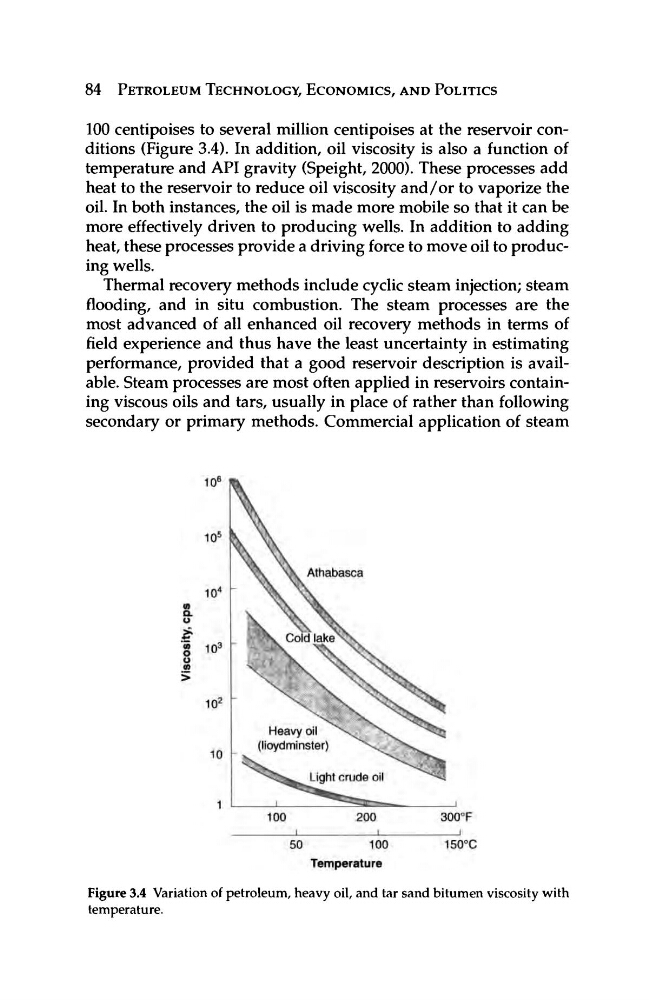
100 centipoises to several million centipoises at the reservoir conditions (Figure 3.4). In addition, oil viscosity is also a function of
temperature and API gravity (Speight, 2000). These processes add
heat to the reservoir to reduce oil viscosity and /or to vaporize the
oil. In both instances, the oil is made more mobile so that it can be
more effectively driven to producing wells. In addition to adding
heat, these processes provide a driving force to move oil to producing wells.
Thermal recovery methods include cyclic steam injection; steam
flooding, and in situ combustion. The steam processes are the
most advanced of all enhanced oil recovery methods in terms of
field experience and thus have the least uncertainty in estimating
performance, provided that a good reservoir description is available. Steam processes are most often applied in reservoirs containing viscous oils and tars, usually in place of rather than following
secondary or primary methods. Commercial application of steam
Figure 3.4 Variation of petroleum, heavy oil, and tar sand bitumen viscosity with
temperature.
100 centipoises to several million centipoises at the reservoir conditions (Figure 3.4). In addition, oil viscosity is also a function of
temperature and API gravity (Speight, 2000). These processes add
heat to the reservoir to reduce oil viscosity and /or to vaporize the
oil. In both instances, the oil is made more mobile so that it can be
more effectively driven to producing wells. In addition to adding
heat, these processes provide a driving force to move oil to producing wells.
Thermal recovery methods include cyclic steam injection; steam
flooding, and in situ combustion. The steam processes are the
most advanced of all enhanced oil recovery methods in terms of
field experience and thus have the least uncertainty in estimating
performance, provided that a good reservoir description is available. Steam processes are most often applied in reservoirs containing viscous oils and tars, usually in place of rather than following
secondary or primary methods. Commercial application of steam
Figure 3.4 Variation of petroleum, heavy oil, and tar sand bitumen viscosity with
temperature.