

74 PETROLEUM TECHNOLOGY, ECONOMICS, AND POLITICS
First, a perforating gun is lowered into the well to the production
depth. The gun has explosive charges to create holes in the casing
through which oil can flow. After the casing has been perforated, a
small-diameter pipe (tubing) is run into the hole as a conduit for oil
and gas to flow up the well and a packer is run down the outside of the
tubing. When the packer is set at the production level, it is expanded
to form a seal around the outside of the tubing. Finally, a multi-valve
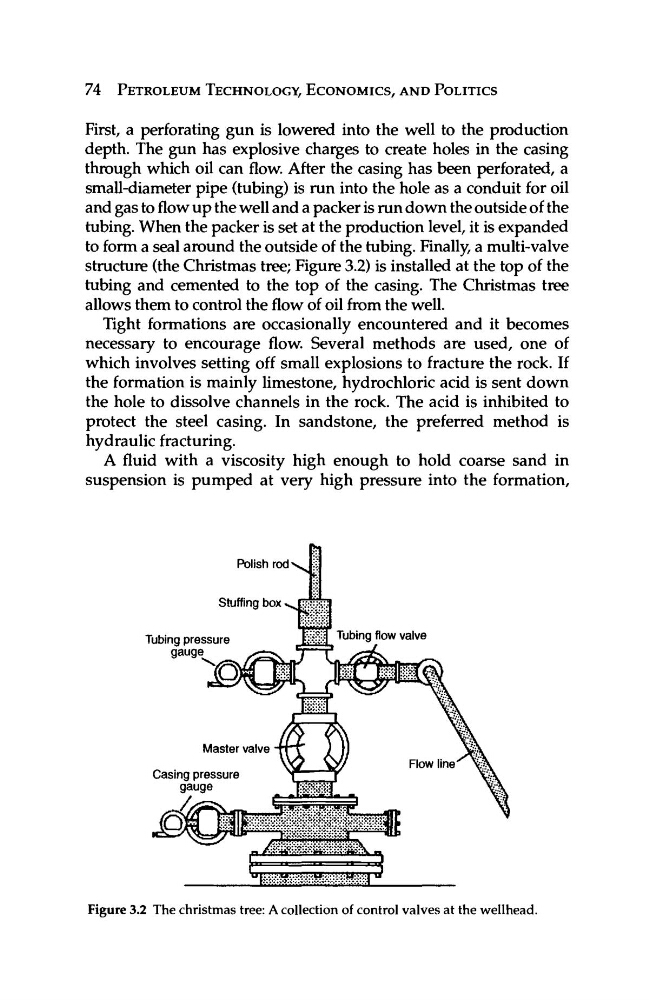
structure (the Christmas tree; Figure 3.2) is installed at the top of the
tubing and cemented to the top of the casing. The Christmas tree
allows them to control the flow of oil from the well.
Tight formations are occasionally encountered and it becomes
necessary to encourage flow. Several methods are used, one of
which involves setting off small explosions to fracture the rock. If
the formation is mainly limestone, hydrochloric acid is sent down
the hole to dissolve channels in the rock. The acid is inhibited to
protect the steel casing. In sandstone, the preferred method is
hydraulic fracturing.
A fluid with a viscosity high enough to hold coarse sand in
suspension is pumped at very high pressure into the formation,
Figure 3.2 The Christmas tree: A collection of control valves at the wellhead.
First, a perforating gun is lowered into the well to the production
depth. The gun has explosive charges to create holes in the casing
through which oil can flow. After the casing has been perforated, a
small-diameter pipe (tubing) is run into the hole as a conduit for oil
and gas to flow up the well and a packer is run down the outside of the
tubing. When the packer is set at the production level, it is expanded
to form a seal around the outside of the tubing. Finally, a multi-valve
structure (the Christmas tree; Figure 3.2) is installed at the top of the
tubing and cemented to the top of the casing. The Christmas tree
allows them to control the flow of oil from the well.
Tight formations are occasionally encountered and it becomes
necessary to encourage flow. Several methods are used, one of
which involves setting off small explosions to fracture the rock. If
the formation is mainly limestone, hydrochloric acid is sent down
the hole to dissolve channels in the rock. The acid is inhibited to
protect the steel casing. In sandstone, the preferred method is
hydraulic fracturing.
A fluid with a viscosity high enough to hold coarse sand in
suspension is pumped at very high pressure into the formation,
Figure 3.2 The Christmas tree: A collection of control valves at the wellhead.