

ORIGIN AND OCCURRENCE OF OIL 37
permeability are covered by a dense, relatively impermeable cap
rock, such as an evaporite or shale. A reservoir rock sealed by a
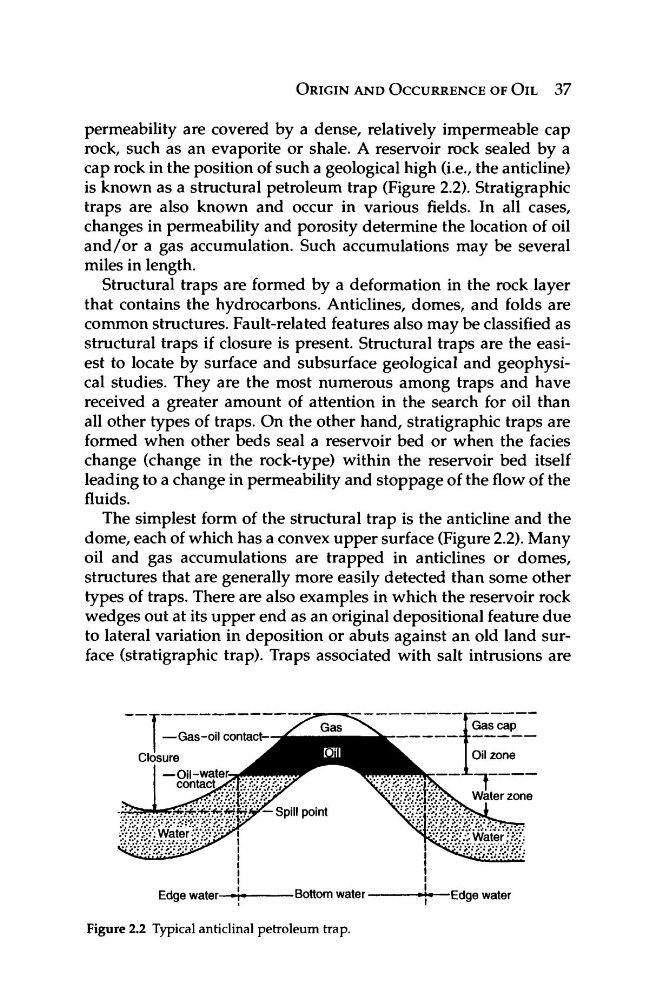
cap rock in the position of such a geological high (i.e., the anticline)
is known as a structural petroleum trap (Figure 2.2). Stratigraphie
traps are also known and occur in various fields. In all cases,
changes in permeability and porosity determine the location of oil
and/or a gas accumulation. Such accumulations may be several
miles in length.
Structural traps are formed by a deformation in the rock layer
that contains the hydrocarbons. Anticlines, domes, and folds are
common structures. Fault-related features also may be classified as
structural traps if closure is present. Structural traps are the easiest to locate by surface and subsurface geological and geophysical studies. They are the most numerous among traps and have
received a greater amount of attention in the search for oil than
all other types of traps. On the other hand, stratigraphie traps are
formed when other beds seal a reservoir bed or when the faciès
change (change in the rock-type) within the reservoir bed itself
leading to a change in permeability and stoppage of the flow of the
fluids.
The simplest form of the structural trap is the anticline and the
dome, each of which has a convex upper surface (Figure 2.2). Many
oil and gas accumulations are trapped in anticlines or domes,
structures that are generally more easily detected than some other
types of traps. There are also examples in which the reservoir rock
wedges out at its upper end as an original depositional feature due
to lateral variation in deposition or abuts against an old land surface (stratigraphie trap). Traps associated with salt intrusions are
Edge water—τ·
Bottom water
»}» Edge water
Figure 2.2 Typical anticlinal petroleum trap.
permeability are covered by a dense, relatively impermeable cap
rock, such as an evaporite or shale. A reservoir rock sealed by a
cap rock in the position of such a geological high (i.e., the anticline)
is known as a structural petroleum trap (Figure 2.2). Stratigraphie
traps are also known and occur in various fields. In all cases,
changes in permeability and porosity determine the location of oil
and/or a gas accumulation. Such accumulations may be several
miles in length.
Structural traps are formed by a deformation in the rock layer
that contains the hydrocarbons. Anticlines, domes, and folds are
common structures. Fault-related features also may be classified as
structural traps if closure is present. Structural traps are the easiest to locate by surface and subsurface geological and geophysical studies. They are the most numerous among traps and have
received a greater amount of attention in the search for oil than
all other types of traps. On the other hand, stratigraphie traps are
formed when other beds seal a reservoir bed or when the faciès
change (change in the rock-type) within the reservoir bed itself
leading to a change in permeability and stoppage of the flow of the
fluids.
The simplest form of the structural trap is the anticline and the
dome, each of which has a convex upper surface (Figure 2.2). Many
oil and gas accumulations are trapped in anticlines or domes,
structures that are generally more easily detected than some other
types of traps. There are also examples in which the reservoir rock
wedges out at its upper end as an original depositional feature due
to lateral variation in deposition or abuts against an old land surface (stratigraphie trap). Traps associated with salt intrusions are
Edge water—τ·
Bottom water
»}» Edge water
Figure 2.2 Typical anticlinal petroleum trap.