

HISTORY AND TERMINOLOGY OF CRUDE O I L
23
1.4.2 Natural Gas
The generic term natural gas applies to gases commonly associated
with petroliferous (petroleum-producing, petroleum-containing)
geologic formations. Natural gas generally contains high proportions of methane (a single carbon hydrocarbon compound, CH 4 )
and some of the higher molecular weight higher paraffins (C n H 2n+2 )
generally containing up to six carbon atoms may also be present
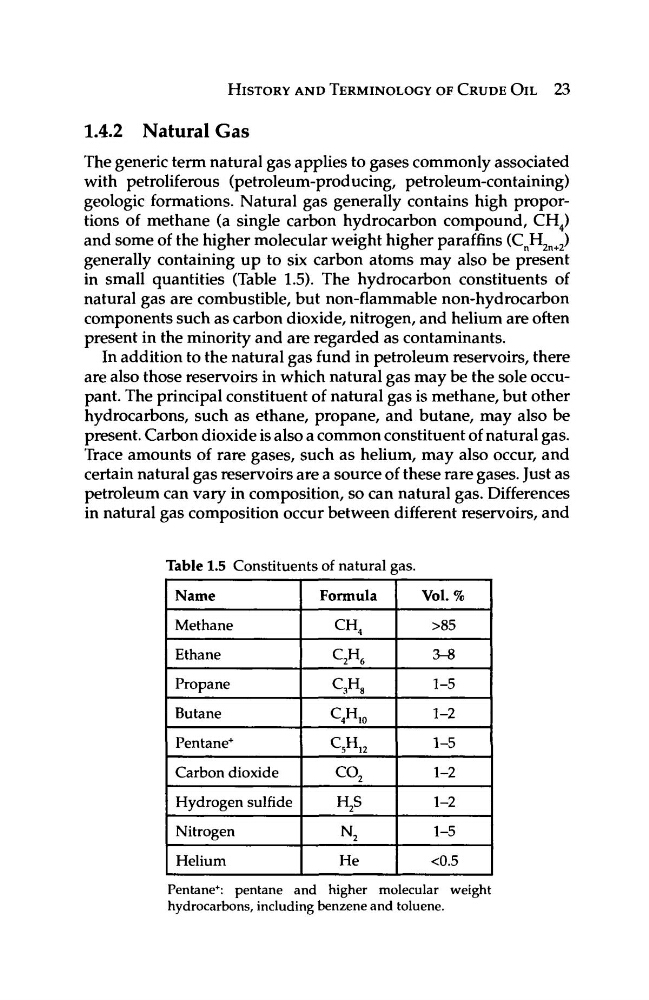
in small quantities (Table 1.5). The hydrocarbon constituents of
natural gas are combustible, but non-flammable non-hydrocarbon
components such as carbon dioxide, nitrogen, and helium are often
present in the minority and are regarded as contaminants.
In addition to the natural gas fund in petroleum reservoirs, there
are also those reservoirs in which natural gas may be the sole occupant. The principal constituent of natural gas is methane, but other
hydrocarbons, such as ethane, propane, and butane, may also be
present. Carbon dioxide is also a common constituent of natural gas.
Trace amounts of rare gases, such as helium, may also occur, and
certain natural gas reservoirs are a source of these rare gases. Just as
petroleum can vary in composition, so can natural gas. Differences
in natural gas composition occur between different reservoirs, and
Table 1.5 Constituents of natural gas.
Name
Methane
Ethane
Propane
Butane
Pentane*
Carbon dioxide
Hydrogen sulfide
Nitrogen
Helium
Formula
CH 4
C 2 H 6
C 3 H,
C 4
H 1 0
C 5
H 1 2
co 2
H 2 S
N 2
He
Vol. %
>85
3-8
1-5
1-2
1-5
1-2
1-2
1-5
«3.5
Pentane*: pentane and higher molecular weight
hydrocarbons, including benzene and toluene.
23
1.4.2 Natural Gas
The generic term natural gas applies to gases commonly associated
with petroliferous (petroleum-producing, petroleum-containing)
geologic formations. Natural gas generally contains high proportions of methane (a single carbon hydrocarbon compound, CH 4 )
and some of the higher molecular weight higher paraffins (C n H 2n+2 )
generally containing up to six carbon atoms may also be present
in small quantities (Table 1.5). The hydrocarbon constituents of
natural gas are combustible, but non-flammable non-hydrocarbon
components such as carbon dioxide, nitrogen, and helium are often
present in the minority and are regarded as contaminants.
In addition to the natural gas fund in petroleum reservoirs, there
are also those reservoirs in which natural gas may be the sole occupant. The principal constituent of natural gas is methane, but other
hydrocarbons, such as ethane, propane, and butane, may also be
present. Carbon dioxide is also a common constituent of natural gas.
Trace amounts of rare gases, such as helium, may also occur, and
certain natural gas reservoirs are a source of these rare gases. Just as
petroleum can vary in composition, so can natural gas. Differences
in natural gas composition occur between different reservoirs, and
Table 1.5 Constituents of natural gas.
Name
Methane
Ethane
Propane
Butane
Pentane*
Carbon dioxide
Hydrogen sulfide
Nitrogen
Helium
Formula
CH 4
C 2 H 6
C 3 H,
C 4
H 1 0
C 5
H 1 2
co 2
H 2 S
N 2
He
Vol. %
>85
3-8
1-5
1-2
1-5
1-2
1-2
1-5
«3.5
Pentane*: pentane and higher molecular weight
hydrocarbons, including benzene and toluene.