

254 PETROLEUM TECHNOLOGY, ECONOMICS, AND POLITICS
of energy independence or energy security for those countries with
vast resources of coal who are also net importers of crude oil.
One of the early processes for the production of liquid fuels from
coal involved the Bergius process. In the process, lignite or subbituminous coal is finely ground and mixed with heavy oil recycled
from the process. Catalyst is typically added to the mixture and the
mixture is pumped into a reactor. The reaction occurs at between
400 to 500°C and 20 to 70 MPa hydrogen pressure. The reaction
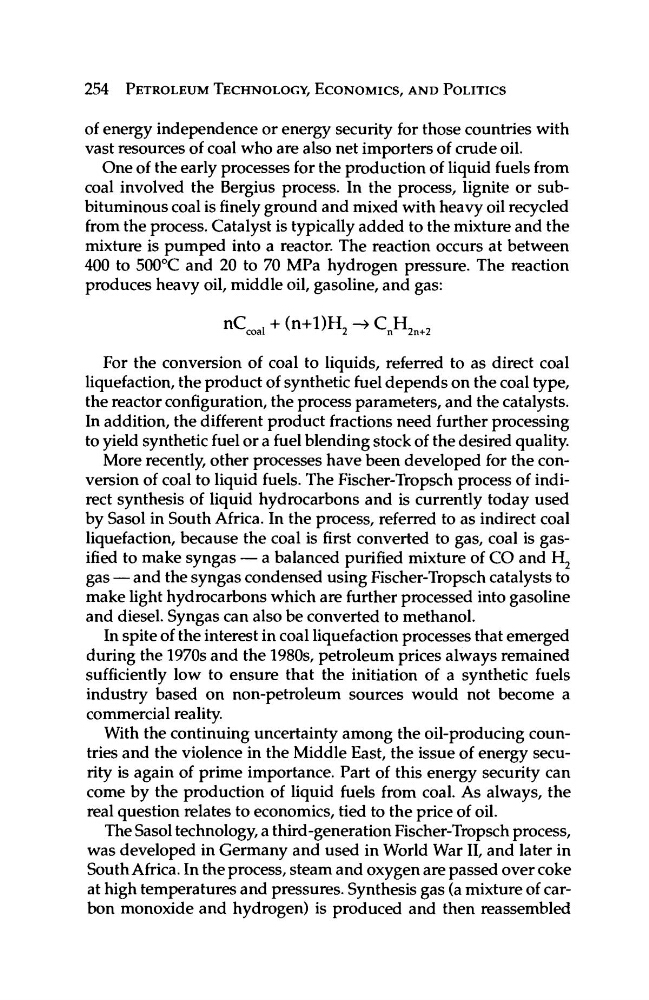
produces heavy oil, middle oil, gasoline, and gas:
nC , + ( n + l E - > C H , ,
coal
2
n 2n+2
For the conversion of coal to liquids, referred to as direct coal
liquefaction, the product of synthetic fuel depends on the coal type,
the reactor configuration, the process parameters, and the catalysts.
In addition, the different product fractions need further processing
to yield synthetic fuel or a fuel blending stock of the desired quality.
More recently, other processes have been developed for the conversion of coal to liquid fuels. The Fischer-Tropsch process of indirect synthesis of liquid hydrocarbons and is currently today used
by Sasol in South Africa. In the process, referred to as indirect coal
liquefaction, because the coal is first converted to gas, coal is gasified to make syngas — a balanced purified mixture of CO and H 2
gas — and the syngas condensed using Fischer-Tropsch catalysts to
make light hydrocarbons which are further processed into gasoline
and diesel. Syngas can also be converted to methanol.
In spite of the interest in coal liquefaction processes that emerged
during the 1970s and the 1980s, petroleum prices always remained
sufficiently low to ensure that the initiation of a synthetic fuels
industry based on non-petroleum sources would not become a
commercial reality.
With the continuing uncertainty among the oil-producing countries and the violence in the Middle East, the issue of energy security is again of prime importance. Part of this energy security can
come by the production of liquid fuels from coal. As always, the
real question relates to economics, tied to the price of oil.
The Sasol technology, a third-generation Fischer-Tropsch process,
was developed in Germany and used in World War II, and later in
South Africa. In the process, steam and oxygen are passed over coke
at high temperatures and pressures. Synthesis gas (a mixture of carbon monoxide and hydrogen) is produced and then reassembled
of energy independence or energy security for those countries with
vast resources of coal who are also net importers of crude oil.
One of the early processes for the production of liquid fuels from
coal involved the Bergius process. In the process, lignite or subbituminous coal is finely ground and mixed with heavy oil recycled
from the process. Catalyst is typically added to the mixture and the
mixture is pumped into a reactor. The reaction occurs at between
400 to 500°C and 20 to 70 MPa hydrogen pressure. The reaction
produces heavy oil, middle oil, gasoline, and gas:
nC , + ( n + l E - > C H , ,
coal
2
n 2n+2
For the conversion of coal to liquids, referred to as direct coal
liquefaction, the product of synthetic fuel depends on the coal type,
the reactor configuration, the process parameters, and the catalysts.
In addition, the different product fractions need further processing
to yield synthetic fuel or a fuel blending stock of the desired quality.
More recently, other processes have been developed for the conversion of coal to liquid fuels. The Fischer-Tropsch process of indirect synthesis of liquid hydrocarbons and is currently today used
by Sasol in South Africa. In the process, referred to as indirect coal
liquefaction, because the coal is first converted to gas, coal is gasified to make syngas — a balanced purified mixture of CO and H 2
gas — and the syngas condensed using Fischer-Tropsch catalysts to
make light hydrocarbons which are further processed into gasoline
and diesel. Syngas can also be converted to methanol.
In spite of the interest in coal liquefaction processes that emerged
during the 1970s and the 1980s, petroleum prices always remained
sufficiently low to ensure that the initiation of a synthetic fuels
industry based on non-petroleum sources would not become a
commercial reality.
With the continuing uncertainty among the oil-producing countries and the violence in the Middle East, the issue of energy security is again of prime importance. Part of this energy security can
come by the production of liquid fuels from coal. As always, the
real question relates to economics, tied to the price of oil.
The Sasol technology, a third-generation Fischer-Tropsch process,
was developed in Germany and used in World War II, and later in
South Africa. In the process, steam and oxygen are passed over coke
at high temperatures and pressures. Synthesis gas (a mixture of carbon monoxide and hydrogen) is produced and then reassembled