

248
PETROLEUM TECHNOLOGY, ECONOMICS, AND POLITICS
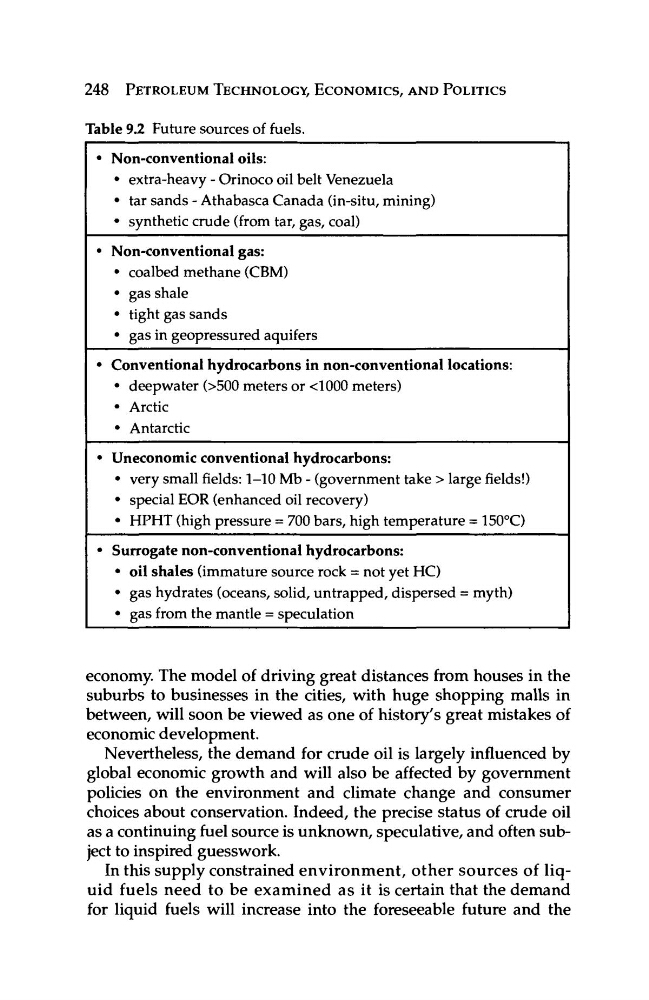
Table 9.2 Future sources of fuels.
Non-conventional oils:
extra-heavy - Orinoco oil belt Venezuela
tar sands - Athabasca Canada (in-situ, mining)
synthetic crude (from tar, gas, coal)
Non-conventional gas:
coalbed methane (CBM)
gas shale
tight gas sands
gas in geopressured aquifers
• Conventional hydrocarbons in non-conventional locations:
deepwater (>500 meters or <1000 meters)
Arctic
Antarctic
Uneconomic conventional hydrocarbons:
very small fields: 1-10 Mb - (government take > large fields!)
special EOR (enhanced oil recovery)
HPHT (high pressure = 700 bars, high temperature = 150°C)
Surrogate non-conventional hydrocarbons:
oil shales (immature source rock = not yet HC)
gas hydrates (oceans, solid, untrapped, dispersed = myth)
gas from the mantle = speculation
economy The model of driving great distances from houses in the
suburbs to businesses in the cities, with huge shopping malls in
between, will soon be viewed as one of history's great mistakes of
economic development.
Nevertheless, the demand for crude oil is largely influenced by
global economic growth and will also be affected by government
policies on the environment and climate change and consumer
choices about conservation. Indeed, the precise status of crude oil
as a continuing fuel source is unknown, speculative, and often subject to inspired guesswork.
In this supply constrained environment, other sources of liquid fuels need to be examined as it is certain that the demand
for liquid fuels will increase into the foreseeable future and the
PETROLEUM TECHNOLOGY, ECONOMICS, AND POLITICS
Table 9.2 Future sources of fuels.
Non-conventional oils:
extra-heavy - Orinoco oil belt Venezuela
tar sands - Athabasca Canada (in-situ, mining)
synthetic crude (from tar, gas, coal)
Non-conventional gas:
coalbed methane (CBM)
gas shale
tight gas sands
gas in geopressured aquifers
• Conventional hydrocarbons in non-conventional locations:
deepwater (>500 meters or <1000 meters)
Arctic
Antarctic
Uneconomic conventional hydrocarbons:
very small fields: 1-10 Mb - (government take > large fields!)
special EOR (enhanced oil recovery)
HPHT (high pressure = 700 bars, high temperature = 150°C)
Surrogate non-conventional hydrocarbons:
oil shales (immature source rock = not yet HC)
gas hydrates (oceans, solid, untrapped, dispersed = myth)
gas from the mantle = speculation
economy The model of driving great distances from houses in the
suburbs to businesses in the cities, with huge shopping malls in
between, will soon be viewed as one of history's great mistakes of
economic development.
Nevertheless, the demand for crude oil is largely influenced by
global economic growth and will also be affected by government
policies on the environment and climate change and consumer
choices about conservation. Indeed, the precise status of crude oil
as a continuing fuel source is unknown, speculative, and often subject to inspired guesswork.
In this supply constrained environment, other sources of liquid fuels need to be examined as it is certain that the demand
for liquid fuels will increase into the foreseeable future and the