

184 PETROLEUM TECHNOLOGY, ECONOMICS, AND POLITICS
6.6.4 Refining and Refinery Economics
A petroleum refinery is an installation that manufactures finished
petroleum products from crude oil, unfinished oils, natural gas liquids, other hydrocarbons, and alcohol. Refined petroleum products
include but are not limited to gasoline, kerosene, distillate fuel oils
(including No. 2 fuel oil), liquefied petroleum gas, asphalt, lubricating oil, diesel fuel, and residual fuel.
A typical large refinery costs billions of dollars to build and
millions more to maintain and upgrade. It runs around the clock
365 days a year, employs between 1,000 and 2,000 people, and can
occupy as much as one section (1 square mile, 640 acres) of land.
Many refineries are of such a size that workers ride bicycles, or
some other convenient form of transportation, to get from one station to another.
The complexity of refinery equipment varies from one refinery
to the next. In general, the more sophisticated a refinery, the better
its ability to upgrade crude oil into high-value products. However,
whether simple or complex, all refineries perform three basic steps:
separation, conversion, and treatment.
Thus, although the physical and chemical characteristics of
crude oils differ, the core refining process is simple distillation (or
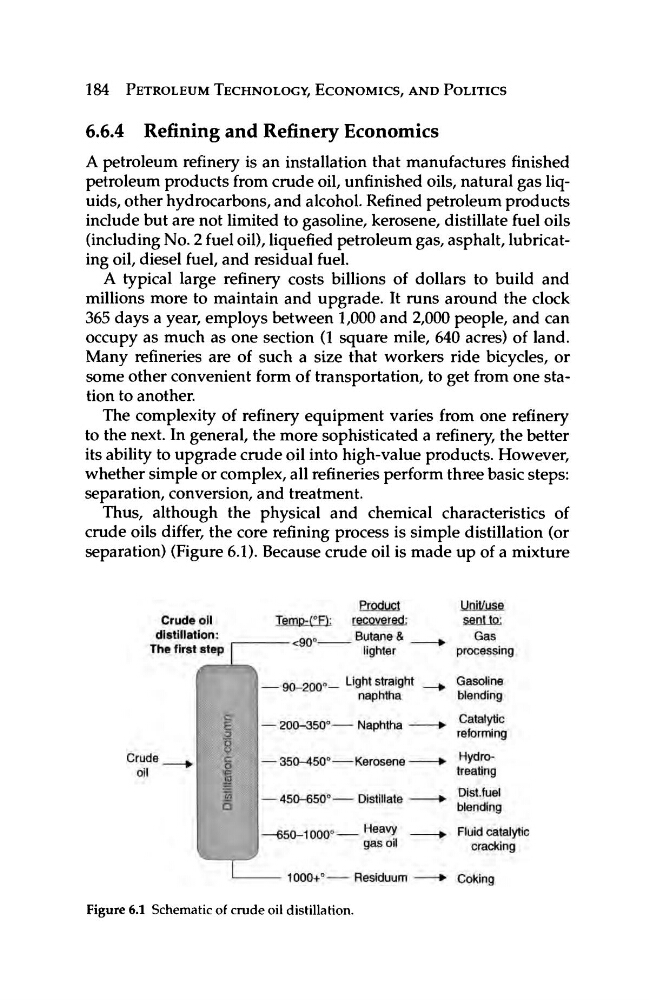
separation) (Figure 6.1). Because crude oil is made up of a mixture
Figure 6.1 Schematic of crude oil distillation.
6.6.4 Refining and Refinery Economics
A petroleum refinery is an installation that manufactures finished
petroleum products from crude oil, unfinished oils, natural gas liquids, other hydrocarbons, and alcohol. Refined petroleum products
include but are not limited to gasoline, kerosene, distillate fuel oils
(including No. 2 fuel oil), liquefied petroleum gas, asphalt, lubricating oil, diesel fuel, and residual fuel.
A typical large refinery costs billions of dollars to build and
millions more to maintain and upgrade. It runs around the clock
365 days a year, employs between 1,000 and 2,000 people, and can
occupy as much as one section (1 square mile, 640 acres) of land.
Many refineries are of such a size that workers ride bicycles, or
some other convenient form of transportation, to get from one station to another.
The complexity of refinery equipment varies from one refinery
to the next. In general, the more sophisticated a refinery, the better
its ability to upgrade crude oil into high-value products. However,
whether simple or complex, all refineries perform three basic steps:
separation, conversion, and treatment.
Thus, although the physical and chemical characteristics of
crude oils differ, the core refining process is simple distillation (or
separation) (Figure 6.1). Because crude oil is made up of a mixture
Figure 6.1 Schematic of crude oil distillation.