

110 PETROLEUM TECHNOLOGY, ECONOMICS, AND POLITICS
one having a viscosity of 10,050 cp. Furthermore, the inaccuracies
(i.e., the limits of experimental error) of the method of measuring
viscosity also increase the potential for misclassification.
The use of viscosity also does not circumvent the use of one
physical property and the difference between a material having viscosity equal to 49,900 and 50,100 centipoises (or 99,900 and 100,100
centipoises).
4.1.5 UOP Characterization Factor
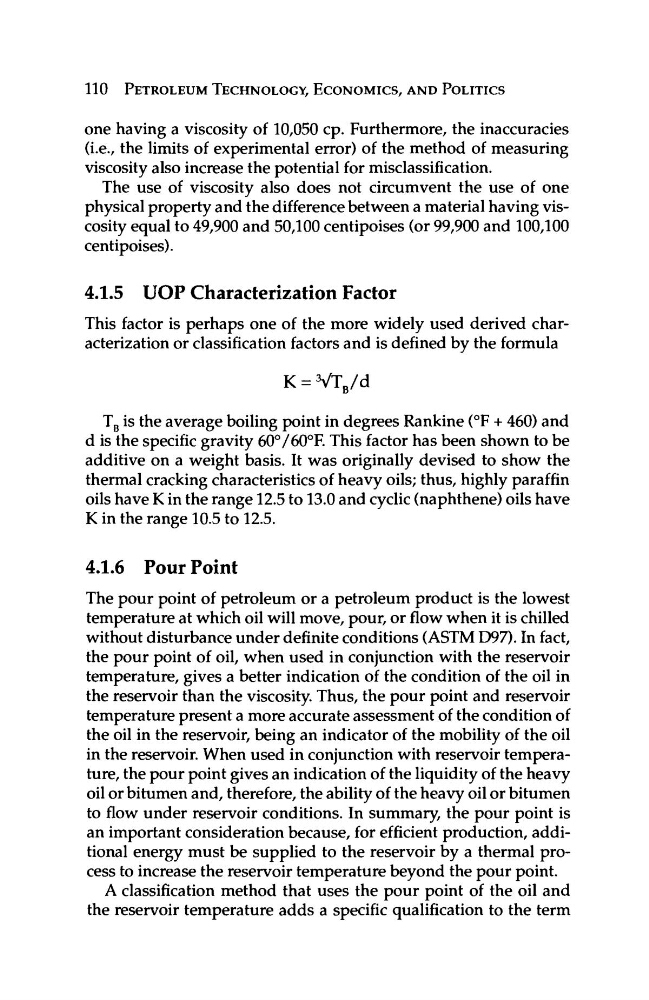
This factor is perhaps one of the more widely used derived characterization or classification factors and is defined by the formula
K = VT B /d
T B is the average boiling point in degrees Rankine (°F + 460) and
d is the specific gravity 60°/60°F. This factor has been shown to be
additive on a weight basis. It was originally devised to show the
thermal cracking characteristics of heavy oils; thus, highly paraffin
oils have K in the range 12.5 to 13.0 and cyclic (naphthene) oils have
K in the range 10.5 to 12.5.
4.1.6 Pour Point
The pour point of petroleum or a petroleum product is the lowest
temperature at which oil will move, pour, or flow when it is chilled
without disturbance under definite conditions (ASTM D97). In fact,
the pour point of oil, when used in conjunction with the reservoir
temperature, gives a better indication of the condition of the oil in
the reservoir than the viscosity. Thus, the pour point and reservoir
temperature present a more accurate assessment of the condition of
the oil in the reservoir, being an indicator of the mobility of the oil
in the reservoir. When used in conjunction with reservoir temperature, the pour point gives an indication of the liquidity of the heavy
oil or bitumen and, therefore, the ability of the heavy oil or bitumen
to flow under reservoir conditions. In summary, the pour point is
an important consideration because, for efficient production, additional energy must be supplied to the reservoir by a thermal process to increase the reservoir temperature beyond the pour point.
A classification method that uses the pour point of the oil and
the reservoir temperature adds a specific qualification to the term
one having a viscosity of 10,050 cp. Furthermore, the inaccuracies
(i.e., the limits of experimental error) of the method of measuring
viscosity also increase the potential for misclassification.
The use of viscosity also does not circumvent the use of one
physical property and the difference between a material having viscosity equal to 49,900 and 50,100 centipoises (or 99,900 and 100,100
centipoises).
4.1.5 UOP Characterization Factor
This factor is perhaps one of the more widely used derived characterization or classification factors and is defined by the formula
K = VT B /d
T B is the average boiling point in degrees Rankine (°F + 460) and
d is the specific gravity 60°/60°F. This factor has been shown to be
additive on a weight basis. It was originally devised to show the
thermal cracking characteristics of heavy oils; thus, highly paraffin
oils have K in the range 12.5 to 13.0 and cyclic (naphthene) oils have
K in the range 10.5 to 12.5.
4.1.6 Pour Point
The pour point of petroleum or a petroleum product is the lowest
temperature at which oil will move, pour, or flow when it is chilled
without disturbance under definite conditions (ASTM D97). In fact,
the pour point of oil, when used in conjunction with the reservoir
temperature, gives a better indication of the condition of the oil in
the reservoir than the viscosity. Thus, the pour point and reservoir
temperature present a more accurate assessment of the condition of
the oil in the reservoir, being an indicator of the mobility of the oil
in the reservoir. When used in conjunction with reservoir temperature, the pour point gives an indication of the liquidity of the heavy
oil or bitumen and, therefore, the ability of the heavy oil or bitumen
to flow under reservoir conditions. In summary, the pour point is
an important consideration because, for efficient production, additional energy must be supplied to the reservoir by a thermal process to increase the reservoir temperature beyond the pour point.
A classification method that uses the pour point of the oil and
the reservoir temperature adds a specific qualification to the term