

EXPLORATION, RECOVERY, AND TRANSPORTATION 91
channels, or undercut by lateral growth of the chamber beyond the
lateral extent of the limited barrier, or baffle.
Microbial enhanced oil recovery (MEOR) processes involve the
use of reservoir microorganisms or specially selected natural bacterial to produce specific metabolic events that lead to enhanced oil
recovery (Speight, 2009).
Microbial enhanced oil recovery differs from chemical enhanced
oil recovery in the method by which the enhancing products are
introduced into the reservoir. However, even though microbes
produce the necessary chemical reactions in situ whereas surface
injected chemicals may tend to follow areas of higher permeability,
resulting in decreased sweep efficiency, there is need for caution
and astute observation of the effects of the microorganisms on the
reservoir chemistry. The mechanism by which microbial enhanced
oil recovery processes work can be quite complex and may involve
multiple biochemical processes.
3.5 Transportation
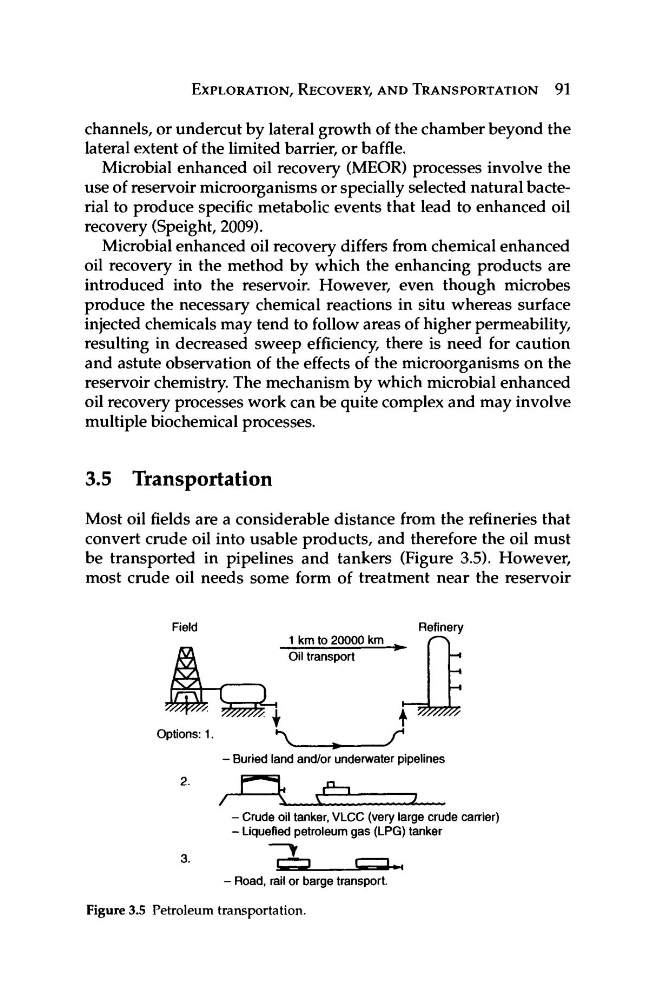
Most oil fields are a considerable distance from the refineries that
convert crude oil into usable products, and therefore the oil must
be transported in pipelines and tankers (Figure 3.5). However,
most crude oil needs some form of treatment near the reservoir
Field
Refinery
1 km to 20000 km
Oil transport
-*Options: 1.
"-\
y~*
- Buried land and/or underwater pipelines
r
Γ^_£=,
■ Crude oil tanker, VLCC (very large crude carrier)
• Liquefied petroleum gas (LPG) tanker
3.
- Road, rail or barge transport.
Figure 3.5 Petroleum transportation.
channels, or undercut by lateral growth of the chamber beyond the
lateral extent of the limited barrier, or baffle.
Microbial enhanced oil recovery (MEOR) processes involve the
use of reservoir microorganisms or specially selected natural bacterial to produce specific metabolic events that lead to enhanced oil
recovery (Speight, 2009).
Microbial enhanced oil recovery differs from chemical enhanced
oil recovery in the method by which the enhancing products are
introduced into the reservoir. However, even though microbes
produce the necessary chemical reactions in situ whereas surface
injected chemicals may tend to follow areas of higher permeability,
resulting in decreased sweep efficiency, there is need for caution
and astute observation of the effects of the microorganisms on the
reservoir chemistry. The mechanism by which microbial enhanced
oil recovery processes work can be quite complex and may involve
multiple biochemical processes.
3.5 Transportation
Most oil fields are a considerable distance from the refineries that
convert crude oil into usable products, and therefore the oil must
be transported in pipelines and tankers (Figure 3.5). However,
most crude oil needs some form of treatment near the reservoir
Field
Refinery
1 km to 20000 km
Oil transport
-*Options: 1.
"-\
y~*
- Buried land and/or underwater pipelines
r
Γ^_£=,
■ Crude oil tanker, VLCC (very large crude carrier)
• Liquefied petroleum gas (LPG) tanker
3.
- Road, rail or barge transport.
Figure 3.5 Petroleum transportation.