

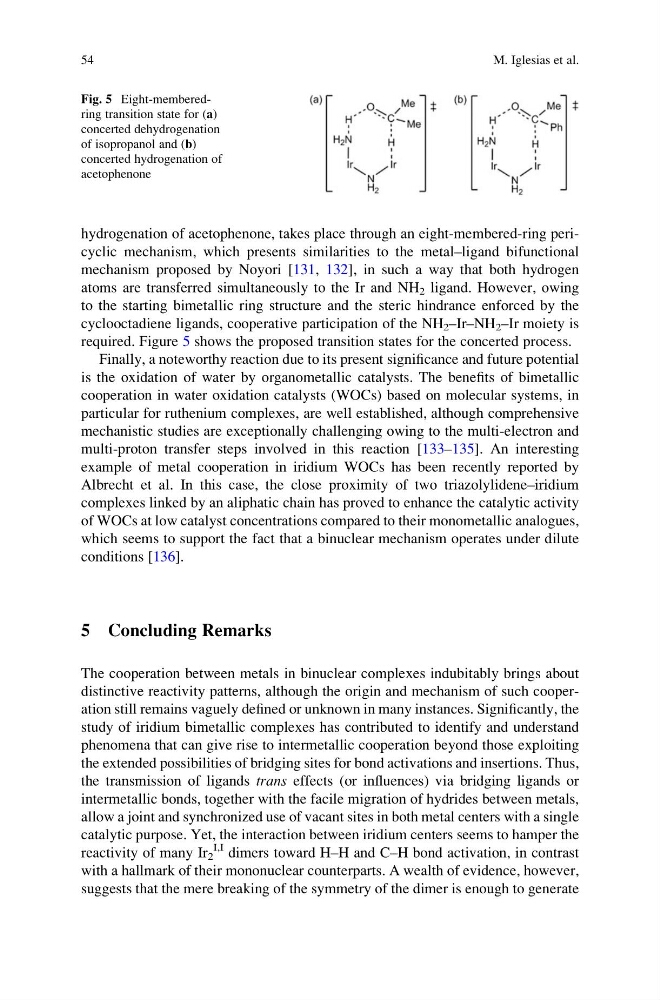
hydrogenation of acetophenone, takes place through an eight-membered-ring pericyclic mechanism, which presents similarities to the metal–ligand bifunctional
mechanism proposed by Noyori [131, 132], in such a way that both hydrogen
atoms are transferred simultaneously to the Ir and NH 2 ligand. However, owing
to the starting bimetallic ring structure and the steric hindrance enforced by the
cyclooctadiene ligands, cooperative participation of the NH 2 –Ir–NH 2 –Ir moiety is
required. Figure 5 shows the proposed transition states for the concerted process.
Finally, a noteworthy reaction due to its present significance and future potential
is the oxidation of water by organometallic catalysts. The benefits of bimetallic
cooperation in water oxidation catalysts (WOCs) based on molecular systems, in
particular for ruthenium complexes, are well established, although comprehensive
mechanistic studies are exceptionally challenging owing to the multi-electron and
multi-proton transfer steps involved in this reaction [133–135]. An interesting
example of metal cooperation in iridium WOCs has been recently reported by
Albrecht et al. In this case, the close proximity of two triazolylidene–iridium
complexes linked by an aliphatic chain has proved to enhance the catalytic activity
of WOCs at low catalyst concentrations compared to their monometallic analogues,
which seems to support the fact that a binuclear mechanism operates under dilute
conditions [136].
5 Concluding Remarks
The cooperation between metals in binuclear complexes indubitably brings about
distinctive reactivity patterns, although the origin and mechanism of such cooperation still remains vaguely defined or unknown in many instances. Significantly, the
study of iridium bimetallic complexes has contributed to identify and understand
phenomena that can give rise to intermetallic cooperation beyond those exploiting
the extended possibilities of bridging sites for bond activations and insertions. Thus,
the transmission of ligands trans effects (or influences) via bridging ligands or
intermetallic bonds, together with the facile migration of hydrides between metals,
allow a joint and synchronized use of vacant sites in both metal centers with a single
catalytic purpose. Yet, the interaction between iridium centers seems to hamper the
reactivity of many Ir 2
I,I dimers toward H–H and C–H bond activation, in contrast
with a hallmark of their mononuclear counterparts. A wealth of evidence, however,
suggests that the mere breaking of the symmetry of the dimer is enough to generate
Fig. 5 Eight-memberedring transition state for (a)
concerted dehydrogenation
of isopropanol and (b)
concerted hydrogenation of
acetophenone
54
M. Iglesias et al.
mechanism proposed by Noyori [131, 132], in such a way that both hydrogen
atoms are transferred simultaneously to the Ir and NH 2 ligand. However, owing
to the starting bimetallic ring structure and the steric hindrance enforced by the
cyclooctadiene ligands, cooperative participation of the NH 2 –Ir–NH 2 –Ir moiety is
required. Figure 5 shows the proposed transition states for the concerted process.
Finally, a noteworthy reaction due to its present significance and future potential
is the oxidation of water by organometallic catalysts. The benefits of bimetallic
cooperation in water oxidation catalysts (WOCs) based on molecular systems, in
particular for ruthenium complexes, are well established, although comprehensive
mechanistic studies are exceptionally challenging owing to the multi-electron and
multi-proton transfer steps involved in this reaction [133–135]. An interesting
example of metal cooperation in iridium WOCs has been recently reported by
Albrecht et al. In this case, the close proximity of two triazolylidene–iridium
complexes linked by an aliphatic chain has proved to enhance the catalytic activity
of WOCs at low catalyst concentrations compared to their monometallic analogues,
which seems to support the fact that a binuclear mechanism operates under dilute
conditions [136].
5 Concluding Remarks
The cooperation between metals in binuclear complexes indubitably brings about
distinctive reactivity patterns, although the origin and mechanism of such cooperation still remains vaguely defined or unknown in many instances. Significantly, the
study of iridium bimetallic complexes has contributed to identify and understand
phenomena that can give rise to intermetallic cooperation beyond those exploiting
the extended possibilities of bridging sites for bond activations and insertions. Thus,
the transmission of ligands trans effects (or influences) via bridging ligands or
intermetallic bonds, together with the facile migration of hydrides between metals,
allow a joint and synchronized use of vacant sites in both metal centers with a single
catalytic purpose. Yet, the interaction between iridium centers seems to hamper the
reactivity of many Ir 2
I,I dimers toward H–H and C–H bond activation, in contrast
with a hallmark of their mononuclear counterparts. A wealth of evidence, however,
suggests that the mere breaking of the symmetry of the dimer is enough to generate
Fig. 5 Eight-memberedring transition state for (a)
concerted dehydrogenation
of isopropanol and (b)
concerted hydrogenation of
acetophenone
54
M. Iglesias et al.