

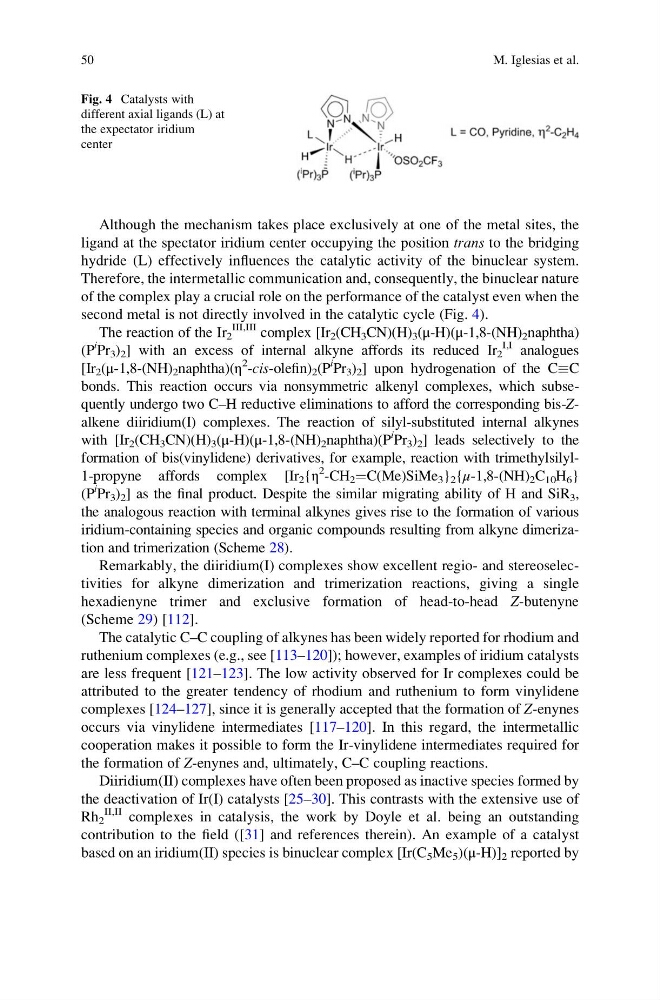
Although the mechanism takes place exclusively at one of the metal sites, the
ligand at the spectator iridium center occupying the position trans to the bridging
hydride (L) effectively influences the catalytic activity of the binuclear system.
Therefore, the intermetallic communication and, consequently, the binuclear nature
of the complex play a crucial role on the performance of the catalyst even when the
second metal is not directly involved in the catalytic cycle (Fig. 4).
The reaction of the Ir 2
III,III complex [Ir 2 (CH 3 CN)(H) 3 (μ-H)(μ-1,8-(NH) 2 naphtha)
(P
i
Pr 3 ) 2 ] with an excess of internal alkyne affords its reduced Ir 2
I,I analogues
[Ir 2 (μ-1,8-(NH) 2 naphtha)(η
2
-cis-olefin) 2 (P
i
Pr 3 ) 2 ] upon hydrogenation of the CC
bonds. This reaction occurs via nonsymmetric alkenyl complexes, which subsequently undergo two C–H reductive eliminations to afford the corresponding bis-Zalkene diiridium(I) complexes. The reaction of silyl-substituted internal alkynes
with [Ir 2 (CH 3 CN)(H) 3 (μ-H)(μ-1,8-(NH) 2 naphtha)(P
i
Pr 3 ) 2 ] leads selectively to the
formation of bis(vinylidene) derivatives, for example, reaction with trimethylsilyl1-propyne affords complex [Ir 2 {η
2
-CH 2 ¼C(Me)SiMe 3 } 2 {μ-1,8-(NH) 2 C 10 H 6 }
(P
i
Pr 3 ) 2 ] as the final product. Despite the similar migrating ability of H and SiR 3 ,
the analogous reaction with terminal alkynes gives rise to the formation of various
iridium-containing species and organic compounds resulting from alkyne dimerization and trimerization (Scheme 28).
Remarkably, the diiridium(I) complexes show excellent regio- and stereoselectivities for alkyne dimerization and trimerization reactions, giving a single
hexadienyne trimer and exclusive formation of head-to-head Z-butenyne
(Scheme 29) [112].
The catalytic C–C coupling of alkynes has been widely reported for rhodium and
ruthenium complexes (e.g., see [113–120]); however, examples of iridium catalysts
are less frequent [121–123]. The low activity observed for Ir complexes could be
attributed to the greater tendency of rhodium and ruthenium to form vinylidene
complexes [124–127], since it is generally accepted that the formation of Z-enynes
occurs via vinylidene intermediates [117–120]. In this regard, the intermetallic
cooperation makes it possible to form the Ir-vinylidene intermediates required for
the formation of Z-enynes and, ultimately, C–C coupling reactions.
Diiridium(II) complexes have often been proposed as inactive species formed by
the deactivation of Ir(I) catalysts [25–30]. This contrasts with the extensive use of
Rh 2
II,II complexes in catalysis, the work by Doyle et al. being an outstanding
contribution to the field ([31] and references therein). An example of a catalyst
based on an iridium(II) species is binuclear complex [Ir(C 5 Me 5 )(μ-H)] 2 reported by
Fig. 4 Catalysts with
different axial ligands (L) at
the expectator iridium
center
50
M. Iglesias et al.
ligand at the spectator iridium center occupying the position trans to the bridging
hydride (L) effectively influences the catalytic activity of the binuclear system.
Therefore, the intermetallic communication and, consequently, the binuclear nature
of the complex play a crucial role on the performance of the catalyst even when the
second metal is not directly involved in the catalytic cycle (Fig. 4).
The reaction of the Ir 2
III,III complex [Ir 2 (CH 3 CN)(H) 3 (μ-H)(μ-1,8-(NH) 2 naphtha)
(P
i
Pr 3 ) 2 ] with an excess of internal alkyne affords its reduced Ir 2
I,I analogues
[Ir 2 (μ-1,8-(NH) 2 naphtha)(η
2
-cis-olefin) 2 (P
i
Pr 3 ) 2 ] upon hydrogenation of the CC
bonds. This reaction occurs via nonsymmetric alkenyl complexes, which subsequently undergo two C–H reductive eliminations to afford the corresponding bis-Zalkene diiridium(I) complexes. The reaction of silyl-substituted internal alkynes
with [Ir 2 (CH 3 CN)(H) 3 (μ-H)(μ-1,8-(NH) 2 naphtha)(P
i
Pr 3 ) 2 ] leads selectively to the
formation of bis(vinylidene) derivatives, for example, reaction with trimethylsilyl1-propyne affords complex [Ir 2 {η
2
-CH 2 ¼C(Me)SiMe 3 } 2 {μ-1,8-(NH) 2 C 10 H 6 }
(P
i
Pr 3 ) 2 ] as the final product. Despite the similar migrating ability of H and SiR 3 ,
the analogous reaction with terminal alkynes gives rise to the formation of various
iridium-containing species and organic compounds resulting from alkyne dimerization and trimerization (Scheme 28).
Remarkably, the diiridium(I) complexes show excellent regio- and stereoselectivities for alkyne dimerization and trimerization reactions, giving a single
hexadienyne trimer and exclusive formation of head-to-head Z-butenyne
(Scheme 29) [112].
The catalytic C–C coupling of alkynes has been widely reported for rhodium and
ruthenium complexes (e.g., see [113–120]); however, examples of iridium catalysts
are less frequent [121–123]. The low activity observed for Ir complexes could be
attributed to the greater tendency of rhodium and ruthenium to form vinylidene
complexes [124–127], since it is generally accepted that the formation of Z-enynes
occurs via vinylidene intermediates [117–120]. In this regard, the intermetallic
cooperation makes it possible to form the Ir-vinylidene intermediates required for
the formation of Z-enynes and, ultimately, C–C coupling reactions.
Diiridium(II) complexes have often been proposed as inactive species formed by
the deactivation of Ir(I) catalysts [25–30]. This contrasts with the extensive use of
Rh 2
II,II complexes in catalysis, the work by Doyle et al. being an outstanding
contribution to the field ([31] and references therein). An example of a catalyst
based on an iridium(II) species is binuclear complex [Ir(C 5 Me 5 )(μ-H)] 2 reported by
Fig. 4 Catalysts with
different axial ligands (L) at
the expectator iridium
center
50
M. Iglesias et al.