

less efficient than the free compounds. Unfortunately, stability of the system is also
clearly a problem with turnover numbers on the order of five reported.
Finally, we offer a word of caution. A number of different groups have shown
that heterogeneous proton reduction or water oxidation catalysts, formed in situ
from bio-inspired Ni and Co complexes in electrochemical experiments, can be
deposited on the electrode surface [96–100]. Thus it is essential that researchers
take every effort to ensure that the species they believe they are studying is indeed
the active catalyst.
3.3.3 Mononuclear Nickel Proton Reduction Catalysts
Many of the ligand sets that have been used to create cobalt complexes have also
been used to produce nickel-based hydrogen evolution catalysts. For example,
mononuclear nickel complexes employing bidentate phosphine, thiolate, and
amine ligands have been reported to be excellent proton reduction complexes.
The groups of Bullock, DuBois, and Helm have prepared a large family of nickel
complexes supported by phosphines that contain amines in the second coordination
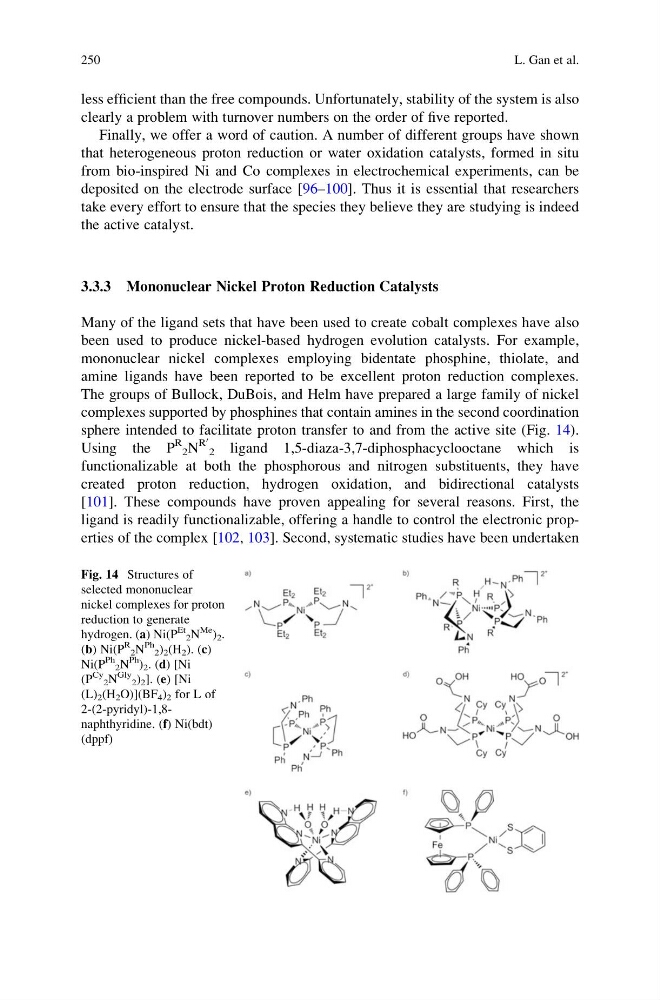
sphere intended to facilitate proton transfer to and from the active site (Fig. 14).
Using the P
R
2 N
R
0
2
ligand 1,5-diaza-3,7-diphosphacyclooctane which is
functionalizable at both the phosphorous and nitrogen substituents, they have
created proton reduction, hydrogen oxidation, and bidirectional catalysts
[101]. These compounds have proven appealing for several reasons. First, the
ligand is readily functionalizable, offering a handle to control the electronic properties of the complex [102, 103]. Second, systematic studies have been undertaken
Fig. 14 Structures of
selected mononuclear
nickel complexes for proton
reduction to generate
hydrogen. (a) Ni(P
Et
2 N
Me ) 2 .
(b) Ni(P
R
2 N
Ph
2 ) 2 (H 2 ). (c)
Ni(P
Ph
2 N
Ph ) 2 . (d) [Ni
(P
Cy
2 N
Gly
2 ) 2 ]. (e) [Ni
(L) 2 (H 2 O)](BF 4 ) 2 for L of
2-(2-pyridyl)-1,8naphthyridine. (f) Ni(bdt)
(dppf)
250
L. Gan et al.
clearly a problem with turnover numbers on the order of five reported.
Finally, we offer a word of caution. A number of different groups have shown
that heterogeneous proton reduction or water oxidation catalysts, formed in situ
from bio-inspired Ni and Co complexes in electrochemical experiments, can be
deposited on the electrode surface [96–100]. Thus it is essential that researchers
take every effort to ensure that the species they believe they are studying is indeed
the active catalyst.
3.3.3 Mononuclear Nickel Proton Reduction Catalysts
Many of the ligand sets that have been used to create cobalt complexes have also
been used to produce nickel-based hydrogen evolution catalysts. For example,
mononuclear nickel complexes employing bidentate phosphine, thiolate, and
amine ligands have been reported to be excellent proton reduction complexes.
The groups of Bullock, DuBois, and Helm have prepared a large family of nickel
complexes supported by phosphines that contain amines in the second coordination
sphere intended to facilitate proton transfer to and from the active site (Fig. 14).
Using the P
R
2 N
R
0
2
ligand 1,5-diaza-3,7-diphosphacyclooctane which is
functionalizable at both the phosphorous and nitrogen substituents, they have
created proton reduction, hydrogen oxidation, and bidirectional catalysts
[101]. These compounds have proven appealing for several reasons. First, the
ligand is readily functionalizable, offering a handle to control the electronic properties of the complex [102, 103]. Second, systematic studies have been undertaken
Fig. 14 Structures of
selected mononuclear
nickel complexes for proton
reduction to generate
hydrogen. (a) Ni(P
Et
2 N
Me ) 2 .
(b) Ni(P
R
2 N
Ph
2 ) 2 (H 2 ). (c)
Ni(P
Ph
2 N
Ph ) 2 . (d) [Ni
(P
Cy
2 N
Gly
2 ) 2 ]. (e) [Ni
(L) 2 (H 2 O)](BF 4 ) 2 for L of
2-(2-pyridyl)-1,8naphthyridine. (f) Ni(bdt)
(dppf)
250
L. Gan et al.