

3.6 Possible Future Applications
The most obvious chemistries to try next are chemistries closely related to
hydroformylation, for example, the hydroaminations, hydrosilations,
hydrocyanations, etc., using the metals noted throughout this chapter. The extension of CBER mechanisms to regio-, chemo- and stereoselective hydroformylation
systems as well as the aforementioned chemistries should produce an incredibly
rich variety of new results and go a long way towards classifying the scope of
non-linear CBER mechanisms.
In terms of connectivity of intermediates in CBER systems, new possibilities
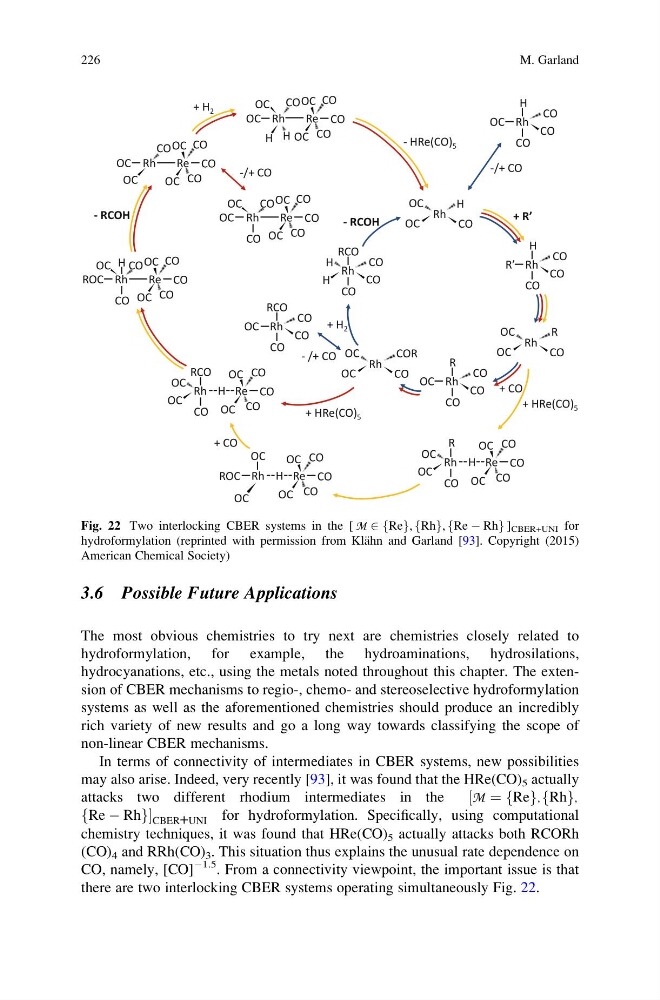
may also arise. Indeed, very recently [93], it was found that the HRe(CO) 5 actually
attacks two different rhodium intermediates in the
½M ¼ Re
f g, Rh
f g,
Re À Rh
f
g CBER+UNI for hydroformylation. Specifically, using computational
chemistry techniques, it was found that HRe(CO) 5 actually attacks both RCORh
(CO) 4 and RRh(CO) 3 . This situation thus explains the unusual rate dependence on
CO, namely, [CO]
À1.5 . From a connectivity viewpoint, the important issue is that
there are two interlocking CBER systems operating simultaneously Fig. 22.
-/+ CO
+ R’
+ CO
- /+ CO
+ H 2
- RCOH
+ HRe(CO) 5
+ CO
+ HRe(CO) 5
- RCOH
-/+ CO
+ H 2
- HRe(CO) 5
Rh
OC
OC
CO
H
Rh CO
CO
CO
H
R’
Rh
OC
OC
CO
R
Rh
OC
OC
CO
COR
Rh CO
CO
CO
RCO
H
H
Rh CO
CO
CO
H
OC
Rh CO
CO
CO
R
OC
Rh CO
CO
CO
RCO
OC
Rh H
CO
RCO
OC
OC
Re
OC CO
OC CO
CO
Rh
H
CO
ROC
CO
OC
Re
OC CO
OC CO
CO
Rh
OC
CO
OC
Re
OC CO
OC CO
CO
Rh
CO
OC
CO
OC
Re
OC CO
OC CO
CO
Rh
OC
CO
OC
Re
OC CO
OC CO
CO
H H
Rh H
CO
R
OC
OC
Re
OC CO
OC CO
CO
Rh H
OC
OC
Re
OC CO
OC CO
CO
ROC
Fig. 22 Two interlocking CBER systems in the [ M 2 Re
f g, Rh
f g, Re À Rh
f
g] CBER+UNI for
hydroformylation (reprinted with permission from Kla ¨hn and Garland [93]. Copyright (2015)
American Chemical Society)
226
M. Garland
The most obvious chemistries to try next are chemistries closely related to
hydroformylation, for example, the hydroaminations, hydrosilations,
hydrocyanations, etc., using the metals noted throughout this chapter. The extension of CBER mechanisms to regio-, chemo- and stereoselective hydroformylation
systems as well as the aforementioned chemistries should produce an incredibly
rich variety of new results and go a long way towards classifying the scope of
non-linear CBER mechanisms.
In terms of connectivity of intermediates in CBER systems, new possibilities
may also arise. Indeed, very recently [93], it was found that the HRe(CO) 5 actually
attacks two different rhodium intermediates in the
½M ¼ Re
f g, Rh
f g,
Re À Rh
f
g CBER+UNI for hydroformylation. Specifically, using computational
chemistry techniques, it was found that HRe(CO) 5 actually attacks both RCORh
(CO) 4 and RRh(CO) 3 . This situation thus explains the unusual rate dependence on
CO, namely, [CO]
À1.5 . From a connectivity viewpoint, the important issue is that
there are two interlocking CBER systems operating simultaneously Fig. 22.
-/+ CO
+ R’
+ CO
- /+ CO
+ H 2
- RCOH
+ HRe(CO) 5
+ CO
+ HRe(CO) 5
- RCOH
-/+ CO
+ H 2
- HRe(CO) 5
Rh
OC
OC
CO
H
Rh CO
CO
CO
H
R’
Rh
OC
OC
CO
R
Rh
OC
OC
CO
COR
Rh CO
CO
CO
RCO
H
H
Rh CO
CO
CO
H
OC
Rh CO
CO
CO
R
OC
Rh CO
CO
CO
RCO
OC
Rh H
CO
RCO
OC
OC
Re
OC CO
OC CO
CO
Rh
H
CO
ROC
CO
OC
Re
OC CO
OC CO
CO
Rh
OC
CO
OC
Re
OC CO
OC CO
CO
Rh
CO
OC
CO
OC
Re
OC CO
OC CO
CO
Rh
OC
CO
OC
Re
OC CO
OC CO
CO
H H
Rh H
CO
R
OC
OC
Re
OC CO
OC CO
CO
Rh H
OC
OC
Re
OC CO
OC CO
CO
ROC
Fig. 22 Two interlocking CBER systems in the [ M 2 Re
f g, Rh
f g, Re À Rh
f
g] CBER+UNI for
hydroformylation (reprinted with permission from Kla ¨hn and Garland [93]. Copyright (2015)
American Chemical Society)
226
M. Garland