

boxes will always represent product(s) even if there is no chemical formula or
structure explicitly entered.
In metal-mediated homogeneous catalysis, the term [cat] is often focused on the
metallic element involved. Thus, for example, in palladium-mediated C–C crosscoupling reactions [6], one typically simply sees the representation [Pd]. In generic
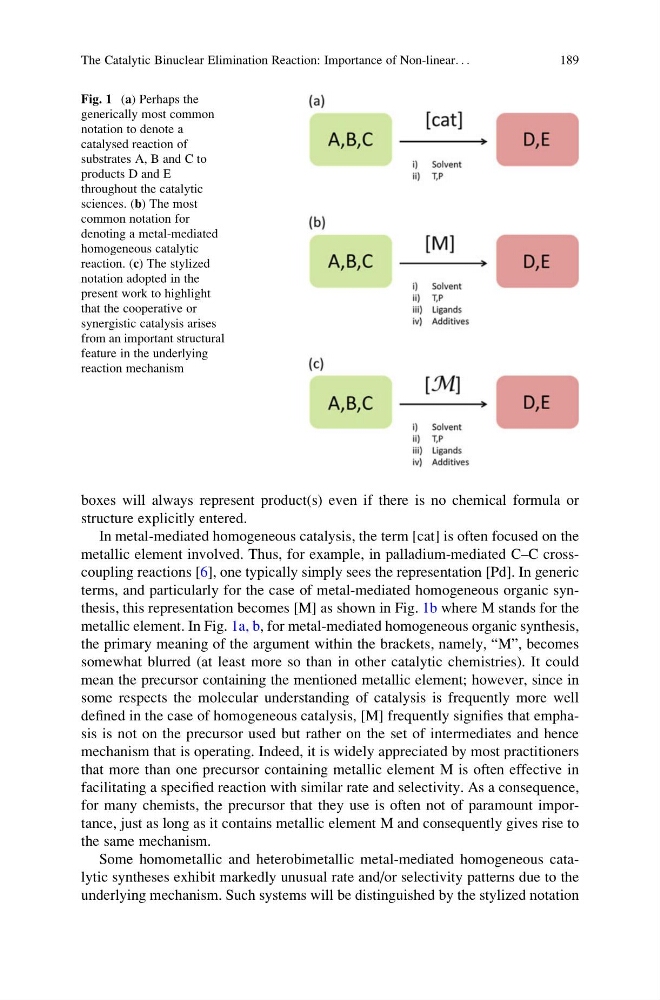
terms, and particularly for the case of metal-mediated homogeneous organic synthesis, this representation becomes [M] as shown in Fig. 1b where M stands for the
metallic element. In Fig. 1a, b, for metal-mediated homogeneous organic synthesis,
the primary meaning of the argument within the brackets, namely, “M”, becomes
somewhat blurred (at least more so than in other catalytic chemistries). It could
mean the precursor containing the mentioned metallic element; however, since in
some respects the molecular understanding of catalysis is frequently more well
defined in the case of homogeneous catalysis, [M] frequently signifies that emphasis is not on the precursor used but rather on the set of intermediates and hence
mechanism that is operating. Indeed, it is widely appreciated by most practitioners
that more than one precursor containing metallic element M is often effective in
facilitating a specified reaction with similar rate and selectivity. As a consequence,
for many chemists, the precursor that they use is often not of paramount importance, just as long as it contains metallic element M and consequently gives rise to
the same mechanism.
Some homometallic and heterobimetallic metal-mediated homogeneous catalytic syntheses exhibit markedly unusual rate and/or selectivity patterns due to the
underlying mechanism. Such systems will be distinguished by the stylized notation
Fig. 1 (a) Perhaps the
generically most common
notation to denote a
catalysed reaction of
substrates A, B and C to
products D and E
throughout the catalytic
sciences. (b) The most
common notation for
denoting a metal-mediated
homogeneous catalytic
reaction. (c) The stylized
notation adopted in the
present work to highlight
that the cooperative or
synergistic catalysis arises
from an important structural
feature in the underlying
reaction mechanism
The Catalytic Binuclear Elimination Reaction: Importance of Non-linear. . .
189
structure explicitly entered.
In metal-mediated homogeneous catalysis, the term [cat] is often focused on the
metallic element involved. Thus, for example, in palladium-mediated C–C crosscoupling reactions [6], one typically simply sees the representation [Pd]. In generic
terms, and particularly for the case of metal-mediated homogeneous organic synthesis, this representation becomes [M] as shown in Fig. 1b where M stands for the
metallic element. In Fig. 1a, b, for metal-mediated homogeneous organic synthesis,
the primary meaning of the argument within the brackets, namely, “M”, becomes
somewhat blurred (at least more so than in other catalytic chemistries). It could
mean the precursor containing the mentioned metallic element; however, since in
some respects the molecular understanding of catalysis is frequently more well
defined in the case of homogeneous catalysis, [M] frequently signifies that emphasis is not on the precursor used but rather on the set of intermediates and hence
mechanism that is operating. Indeed, it is widely appreciated by most practitioners
that more than one precursor containing metallic element M is often effective in
facilitating a specified reaction with similar rate and selectivity. As a consequence,
for many chemists, the precursor that they use is often not of paramount importance, just as long as it contains metallic element M and consequently gives rise to
the same mechanism.
Some homometallic and heterobimetallic metal-mediated homogeneous catalytic syntheses exhibit markedly unusual rate and/or selectivity patterns due to the
underlying mechanism. Such systems will be distinguished by the stylized notation
Fig. 1 (a) Perhaps the
generically most common
notation to denote a
catalysed reaction of
substrates A, B and C to
products D and E
throughout the catalytic
sciences. (b) The most
common notation for
denoting a metal-mediated
homogeneous catalytic
reaction. (c) The stylized
notation adopted in the
present work to highlight
that the cooperative or
synergistic catalysis arises
from an important structural
feature in the underlying
reaction mechanism
The Catalytic Binuclear Elimination Reaction: Importance of Non-linear. . .
189