

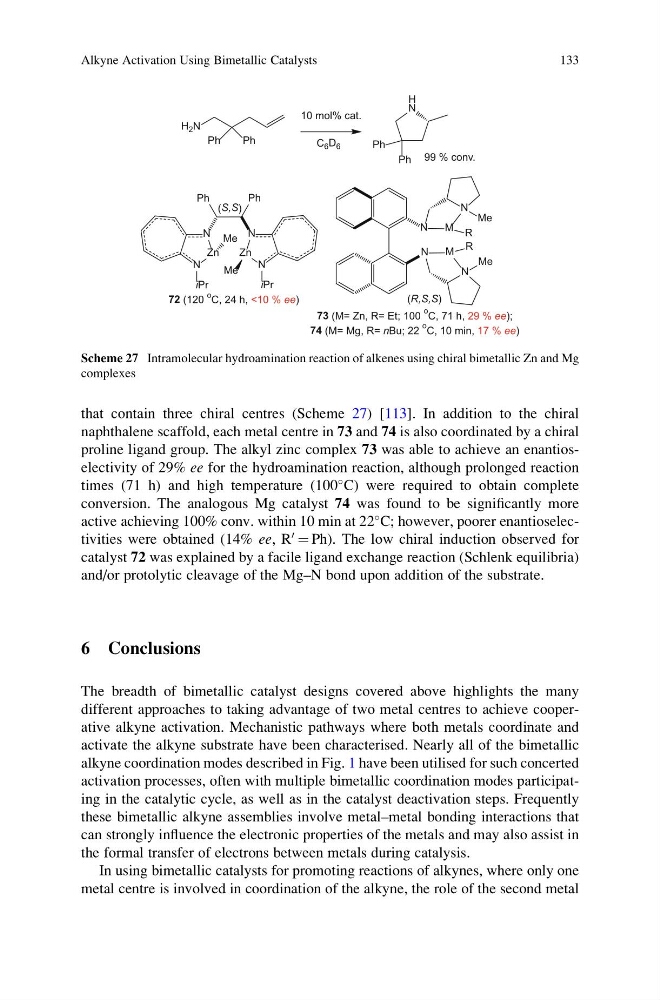
that contain three chiral centres (Scheme 27) [113]. In addition to the chiral
naphthalene scaffold, each metal centre in 73 and 74 is also coordinated by a chiral
proline ligand group. The alkyl zinc complex 73 was able to achieve an enantioselectivity of 29% ee for the hydroamination reaction, although prolonged reaction
times (71 h) and high temperature (100
C) were required to obtain complete
conversion. The analogous Mg catalyst 74 was found to be significantly more
active achieving 100% conv. within 10 min at 22
C; however, poorer enantioselectivities were obtained (14% ee, R
0
¼ Ph). The low chiral induction observed for
catalyst 72 was explained by a facile ligand exchange reaction (Schlenk equilibria)
and/or protolytic cleavage of the Mg–N bond upon addition of the substrate.
6 Conclusions
The breadth of bimetallic catalyst designs covered above highlights the many
different approaches to taking advantage of two metal centres to achieve cooperative alkyne activation. Mechanistic pathways where both metals coordinate and
activate the alkyne substrate have been characterised. Nearly all of the bimetallic
alkyne coordination modes described in Fig. 1 have been utilised for such concerted
activation processes, often with multiple bimetallic coordination modes participating in the catalytic cycle, as well as in the catalyst deactivation steps. Frequently
these bimetallic alkyne assemblies involve metal–metal bonding interactions that
can strongly influence the electronic properties of the metals and may also assist in
the formal transfer of electrons between metals during catalysis.
In using bimetallic catalysts for promoting reactions of alkynes, where only one
metal centre is involved in coordination of the alkyne, the role of the second metal
N
N
M R
N
N
M R
Me
Me
73 (M= Zn, R= Et; 100
o C, 71 h, 29 % ee);
74 (M= Mg, R= nBu; 22
o C, 10 min, 17 % ee)
N
N
H 2 N
Ph
Ph
H
N
10 mol% cat.
Ph
Ph
C 6 D 6
72 (120
o C, 24 h, <10 % ee)
Zn
N
iPr
N
Zn
Me
Me
Ph
Ph
iPr
(S,S)
(R,S,S)
99 % conv.
Scheme 27 Intramolecular hydroamination reaction of alkenes using chiral bimetallic Zn and Mg
complexes
Alkyne Activation Using Bimetallic Catalysts
133
naphthalene scaffold, each metal centre in 73 and 74 is also coordinated by a chiral
proline ligand group. The alkyl zinc complex 73 was able to achieve an enantioselectivity of 29% ee for the hydroamination reaction, although prolonged reaction
times (71 h) and high temperature (100
C) were required to obtain complete
conversion. The analogous Mg catalyst 74 was found to be significantly more
active achieving 100% conv. within 10 min at 22
C; however, poorer enantioselectivities were obtained (14% ee, R
0
¼ Ph). The low chiral induction observed for
catalyst 72 was explained by a facile ligand exchange reaction (Schlenk equilibria)
and/or protolytic cleavage of the Mg–N bond upon addition of the substrate.
6 Conclusions
The breadth of bimetallic catalyst designs covered above highlights the many
different approaches to taking advantage of two metal centres to achieve cooperative alkyne activation. Mechanistic pathways where both metals coordinate and
activate the alkyne substrate have been characterised. Nearly all of the bimetallic
alkyne coordination modes described in Fig. 1 have been utilised for such concerted
activation processes, often with multiple bimetallic coordination modes participating in the catalytic cycle, as well as in the catalyst deactivation steps. Frequently
these bimetallic alkyne assemblies involve metal–metal bonding interactions that
can strongly influence the electronic properties of the metals and may also assist in
the formal transfer of electrons between metals during catalysis.
In using bimetallic catalysts for promoting reactions of alkynes, where only one
metal centre is involved in coordination of the alkyne, the role of the second metal
N
N
M R
N
N
M R
Me
Me
73 (M= Zn, R= Et; 100
o C, 71 h, 29 % ee);
74 (M= Mg, R= nBu; 22
o C, 10 min, 17 % ee)
N
N
H 2 N
Ph
Ph
H
N
10 mol% cat.
Ph
Ph
C 6 D 6
72 (120
o C, 24 h, <10 % ee)
Zn
N
iPr
N
Zn
Me
Me
Ph
Ph
iPr
(S,S)
(R,S,S)
99 % conv.
Scheme 27 Intramolecular hydroamination reaction of alkenes using chiral bimetallic Zn and Mg
complexes
Alkyne Activation Using Bimetallic Catalysts
133