

Alkynes are highly versatile building blocks for the synthesis of a wide range of
organic molecules. The unsaturated alkyne triple bond can undergo a variety of
metal-catalysed reactions, including the inter- or intramolecular addition of carbon
or heteroatom nucleophiles; cycloaddition with other π-acidic functional groups
such as carbon monoxide, alkenes, other alkynes and nitriles; or the coupling of
nucleophilic acetylides with other electrophiles [8–11]. This reactivity is associated
with a diverse coordination chemistry of organometallic alkyne species. The alkyne
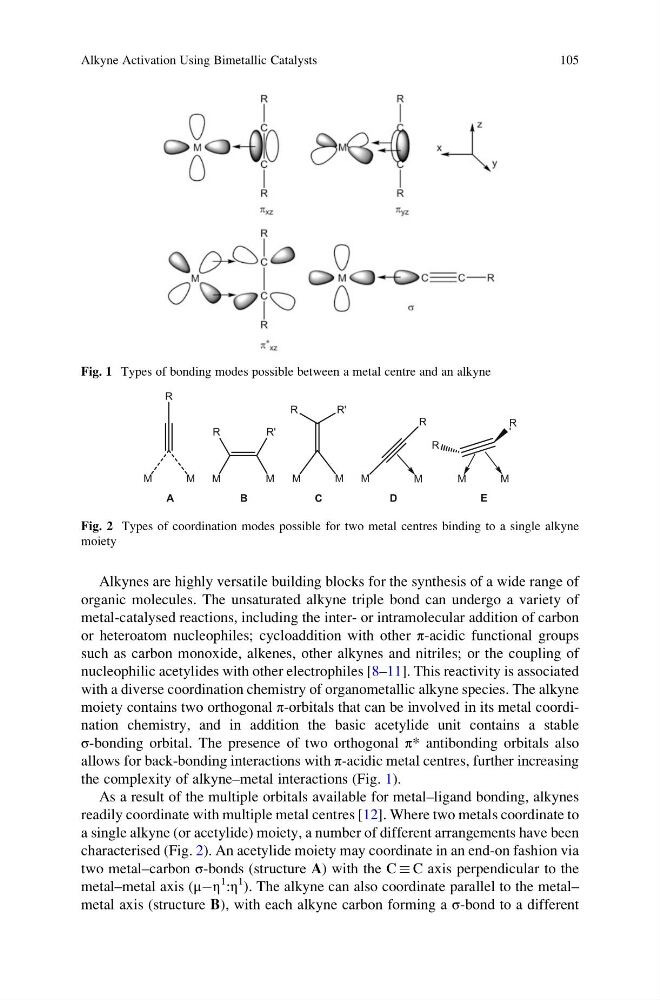
moiety contains two orthogonal π-orbitals that can be involved in its metal coordination chemistry, and in addition the basic acetylide unit contains a stable
σ-bonding orbital. The presence of two orthogonal π* antibonding orbitals also
allows for back-bonding interactions with π-acidic metal centres, further increasing
the complexity of alkyne–metal interactions (Fig. 1).
As a result of the multiple orbitals available for metal–ligand bonding, alkynes
readily coordinate with multiple metal centres [12]. Where two metals coordinate to
a single alkyne (or acetylide) moiety, a number of different arrangements have been
characterised (Fig. 2). An acetylide moiety may coordinate in an end-on fashion via
two metal–carbon σ-bonds (structure A) with the C C axis perpendicular to the
metal–metal axis (μÀη
1 :η
1 ). The alkyne can also coordinate parallel to the metal–
metal axis (structure B), with each alkyne carbon forming a σ-bond to a different
Fig. 1 Types of bonding modes possible between a metal centre and an alkyne
M
M
R
R
'
M
M
R
M
M
R'
R
R
R'
M
M
M
M
R
A
B
C
D
E
Fig. 2 Types of coordination modes possible for two metal centres binding to a single alkyne
moiety
Alkyne Activation Using Bimetallic Catalysts
105
organic molecules. The unsaturated alkyne triple bond can undergo a variety of
metal-catalysed reactions, including the inter- or intramolecular addition of carbon
or heteroatom nucleophiles; cycloaddition with other π-acidic functional groups
such as carbon monoxide, alkenes, other alkynes and nitriles; or the coupling of
nucleophilic acetylides with other electrophiles [8–11]. This reactivity is associated
with a diverse coordination chemistry of organometallic alkyne species. The alkyne
moiety contains two orthogonal π-orbitals that can be involved in its metal coordination chemistry, and in addition the basic acetylide unit contains a stable
σ-bonding orbital. The presence of two orthogonal π* antibonding orbitals also
allows for back-bonding interactions with π-acidic metal centres, further increasing
the complexity of alkyne–metal interactions (Fig. 1).
As a result of the multiple orbitals available for metal–ligand bonding, alkynes
readily coordinate with multiple metal centres [12]. Where two metals coordinate to
a single alkyne (or acetylide) moiety, a number of different arrangements have been
characterised (Fig. 2). An acetylide moiety may coordinate in an end-on fashion via
two metal–carbon σ-bonds (structure A) with the C C axis perpendicular to the
metal–metal axis (μÀη
1 :η
1 ). The alkyne can also coordinate parallel to the metal–
metal axis (structure B), with each alkyne carbon forming a σ-bond to a different
Fig. 1 Types of bonding modes possible between a metal centre and an alkyne
M
M
R
R
'
M
M
R
M
M
R'
R
R
R'
M
M
M
M
R
A
B
C
D
E
Fig. 2 Types of coordination modes possible for two metal centres binding to a single alkyne
moiety
Alkyne Activation Using Bimetallic Catalysts
105