

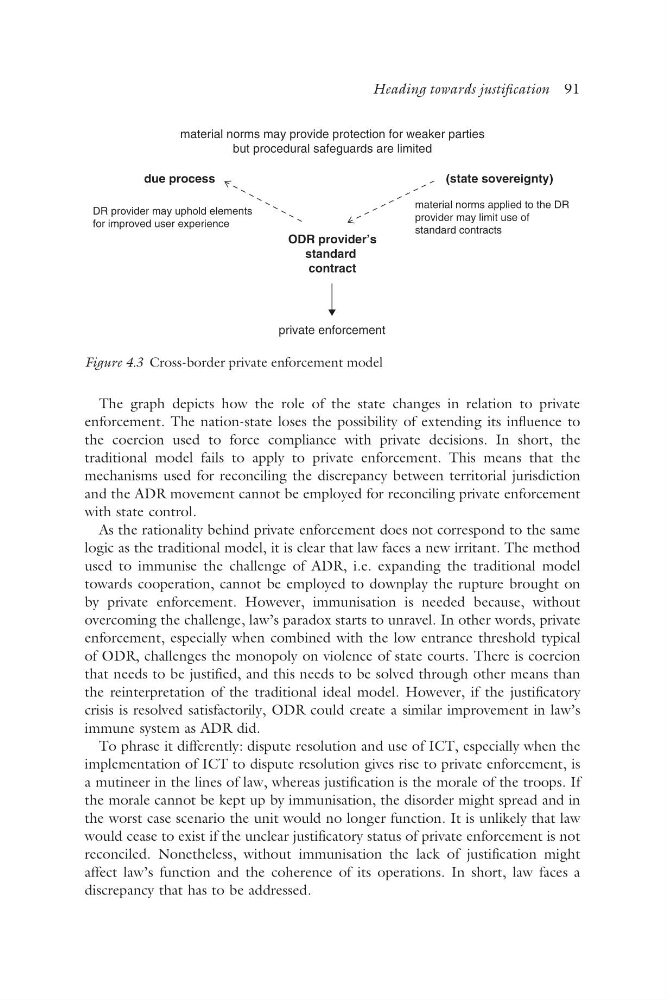
The graph depicts how the role of the state changes in relation to private
enforcement. The nation-state loses the possibility of extending its influence to
the coercion used to force compliance with private decisions. In short, the
traditional model fails to apply to private enforcement. This means that the
mechanisms used for reconciling the discrepancy between territorial jurisdiction
and the ADR movement cannot be employed for reconciling private enforcement
with state control.
As the rationality behind private enforcement does not correspond to the same
logic as the traditional model, it is clear that law faces a new irritant. The method
used to immunise the challenge of ADR, i.e. expanding the traditional model
towards cooperation, cannot be employed to downplay the rupture brought on
by private enforcement. However, immunisation is needed because, without
overcoming the challenge, law’s paradox starts to unravel. In other words, private
enforcement, especially when combined with the low entrance threshold typical
of ODR, challenges the monopoly on violence of state courts. There is coercion
that needs to be justified, and this needs to be solved through other means than
the reinterpretation of the traditional ideal model. However, if the justificatory
crisis is resolved satisfactorily, ODR could create a similar improvement in law’s
immune system as ADR did.
To phrase it differently: dispute resolution and use of ICT, especially when the
implementation of ICT to dispute resolution gives rise to private enforcement, is
a mutineer in the lines of law, whereas justification is the morale of the troops. If
the morale cannot be kept up by immunisation, the disorder might spread and in
the worst case scenario the unit would no longer function. It is unlikely that law
would cease to exist if the unclear justificatory status of private enforcement is not
reconciled. Nonetheless, without immunisation the lack of justification might
affect law’s function and the coherence of its operations. In short, law faces a
discrepancy that has to be addressed.
material norms may provide protection for weaker parties
but procedural safeguards are limited
due process
(state sovereignty)
DR provider may uphold elements
for improved user experience
material norms applied to the DR
provider may limit use of
standard contracts
ODR provider’s
standard
contract
private enforcement
Figure 4.3 Cross-border private enforcement model
Heading towards justification 91
enforcement. The nation-state loses the possibility of extending its influence to
the coercion used to force compliance with private decisions. In short, the
traditional model fails to apply to private enforcement. This means that the
mechanisms used for reconciling the discrepancy between territorial jurisdiction
and the ADR movement cannot be employed for reconciling private enforcement
with state control.
As the rationality behind private enforcement does not correspond to the same
logic as the traditional model, it is clear that law faces a new irritant. The method
used to immunise the challenge of ADR, i.e. expanding the traditional model
towards cooperation, cannot be employed to downplay the rupture brought on
by private enforcement. However, immunisation is needed because, without
overcoming the challenge, law’s paradox starts to unravel. In other words, private
enforcement, especially when combined with the low entrance threshold typical
of ODR, challenges the monopoly on violence of state courts. There is coercion
that needs to be justified, and this needs to be solved through other means than
the reinterpretation of the traditional ideal model. However, if the justificatory
crisis is resolved satisfactorily, ODR could create a similar improvement in law’s
immune system as ADR did.
To phrase it differently: dispute resolution and use of ICT, especially when the
implementation of ICT to dispute resolution gives rise to private enforcement, is
a mutineer in the lines of law, whereas justification is the morale of the troops. If
the morale cannot be kept up by immunisation, the disorder might spread and in
the worst case scenario the unit would no longer function. It is unlikely that law
would cease to exist if the unclear justificatory status of private enforcement is not
reconciled. Nonetheless, without immunisation the lack of justification might
affect law’s function and the coherence of its operations. In short, law faces a
discrepancy that has to be addressed.
material norms may provide protection for weaker parties
but procedural safeguards are limited
due process
(state sovereignty)
DR provider may uphold elements
for improved user experience
material norms applied to the DR
provider may limit use of
standard contracts
ODR provider’s
standard
contract
private enforcement
Figure 4.3 Cross-border private enforcement model
Heading towards justification 91