

2.2 Double Bond Torsion and Conical Intersections
In this chapter, we focus on the Cls arising during double-bond torsion in unsaturated molecules; thus, let us look more closely at this situation. The origin of Cls for
double-bond torsion can be traced back to a crossing between the electronic states
caused by homolytic and heterolytic breaking of the π-component of the double
bond [78]. The homolytic bond breaking results in a diradicaloid electronic configuration, whereas the heterolytic bond breaking leads to an ionic (or zwitterionic)
electronic configuration. According to the sign-change theorem of Longuet-Higgins
[19], a CI should be present inside a loop connecting the conformations that
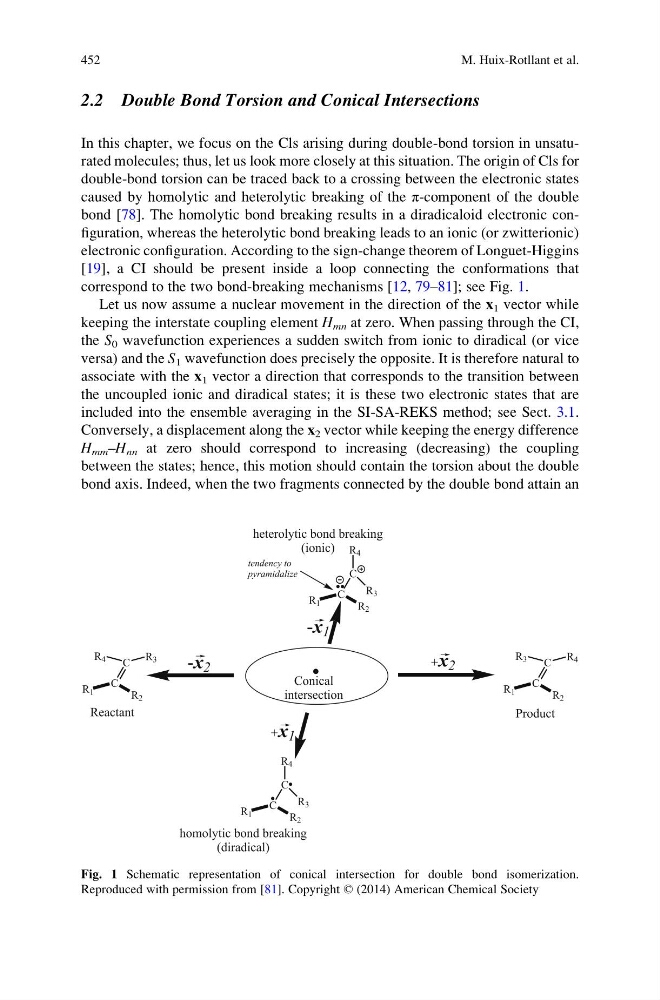
correspond to the two bond-breaking mechanisms [12, 79–81]; see Fig. 1.
Let us now assume a nuclear movement in the direction of the x 1 vector while
keeping the interstate coupling element H mn at zero. When passing through the CI,
the S 0 wavefunction experiences a sudden switch from ionic to diradical (or vice
versa) and the S 1 wavefunction does precisely the opposite. It is therefore natural to
associate with the x 1 vector a direction that corresponds to the transition between
the uncoupled ionic and diradical states; it is these two electronic states that are
included into the ensemble averaging in the SI-SA-REKS method; see Sect. 3.1.
Conversely, a displacement along the x 2 vector while keeping the energy difference
H mm –H nn at zero should correspond to increasing (decreasing) the coupling
between the states; hence, this motion should contain the torsion about the double
bond axis. Indeed, when the two fragments connected by the double bond attain an
Fig. 1 Schematic representation of conical intersection for double bond isomerization.
Reproduced with permission from [81]. Copyright © (2014) American Chemical Society
452
M. Huix-Rotllant et al.
In this chapter, we focus on the Cls arising during double-bond torsion in unsaturated molecules; thus, let us look more closely at this situation. The origin of Cls for
double-bond torsion can be traced back to a crossing between the electronic states
caused by homolytic and heterolytic breaking of the π-component of the double
bond [78]. The homolytic bond breaking results in a diradicaloid electronic configuration, whereas the heterolytic bond breaking leads to an ionic (or zwitterionic)
electronic configuration. According to the sign-change theorem of Longuet-Higgins
[19], a CI should be present inside a loop connecting the conformations that
correspond to the two bond-breaking mechanisms [12, 79–81]; see Fig. 1.
Let us now assume a nuclear movement in the direction of the x 1 vector while
keeping the interstate coupling element H mn at zero. When passing through the CI,
the S 0 wavefunction experiences a sudden switch from ionic to diradical (or vice
versa) and the S 1 wavefunction does precisely the opposite. It is therefore natural to
associate with the x 1 vector a direction that corresponds to the transition between
the uncoupled ionic and diradical states; it is these two electronic states that are
included into the ensemble averaging in the SI-SA-REKS method; see Sect. 3.1.
Conversely, a displacement along the x 2 vector while keeping the energy difference
H mm –H nn at zero should correspond to increasing (decreasing) the coupling
between the states; hence, this motion should contain the torsion about the double
bond axis. Indeed, when the two fragments connected by the double bond attain an
Fig. 1 Schematic representation of conical intersection for double bond isomerization.
Reproduced with permission from [81]. Copyright © (2014) American Chemical Society
452
M. Huix-Rotllant et al.