

SH/SDKS has allowed the limits of the simulations to be stretched much beyond
what can currently be done with TDDFT or wavefunction-based methods. In
particular, it has allowed one to investigate large organic chromophores [63],
adsorbance of molecules on metal [64, 136] and semiconductor [134, 172] surfaces,
Auger dynamics in quantum dots [23], carbon nanostructures [160, 162], and
organic crystals [61, 166].
An interesting example in this class of systems related to condensed matter and
materials science is the recently published simulations for a P3HT/carbon-nanotube
heterojunction [161]. Organic heterojunctions have been intensively explored for
the development of organic photovoltaics based on photoinduced electron transfer
[183, 184]. P3HT (poly(3-hexylthiophene)) is a standard organic polymer used as
chromophore and electron donor [185], while carbon nanotubes (CNT) are
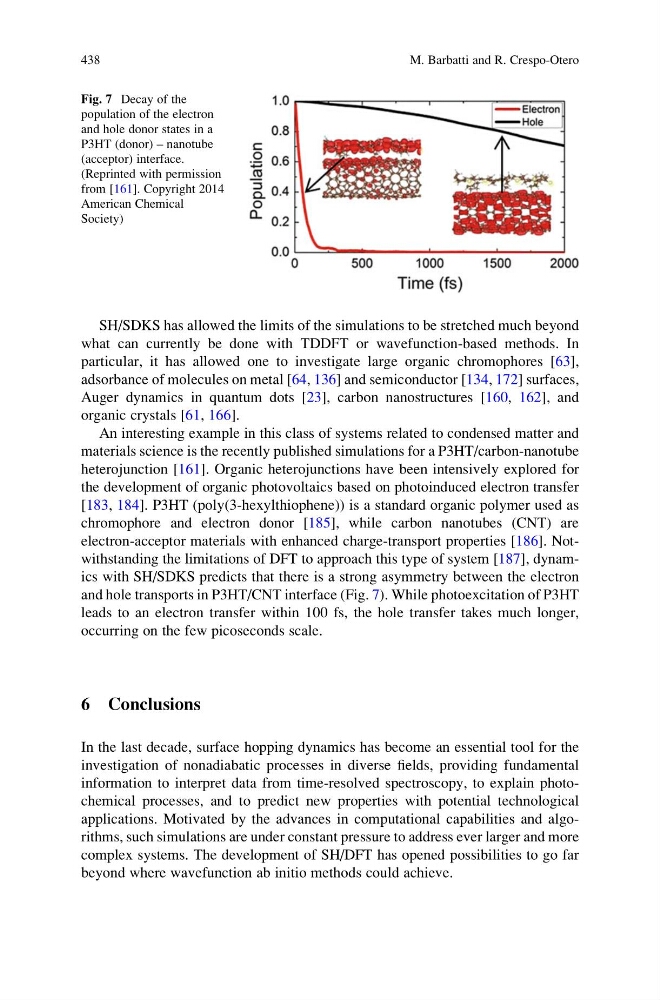
electron-acceptor materials with enhanced charge-transport properties [186]. Notwithstanding the limitations of DFT to approach this type of system [187], dynamics with SH/SDKS predicts that there is a strong asymmetry between the electron
and hole transports in P3HT/CNT interface (Fig. 7). While photoexcitation of P3HT
leads to an electron transfer within 100 fs, the hole transfer takes much longer,
occurring on the few picoseconds scale.
6 Conclusions
In the last decade, surface hopping dynamics has become an essential tool for the
investigation of nonadiabatic processes in diverse fields, providing fundamental
information to interpret data from time-resolved spectroscopy, to explain photochemical processes, and to predict new properties with potential technological
applications. Motivated by the advances in computational capabilities and algorithms, such simulations are under constant pressure to address ever larger and more
complex systems. The development of SH/DFT has opened possibilities to go far
beyond where wavefunction ab initio methods could achieve.
Fig. 7 Decay of the
population of the electron
and hole donor states in a
P3HT (donor) – nanotube
(acceptor) interface.
(Reprinted with permission
from [161]. Copyright 2014
American Chemical
Society)
438
M. Barbatti and R. Crespo-Otero
what can currently be done with TDDFT or wavefunction-based methods. In
particular, it has allowed one to investigate large organic chromophores [63],
adsorbance of molecules on metal [64, 136] and semiconductor [134, 172] surfaces,
Auger dynamics in quantum dots [23], carbon nanostructures [160, 162], and
organic crystals [61, 166].
An interesting example in this class of systems related to condensed matter and
materials science is the recently published simulations for a P3HT/carbon-nanotube
heterojunction [161]. Organic heterojunctions have been intensively explored for
the development of organic photovoltaics based on photoinduced electron transfer
[183, 184]. P3HT (poly(3-hexylthiophene)) is a standard organic polymer used as
chromophore and electron donor [185], while carbon nanotubes (CNT) are
electron-acceptor materials with enhanced charge-transport properties [186]. Notwithstanding the limitations of DFT to approach this type of system [187], dynamics with SH/SDKS predicts that there is a strong asymmetry between the electron
and hole transports in P3HT/CNT interface (Fig. 7). While photoexcitation of P3HT
leads to an electron transfer within 100 fs, the hole transfer takes much longer,
occurring on the few picoseconds scale.
6 Conclusions
In the last decade, surface hopping dynamics has become an essential tool for the
investigation of nonadiabatic processes in diverse fields, providing fundamental
information to interpret data from time-resolved spectroscopy, to explain photochemical processes, and to predict new properties with potential technological
applications. Motivated by the advances in computational capabilities and algorithms, such simulations are under constant pressure to address ever larger and more
complex systems. The development of SH/DFT has opened possibilities to go far
beyond where wavefunction ab initio methods could achieve.
Fig. 7 Decay of the
population of the electron
and hole donor states in a
P3HT (donor) – nanotube
(acceptor) interface.
(Reprinted with permission
from [161]. Copyright 2014
American Chemical
Society)
438
M. Barbatti and R. Crespo-Otero