

between 550 and 600 nm (Scheme 6). The states population analysis at longer time
scale is meaningful because of the restricted number of active normal modes
included in the simulation. After 300 fs we observe an exchange of population,
mainly between S 2 and T 1 strongly coupled with SOC.
This study, which does not take into account the anharmonicity of the excited
states potentials and keeps constant the SOC values as function of the nuclear
displacements, points to the importance of spin vibronic effects in describing ISC
processes. The interplay between geometry distortion and SOC has also been
shown in the phosphorescence decay of [Ir (ppy) 3 ] complexes described in
Sect. 4.1 and in the excited states dynamics of spin crossover complex
[Fe (bpy) 3 ]
2+ in Sect. 5.1 of the present contribution, as well as in the pioneering
work by Domcke et al. [87].
6 Concluding Remarks
Whereas the simulation of vertical electronic absorption spectra of transition metal
complexes by TD-DFT including solvent effects via polarized continuum models
(PCM) has been consistently performed with success since the beginning of the
2000s, the coverage of spin orbit and vibronic coupling effects in this field is far
from being routine. This contribution reviews the methods available within the
TD-DFT framework for taking into account with reasonable accuracy these important effects. Indeed, they modify the shape of the theoretical spectra and, more
importantly, revise the interpretation of the experimental features.
Whereas the absorption spectra are easily obtained by means of TD-DFT, the
emissive properties originating from S n , T n ! S 0 transitions have been difficult to
analyze until now because the determination of the degree of mixing between the
singlet and triplet states by SOC and the systematic search for nuclear distortions in
several close-lying excited states is still a challenge for computational chemistry.
The applications reported in this chapter have shown three cases for which different
computation strategies have to be developed. The first class of molecules is
represented by Ir(III) complexes, seats of long-lived luminescence, most of the
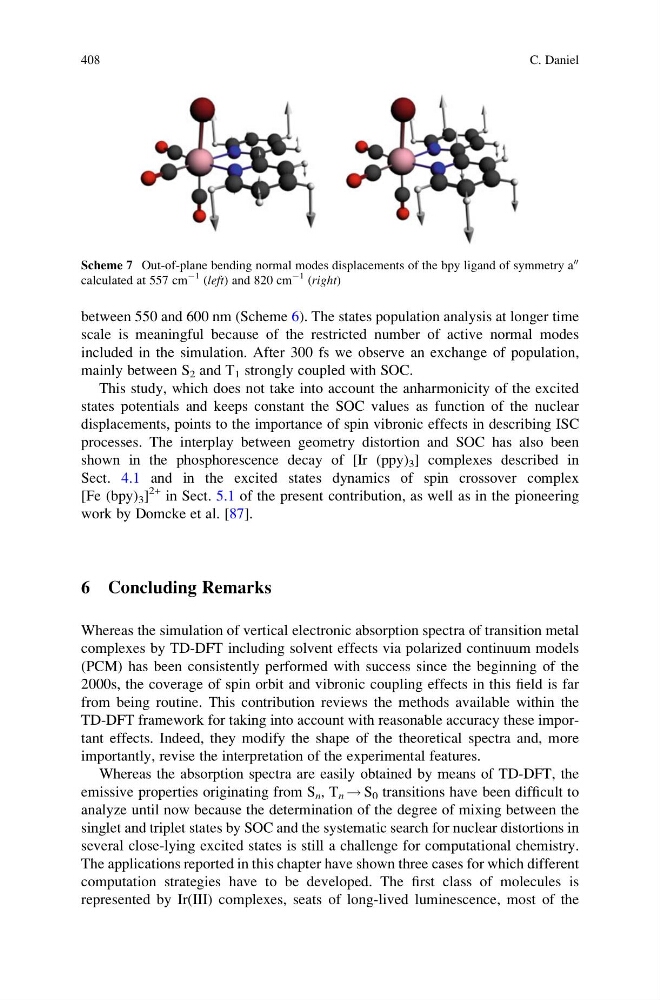
Scheme 7 Out-of-plane bending normal modes displacements of the bpy ligand of symmetry a
00
calculated at 557 cm
À1 (left) and 820 cm
À1 (right)
408
C. Daniel
scale is meaningful because of the restricted number of active normal modes
included in the simulation. After 300 fs we observe an exchange of population,
mainly between S 2 and T 1 strongly coupled with SOC.
This study, which does not take into account the anharmonicity of the excited
states potentials and keeps constant the SOC values as function of the nuclear
displacements, points to the importance of spin vibronic effects in describing ISC
processes. The interplay between geometry distortion and SOC has also been
shown in the phosphorescence decay of [Ir (ppy) 3 ] complexes described in
Sect. 4.1 and in the excited states dynamics of spin crossover complex
[Fe (bpy) 3 ]
2+ in Sect. 5.1 of the present contribution, as well as in the pioneering
work by Domcke et al. [87].
6 Concluding Remarks
Whereas the simulation of vertical electronic absorption spectra of transition metal
complexes by TD-DFT including solvent effects via polarized continuum models
(PCM) has been consistently performed with success since the beginning of the
2000s, the coverage of spin orbit and vibronic coupling effects in this field is far
from being routine. This contribution reviews the methods available within the
TD-DFT framework for taking into account with reasonable accuracy these important effects. Indeed, they modify the shape of the theoretical spectra and, more
importantly, revise the interpretation of the experimental features.
Whereas the absorption spectra are easily obtained by means of TD-DFT, the
emissive properties originating from S n , T n ! S 0 transitions have been difficult to
analyze until now because the determination of the degree of mixing between the
singlet and triplet states by SOC and the systematic search for nuclear distortions in
several close-lying excited states is still a challenge for computational chemistry.
The applications reported in this chapter have shown three cases for which different
computation strategies have to be developed. The first class of molecules is
represented by Ir(III) complexes, seats of long-lived luminescence, most of the
Scheme 7 Out-of-plane bending normal modes displacements of the bpy ligand of symmetry a
00
calculated at 557 cm
À1 (left) and 820 cm
À1 (right)
408
C. Daniel