

observe a fast and efficient population of T 1 and T 3 (Fig. 7, top) with a rapid decay
of the S 2 population to less than 40% within 20 fs. The nearly instantaneous
population of T 1 is because of a large value of SOC between this state and S 2
(600 cm
À1 ), whereas the population of T 3 is controlled by the significant degree of
spin-orbit mixing and the small energy gap between this state and S 2 .
When two additional normal modes of symmetry a
00 corresponding to out-ofplane bending of the bpy ligand are taken into account (Scheme 7), the population
of T 1 and T 3 , controlled mainly by SOC, is not modified but we observe a modest
population of S 1 and T 2 starting after a few tens of fs and increasing until a
maximum of 20% at 350 fs (Fig. 7, bottom, black dashed and red). Interestingly,
the population of T 3 optimum within 25 fs decays rapidly to less than 20%. This
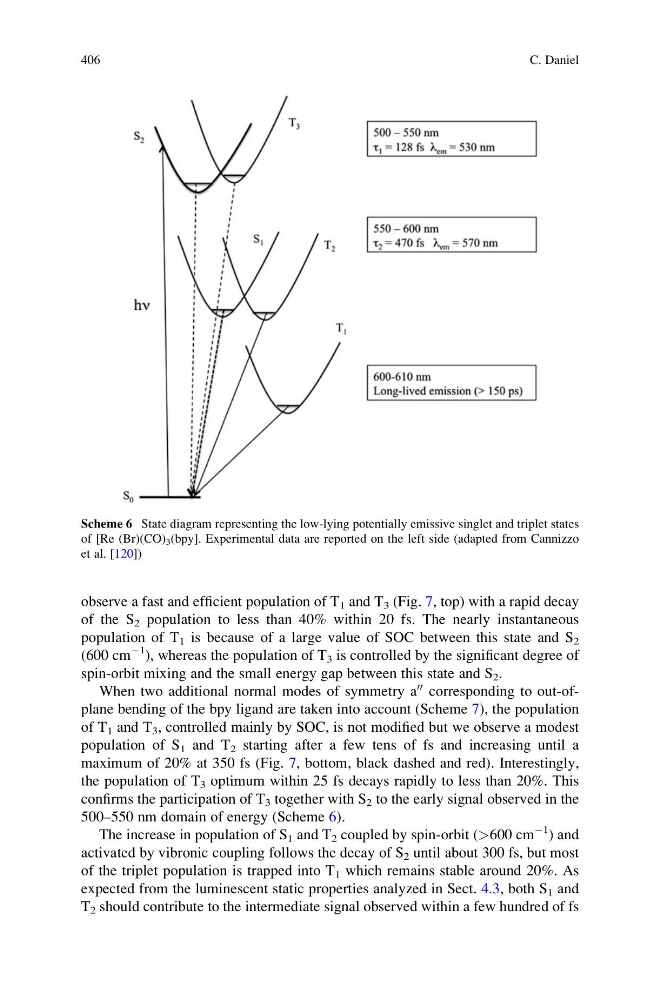
confirms the participation of T 3 together with S 2 to the early signal observed in the
500–550 nm domain of energy (Scheme 6).
The increase in population of S 1 and T 2 coupled by spin-orbit (>600 cm
À1 ) and
activated by vibronic coupling follows the decay of S 2 until about 300 fs, but most
of the triplet population is trapped into T 1 which remains stable around 20%. As
expected from the luminescent static properties analyzed in Sect. 4.3, both S 1 and
T 2 should contribute to the intermediate signal observed within a few hundred of fs
Scheme 6 State diagram representing the low-lying potentially emissive singlet and triplet states
of [Re (Br)(CO) 3 (bpy]. Experimental data are reported on the left side (adapted from Cannizzo
et al. [120])
406
C. Daniel
of the S 2 population to less than 40% within 20 fs. The nearly instantaneous
population of T 1 is because of a large value of SOC between this state and S 2
(600 cm
À1 ), whereas the population of T 3 is controlled by the significant degree of
spin-orbit mixing and the small energy gap between this state and S 2 .
When two additional normal modes of symmetry a
00 corresponding to out-ofplane bending of the bpy ligand are taken into account (Scheme 7), the population
of T 1 and T 3 , controlled mainly by SOC, is not modified but we observe a modest
population of S 1 and T 2 starting after a few tens of fs and increasing until a
maximum of 20% at 350 fs (Fig. 7, bottom, black dashed and red). Interestingly,
the population of T 3 optimum within 25 fs decays rapidly to less than 20%. This
confirms the participation of T 3 together with S 2 to the early signal observed in the
500–550 nm domain of energy (Scheme 6).
The increase in population of S 1 and T 2 coupled by spin-orbit (>600 cm
À1 ) and
activated by vibronic coupling follows the decay of S 2 until about 300 fs, but most
of the triplet population is trapped into T 1 which remains stable around 20%. As
expected from the luminescent static properties analyzed in Sect. 4.3, both S 1 and
T 2 should contribute to the intermediate signal observed within a few hundred of fs
Scheme 6 State diagram representing the low-lying potentially emissive singlet and triplet states
of [Re (Br)(CO) 3 (bpy]. Experimental data are reported on the left side (adapted from Cannizzo
et al. [120])
406
C. Daniel