

4 Emission Spectroscopy
This chapter is dedicated to the emissive properties of third-row transition metal
complexes determined on the basis of optimized structures of the low-lying singlet
and triplet states. Whereas the S 0 ! S n electronic absorption spectra are easily
obtained by means of TD-DFT with or without solvent corrections, the emissive
properties originating from S n , T n ! S 0 transitions have been difficult to analyze
until now because the determination of the degree of mixing between the singlet
and triplet states by SOC and the systematic search for nuclear distortions in several
close-lying excited states is still a challenge for computational chemistry. We may
distinguish between two categories of complexes, the first represented by Ir(III)
complexes seats of long-lived luminescence, most of the time attributed to the
lowest triplet T 1 state. The second class of molecules represented by Re
(I) complexes is characterized by shorter lived signals following a cascade of
ultra-fast luminescence processes attributed to S n as well as T n states. Obviously
all in-between luminescent behaviors may occur in transition metal complexes. The
Pt(II) square planar complexes are a pertinent example. The purpose of this section
is to present three case studies illustrating the contribution of TD-DFT and linear
and quadratic response theories including SOC to the problematic of luminescent
processes in third-row transition metal complexes.
4.1 Phosphorescence of Ir(III) Complexes
The dipole moment of T 1 ! S 0 spin-forbidden phosphorescent transition in Ir(III)
complexes with large π-conjugated ligands may acquire some non-negligible
strength by means of strong SOC. In a series of theoretical studies based on
TD-DFT and using linear and quadratic response theory, Minaev et al. [42, 81,
123] investigated the SOC effects and radiative lifetimes to elucidate and compare
the mechanism of phosphorescence in fac-[Ir(ppy 3 )] (Scheme 1, 1) and fac-[Ir
(piq) x (ppy) 3Àx ] (ppy ¼ 2-phenlypyridine; piq ¼ 1-phenylisoquinoline; n ¼ 3,4)
complexes 3, 4, and 5 (Scheme 3).
In this study a semi-empirical effective single electron SOC operator [73, 74]
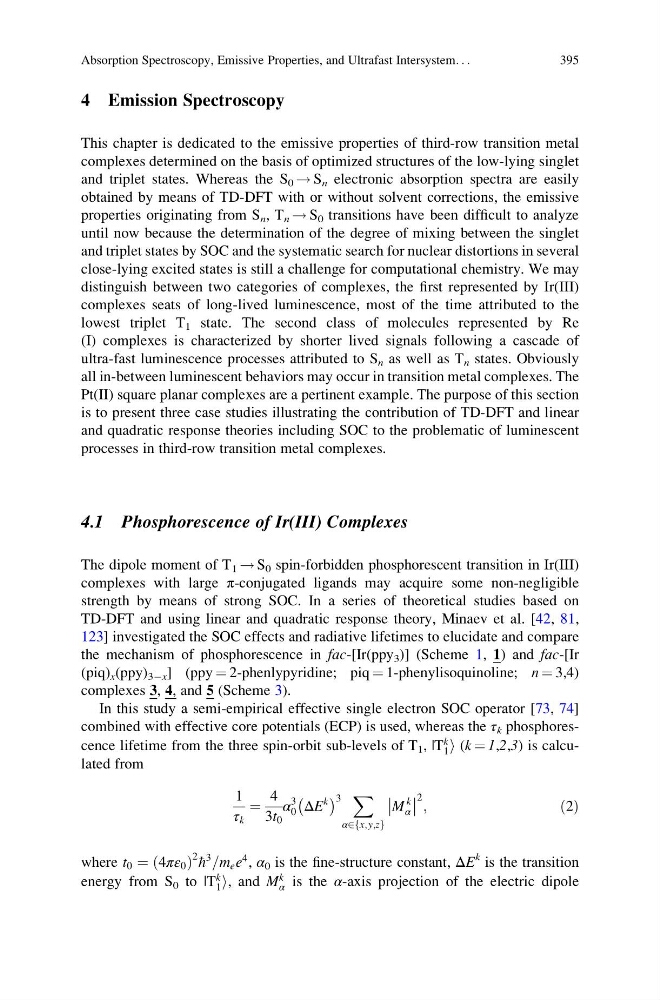
combined with effective core potentials (ECP) is used, whereas the τ k phosphorescence lifetime from the three spin-orbit sub-levels of T 1 , |T
k
1 i (k ¼ 1,2,3) is calculated from
1
τ k
¼
4
3t 0
α
3
0 ΔE
k
À
Á 3 X
α2 x;y;z
f
g
M
k
α
2 ;
ð2Þ
where t 0 ¼ 4πε 0
ð
Þ
2 h
3
=m e e
4 , α 0 is the fine-structure constant, ΔE
k is the transition
energy from S 0 to |T
k
1 i, and M
k
α is the α-axis projection of the electric dipole
Absorption Spectroscopy, Emissive Properties, and Ultrafast Intersystem. . .
395
This chapter is dedicated to the emissive properties of third-row transition metal
complexes determined on the basis of optimized structures of the low-lying singlet
and triplet states. Whereas the S 0 ! S n electronic absorption spectra are easily
obtained by means of TD-DFT with or without solvent corrections, the emissive
properties originating from S n , T n ! S 0 transitions have been difficult to analyze
until now because the determination of the degree of mixing between the singlet
and triplet states by SOC and the systematic search for nuclear distortions in several
close-lying excited states is still a challenge for computational chemistry. We may
distinguish between two categories of complexes, the first represented by Ir(III)
complexes seats of long-lived luminescence, most of the time attributed to the
lowest triplet T 1 state. The second class of molecules represented by Re
(I) complexes is characterized by shorter lived signals following a cascade of
ultra-fast luminescence processes attributed to S n as well as T n states. Obviously
all in-between luminescent behaviors may occur in transition metal complexes. The
Pt(II) square planar complexes are a pertinent example. The purpose of this section
is to present three case studies illustrating the contribution of TD-DFT and linear
and quadratic response theories including SOC to the problematic of luminescent
processes in third-row transition metal complexes.
4.1 Phosphorescence of Ir(III) Complexes
The dipole moment of T 1 ! S 0 spin-forbidden phosphorescent transition in Ir(III)
complexes with large π-conjugated ligands may acquire some non-negligible
strength by means of strong SOC. In a series of theoretical studies based on
TD-DFT and using linear and quadratic response theory, Minaev et al. [42, 81,
123] investigated the SOC effects and radiative lifetimes to elucidate and compare
the mechanism of phosphorescence in fac-[Ir(ppy 3 )] (Scheme 1, 1) and fac-[Ir
(piq) x (ppy) 3Àx ] (ppy ¼ 2-phenlypyridine; piq ¼ 1-phenylisoquinoline; n ¼ 3,4)
complexes 3, 4, and 5 (Scheme 3).
In this study a semi-empirical effective single electron SOC operator [73, 74]
combined with effective core potentials (ECP) is used, whereas the τ k phosphorescence lifetime from the three spin-orbit sub-levels of T 1 , |T
k
1 i (k ¼ 1,2,3) is calculated from
1
τ k
¼
4
3t 0
α
3
0 ΔE
k
À
Á 3 X
α2 x;y;z
f
g
M
k
α
2 ;
ð2Þ
where t 0 ¼ 4πε 0
ð
Þ
2 h
3
=m e e
4 , α 0 is the fine-structure constant, ΔE
k is the transition
energy from S 0 to |T
k
1 i, and M
k
α is the α-axis projection of the electric dipole
Absorption Spectroscopy, Emissive Properties, and Ultrafast Intersystem. . .
395