

model in which SOC is considered as a static property independent of the nuclear
motion.
Spin-orbit and vibronic couplings directly influence the probability of elementary processes such as internal conversions and ISC. The interpretation of ultrafast
structural changes, time-resolved spectra, quantum yields, and time scales of
elementary processes or transient lifetimes not only needs robust theoretical tools
in quantum chemistry but developments in quantum dynamics for solving electronic and nuclear problems. Quantum dynamics has to treat dynamical processes
which are not confined to a single electronic PES and which violate the Born–
Oppenheimer (BO) separation of electronic and nuclear motions, taking into
account nonadiabatic coupling between two or more electronic states via several
vibrational modes [84].
In the applications discussed in the present contribution, running quantum
nuclear dynamics by wavepacket propagation on a set of adiabatic potential energy
hypersurfaces associated with excited states of different multiplicities coupled both
vibronically and by SOC is out of reach. The alternative is to construct a spinvibronic coupling model Hamiltonian based on selected relevant normal modes
which includes the electronic states of interest at the early stage of the dynamical
process, namely between 0 fs and 1 ps.
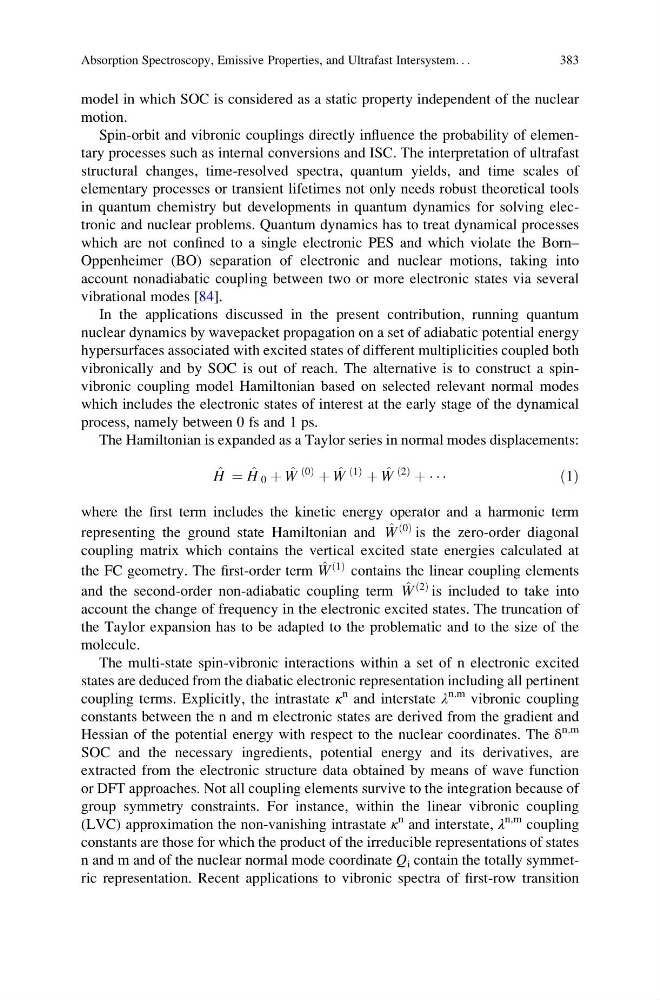
The Hamiltonian is expanded as a Taylor series in normal modes displacements:
^
H ¼ ^
H 0 þ ^
W
0
ð Þ
þ ^
W
1
ð Þ
þ ^
W
2
ð Þ
þ Á Á Á
ð1Þ
where the first term includes the kinetic energy operator and a harmonic term
representing the ground state Hamiltonian and ^
W
0
ð Þ is the zero-order diagonal
coupling matrix which contains the vertical excited state energies calculated at
the FC geometry. The first-order term ^
W
1
ð Þ contains the linear coupling elements
and the second-order non-adiabatic coupling term ^
W
2
ð Þ is included to take into
account the change of frequency in the electronic excited states. The truncation of
the Taylor expansion has to be adapted to the problematic and to the size of the
molecule.
The multi-state spin-vibronic interactions within a set of n electronic excited
states are deduced from the diabatic electronic representation including all pertinent
coupling terms. Explicitly, the intrastate κ
n and interstate λ
n,m vibronic coupling
constants between the n and m electronic states are derived from the gradient and
Hessian of the potential energy with respect to the nuclear coordinates. The δ
n,m
SOC and the necessary ingredients, potential energy and its derivatives, are
extracted from the electronic structure data obtained by means of wave function
or DFT approaches. Not all coupling elements survive to the integration because of
group symmetry constraints. For instance, within the linear vibronic coupling
(LVC) approximation the non-vanishing intrastate κ
n and interstate, λ
n,m coupling
constants are those for which the product of the irreducible representations of states
n and m and of the nuclear normal mode coordinate Q i contain the totally symmetric representation. Recent applications to vibronic spectra of first-row transition
Absorption Spectroscopy, Emissive Properties, and Ultrafast Intersystem. . .
383
motion.
Spin-orbit and vibronic couplings directly influence the probability of elementary processes such as internal conversions and ISC. The interpretation of ultrafast
structural changes, time-resolved spectra, quantum yields, and time scales of
elementary processes or transient lifetimes not only needs robust theoretical tools
in quantum chemistry but developments in quantum dynamics for solving electronic and nuclear problems. Quantum dynamics has to treat dynamical processes
which are not confined to a single electronic PES and which violate the Born–
Oppenheimer (BO) separation of electronic and nuclear motions, taking into
account nonadiabatic coupling between two or more electronic states via several
vibrational modes [84].
In the applications discussed in the present contribution, running quantum
nuclear dynamics by wavepacket propagation on a set of adiabatic potential energy
hypersurfaces associated with excited states of different multiplicities coupled both
vibronically and by SOC is out of reach. The alternative is to construct a spinvibronic coupling model Hamiltonian based on selected relevant normal modes
which includes the electronic states of interest at the early stage of the dynamical
process, namely between 0 fs and 1 ps.
The Hamiltonian is expanded as a Taylor series in normal modes displacements:
^
H ¼ ^
H 0 þ ^
W
0
ð Þ
þ ^
W
1
ð Þ
þ ^
W
2
ð Þ
þ Á Á Á
ð1Þ
where the first term includes the kinetic energy operator and a harmonic term
representing the ground state Hamiltonian and ^
W
0
ð Þ is the zero-order diagonal
coupling matrix which contains the vertical excited state energies calculated at
the FC geometry. The first-order term ^
W
1
ð Þ contains the linear coupling elements
and the second-order non-adiabatic coupling term ^
W
2
ð Þ is included to take into
account the change of frequency in the electronic excited states. The truncation of
the Taylor expansion has to be adapted to the problematic and to the size of the
molecule.
The multi-state spin-vibronic interactions within a set of n electronic excited
states are deduced from the diabatic electronic representation including all pertinent
coupling terms. Explicitly, the intrastate κ
n and interstate λ
n,m vibronic coupling
constants between the n and m electronic states are derived from the gradient and
Hessian of the potential energy with respect to the nuclear coordinates. The δ
n,m
SOC and the necessary ingredients, potential energy and its derivatives, are
extracted from the electronic structure data obtained by means of wave function
or DFT approaches. Not all coupling elements survive to the integration because of
group symmetry constraints. For instance, within the linear vibronic coupling
(LVC) approximation the non-vanishing intrastate κ
n and interstate, λ
n,m coupling
constants are those for which the product of the irreducible representations of states
n and m and of the nuclear normal mode coordinate Q i contain the totally symmetric representation. Recent applications to vibronic spectra of first-row transition
Absorption Spectroscopy, Emissive Properties, and Ultrafast Intersystem. . .
383