

fused aromatics but they fail to provide the correct height of the shoulder in
cyanines (see below for a discussion on the latter derivatives) [16]. For the relative
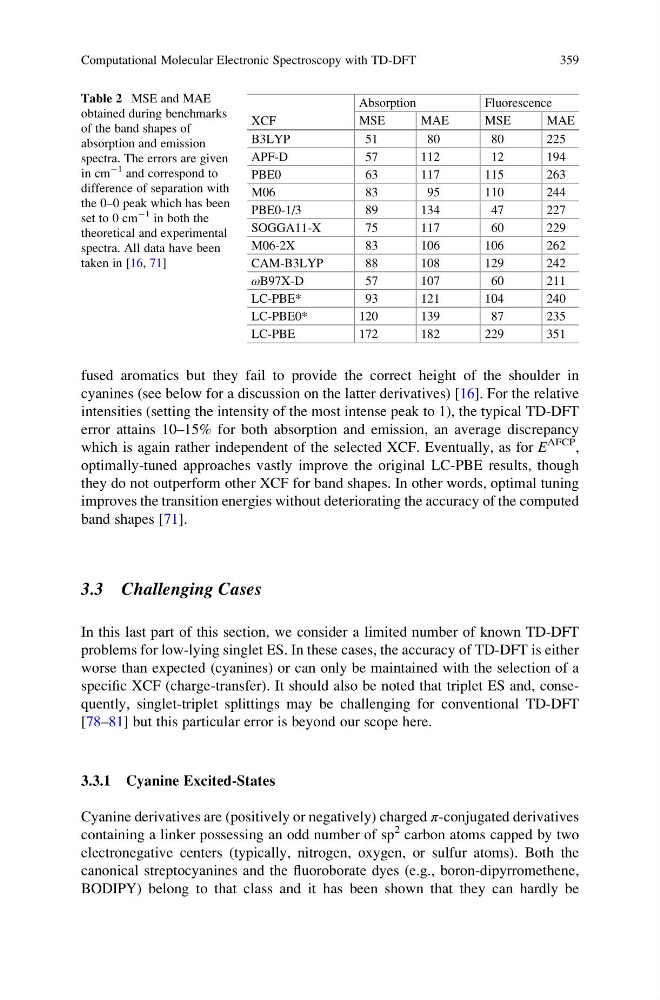
intensities (setting the intensity of the most intense peak to 1), the typical TD-DFT
error attains 10–15% for both absorption and emission, an average discrepancy
which is again rather independent of the selected XCF. Eventually, as for E
AFCP ,
optimally-tuned approaches vastly improve the original LC-PBE results, though
they do not outperform other XCF for band shapes. In other words, optimal tuning
improves the transition energies without deteriorating the accuracy of the computed
band shapes [71].
3.3 Challenging Cases
In this last part of this section, we consider a limited number of known TD-DFT
problems for low-lying singlet ES. In these cases, the accuracy of TD-DFT is either
worse than expected (cyanines) or can only be maintained with the selection of a
specific XCF (charge-transfer). It should also be noted that triplet ES and, consequently, singlet-triplet splittings may be challenging for conventional TD-DFT
[78–81] but this particular error is beyond our scope here.
3.3.1 Cyanine Excited-States
Cyanine derivatives are (positively or negatively) charged π-conjugated derivatives
containing a linker possessing an odd number of sp
2 carbon atoms capped by two
electronegative centers (typically, nitrogen, oxygen, or sulfur atoms). Both the
canonical streptocyanines and the fluoroborate dyes (e.g., boron-dipyrromethene,
BODIPY) belong to that class and it has been shown that they can hardly be
Table 2 MSE and MAE
obtained during benchmarks
of the band shapes of
absorption and emission
spectra. The errors are given
in cm
À1 and correspond to
difference of separation with
the 0–0 peak which has been
set to 0 cm
À1 in both the
theoretical and experimental
spectra. All data have been
taken in [16, 71]
XCF
Absorption
Fluorescence
MSE
MAE
MSE
MAE
B3LYP
51
80
80
225
APF-D
57
112
12
194
PBE0
63
117
115
263
M06
83
95
110
244
PBE0-1/3
89
134
47
227
SOGGA11-X
75
117
60
229
M06-2X
83
106
106
262
CAM-B3LYP
88
108
129
242
ωB97X-D
57
107
60
211
LC-PBE*
93
121
104
240
LC-PBE0*
120
139
87
235
LC-PBE
172
182
229
351
Computational Molecular Electronic Spectroscopy with TD-DFT
359
cyanines (see below for a discussion on the latter derivatives) [16]. For the relative
intensities (setting the intensity of the most intense peak to 1), the typical TD-DFT
error attains 10–15% for both absorption and emission, an average discrepancy
which is again rather independent of the selected XCF. Eventually, as for E
AFCP ,
optimally-tuned approaches vastly improve the original LC-PBE results, though
they do not outperform other XCF for band shapes. In other words, optimal tuning
improves the transition energies without deteriorating the accuracy of the computed
band shapes [71].
3.3 Challenging Cases
In this last part of this section, we consider a limited number of known TD-DFT
problems for low-lying singlet ES. In these cases, the accuracy of TD-DFT is either
worse than expected (cyanines) or can only be maintained with the selection of a
specific XCF (charge-transfer). It should also be noted that triplet ES and, consequently, singlet-triplet splittings may be challenging for conventional TD-DFT
[78–81] but this particular error is beyond our scope here.
3.3.1 Cyanine Excited-States
Cyanine derivatives are (positively or negatively) charged π-conjugated derivatives
containing a linker possessing an odd number of sp
2 carbon atoms capped by two
electronegative centers (typically, nitrogen, oxygen, or sulfur atoms). Both the
canonical streptocyanines and the fluoroborate dyes (e.g., boron-dipyrromethene,
BODIPY) belong to that class and it has been shown that they can hardly be
Table 2 MSE and MAE
obtained during benchmarks
of the band shapes of
absorption and emission
spectra. The errors are given
in cm
À1 and correspond to
difference of separation with
the 0–0 peak which has been
set to 0 cm
À1 in both the
theoretical and experimental
spectra. All data have been
taken in [16, 71]
XCF
Absorption
Fluorescence
MSE
MAE
MSE
MAE
B3LYP
51
80
80
225
APF-D
57
112
12
194
PBE0
63
117
115
263
M06
83
95
110
244
PBE0-1/3
89
134
47
227
SOGGA11-X
75
117
60
229
M06-2X
83
106
106
262
CAM-B3LYP
88
108
129
242
ωB97X-D
57
107
60
211
LC-PBE*
93
121
104
240
LC-PBE0*
120
139
87
235
LC-PBE
172
182
229
351
Computational Molecular Electronic Spectroscopy with TD-DFT
359