

E
AFCP
BE
neq
ð Þ ¼ E
AFCP
TDÀDFT neq
ð Þþ E
adia
Ψ
gas
ð ÞÀE
adia
TDÀDFT gas
ð Þ
Â
Ã
;
ð13Þ
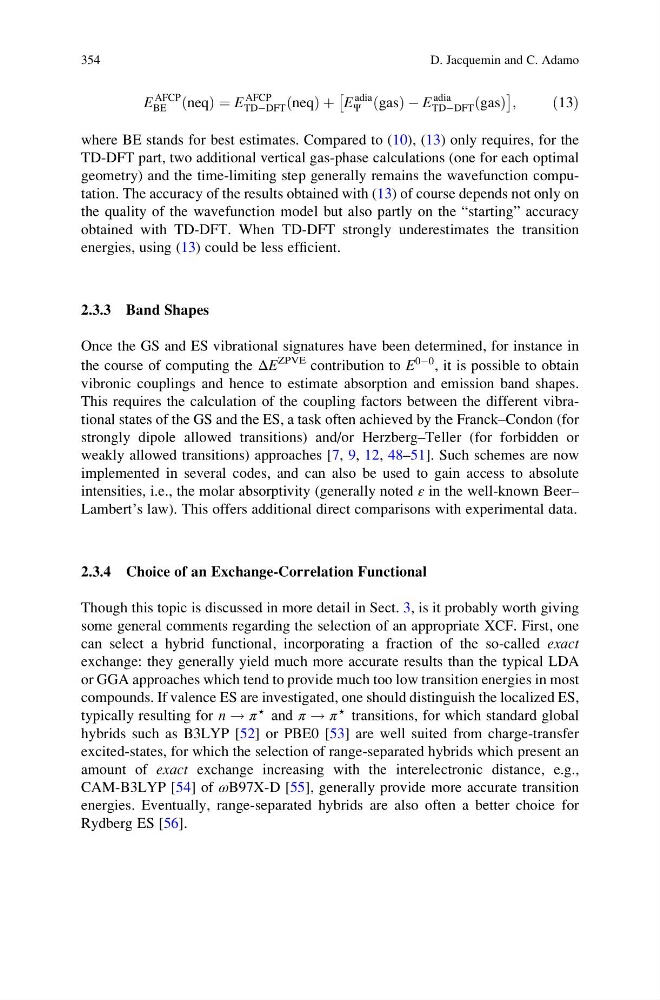
where BE stands for best estimates. Compared to (10), (13) only requires, for the
TD-DFT part, two additional vertical gas-phase calculations (one for each optimal
geometry) and the time-limiting step generally remains the wavefunction computation. The accuracy of the results obtained with (13) of course depends not only on
the quality of the wavefunction model but also partly on the “starting” accuracy
obtained with TD-DFT. When TD-DFT strongly underestimates the transition
energies, using (13) could be less efficient.
2.3.3 Band Shapes
Once the GS and ES vibrational signatures have been determined, for instance in
the course of computing the ΔE
ZPVE contribution to E
0À0 , it is possible to obtain
vibronic couplings and hence to estimate absorption and emission band shapes.
This requires the calculation of the coupling factors between the different vibrational states of the GS and the ES, a task often achieved by the Franck–Condon (for
strongly dipole allowed transitions) and/or Herzberg–Teller (for forbidden or
weakly allowed transitions) approaches [7, 9, 12, 48–51]. Such schemes are now
implemented in several codes, and can also be used to gain access to absolute
intensities, i.e., the molar absorptivity (generally noted ε in the well-known Beer–
Lambert’s law). This offers additional direct comparisons with experimental data.
2.3.4 Choice of an Exchange-Correlation Functional
Though this topic is discussed in more detail in Sect. 3, is it probably worth giving
some general comments regarding the selection of an appropriate XCF. First, one
can select a hybrid functional, incorporating a fraction of the so-called exact
exchange: they generally yield much more accurate results than the typical LDA
or GGA approaches which tend to provide much too low transition energies in most
compounds. If valence ES are investigated, one should distinguish the localized ES,
typically resulting for n ! π
⋆ and π ! π
⋆ transitions, for which standard global
hybrids such as B3LYP [52] or PBE0 [53] are well suited from charge-transfer
excited-states, for which the selection of range-separated hybrids which present an
amount of exact exchange increasing with the interelectronic distance, e.g.,
CAM-B3LYP [54] of ωB97X-D [55], generally provide more accurate transition
energies. Eventually, range-separated hybrids are also often a better choice for
Rydberg ES [56].
354
D. Jacquemin and C. Adamo
AFCP
BE
neq
ð Þ ¼ E
AFCP
TDÀDFT neq
ð Þþ E
adia
Ψ
gas
ð ÞÀE
adia
TDÀDFT gas
ð Þ
Â
Ã
;
ð13Þ
where BE stands for best estimates. Compared to (10), (13) only requires, for the
TD-DFT part, two additional vertical gas-phase calculations (one for each optimal
geometry) and the time-limiting step generally remains the wavefunction computation. The accuracy of the results obtained with (13) of course depends not only on
the quality of the wavefunction model but also partly on the “starting” accuracy
obtained with TD-DFT. When TD-DFT strongly underestimates the transition
energies, using (13) could be less efficient.
2.3.3 Band Shapes
Once the GS and ES vibrational signatures have been determined, for instance in
the course of computing the ΔE
ZPVE contribution to E
0À0 , it is possible to obtain
vibronic couplings and hence to estimate absorption and emission band shapes.
This requires the calculation of the coupling factors between the different vibrational states of the GS and the ES, a task often achieved by the Franck–Condon (for
strongly dipole allowed transitions) and/or Herzberg–Teller (for forbidden or
weakly allowed transitions) approaches [7, 9, 12, 48–51]. Such schemes are now
implemented in several codes, and can also be used to gain access to absolute
intensities, i.e., the molar absorptivity (generally noted ε in the well-known Beer–
Lambert’s law). This offers additional direct comparisons with experimental data.
2.3.4 Choice of an Exchange-Correlation Functional
Though this topic is discussed in more detail in Sect. 3, is it probably worth giving
some general comments regarding the selection of an appropriate XCF. First, one
can select a hybrid functional, incorporating a fraction of the so-called exact
exchange: they generally yield much more accurate results than the typical LDA
or GGA approaches which tend to provide much too low transition energies in most
compounds. If valence ES are investigated, one should distinguish the localized ES,
typically resulting for n ! π
⋆ and π ! π
⋆ transitions, for which standard global
hybrids such as B3LYP [52] or PBE0 [53] are well suited from charge-transfer
excited-states, for which the selection of range-separated hybrids which present an
amount of exact exchange increasing with the interelectronic distance, e.g.,
CAM-B3LYP [54] of ωB97X-D [55], generally provide more accurate transition
energies. Eventually, range-separated hybrids are also often a better choice for
Rydberg ES [56].
354
D. Jacquemin and C. Adamo