

Core hole calculations require a RAS1 space for the core hole orbital with fixed
occupation number. The RAS2 space (and RAS3 space, if necessary) is used for
valence correlation. Optimization of the MCSCF wavefunction with core holes
must avoid the variational collapse. A rigorous treatment of orbital relaxation can
be realized by a two-step procedure [193, 196]. One first freezes the orbital with
core hole (RAS1) and relaxes the rest; the frozen core orbital is relaxed in the
second step. Different optimization algorithms may be used for the two steps, for
example, combining the second-order norm-extended optimization (NEO) algorithm [209, 210] and a straight Newton–Raphson (NR) algorithm. The effect of the
second step can be illustrated by the resulting energy change (i.e., the core orbital
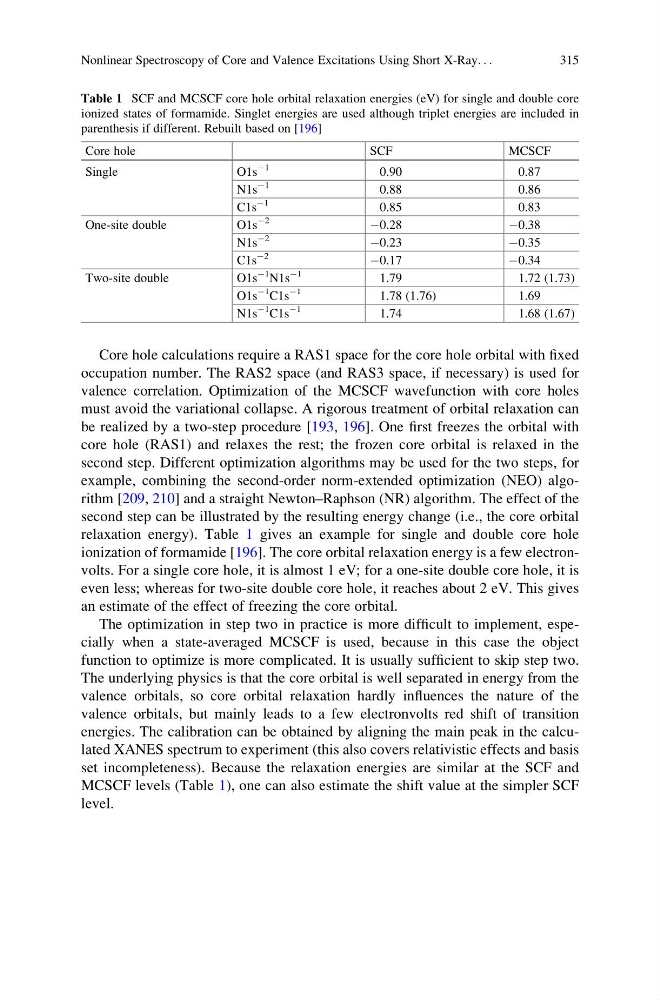
relaxation energy). Table 1 gives an example for single and double core hole
ionization of formamide [196]. The core orbital relaxation energy is a few electronvolts. For a single core hole, it is almost 1 eV; for a one-site double core hole, it is
even less; whereas for two-site double core hole, it reaches about 2 eV. This gives
an estimate of the effect of freezing the core orbital.
The optimization in step two in practice is more difficult to implement, especially when a state-averaged MCSCF is used, because in this case the object
function to optimize is more complicated. It is usually sufficient to skip step two.
The underlying physics is that the core orbital is well separated in energy from the
valence orbitals, so core orbital relaxation hardly influences the nature of the
valence orbitals, but mainly leads to a few electronvolts red shift of transition
energies. The calibration can be obtained by aligning the main peak in the calculated XANES spectrum to experiment (this also covers relativistic effects and basis
set incompleteness). Because the relaxation energies are similar at the SCF and
MCSCF levels (Table 1), one can also estimate the shift value at the simpler SCF
level.
Table 1 SCF and MCSCF core hole orbital relaxation energies (eV) for single and double core
ionized states of formamide. Singlet energies are used although triplet energies are included in
parenthesis if different. Rebuilt based on [196]
Core hole
SCF
MCSCF
Single
O1s
À1
0.90
0.87
N1s
À1
0.88
0.86
C1s
À1
0.85
0.83
One-site double
O1s
À2
À0.28
À0.38
N1s
À2
À0.23
À0.35
C1s
À2
À0.17
À0.34
Two-site double
O1s
À1
N1s
À1
1.79
1.72 (1.73)
O1s
À1
C1s
À1
1.78 (1.76)
1.69
N1s
À1
C1s
À1
1.74
1.68 (1.67)
Nonlinear Spectroscopy of Core and Valence Excitations Using Short X-Ray. . .
315
occupation number. The RAS2 space (and RAS3 space, if necessary) is used for
valence correlation. Optimization of the MCSCF wavefunction with core holes
must avoid the variational collapse. A rigorous treatment of orbital relaxation can
be realized by a two-step procedure [193, 196]. One first freezes the orbital with
core hole (RAS1) and relaxes the rest; the frozen core orbital is relaxed in the
second step. Different optimization algorithms may be used for the two steps, for
example, combining the second-order norm-extended optimization (NEO) algorithm [209, 210] and a straight Newton–Raphson (NR) algorithm. The effect of the
second step can be illustrated by the resulting energy change (i.e., the core orbital
relaxation energy). Table 1 gives an example for single and double core hole
ionization of formamide [196]. The core orbital relaxation energy is a few electronvolts. For a single core hole, it is almost 1 eV; for a one-site double core hole, it is
even less; whereas for two-site double core hole, it reaches about 2 eV. This gives
an estimate of the effect of freezing the core orbital.
The optimization in step two in practice is more difficult to implement, especially when a state-averaged MCSCF is used, because in this case the object
function to optimize is more complicated. It is usually sufficient to skip step two.
The underlying physics is that the core orbital is well separated in energy from the
valence orbitals, so core orbital relaxation hardly influences the nature of the
valence orbitals, but mainly leads to a few electronvolts red shift of transition
energies. The calibration can be obtained by aligning the main peak in the calculated XANES spectrum to experiment (this also covers relativistic effects and basis
set incompleteness). Because the relaxation energies are similar at the SCF and
MCSCF levels (Table 1), one can also estimate the shift value at the simpler SCF
level.
Table 1 SCF and MCSCF core hole orbital relaxation energies (eV) for single and double core
ionized states of formamide. Singlet energies are used although triplet energies are included in
parenthesis if different. Rebuilt based on [196]
Core hole
SCF
MCSCF
Single
O1s
À1
0.90
0.87
N1s
À1
0.88
0.86
C1s
À1
0.85
0.83
One-site double
O1s
À2
À0.28
À0.38
N1s
À2
À0.23
À0.35
C1s
À2
À0.17
À0.34
Two-site double
O1s
À1
N1s
À1
1.79
1.72 (1.73)
O1s
À1
C1s
À1
1.78 (1.76)
1.69
N1s
À1
C1s
À1
1.74
1.68 (1.67)
Nonlinear Spectroscopy of Core and Valence Excitations Using Short X-Ray. . .
315