

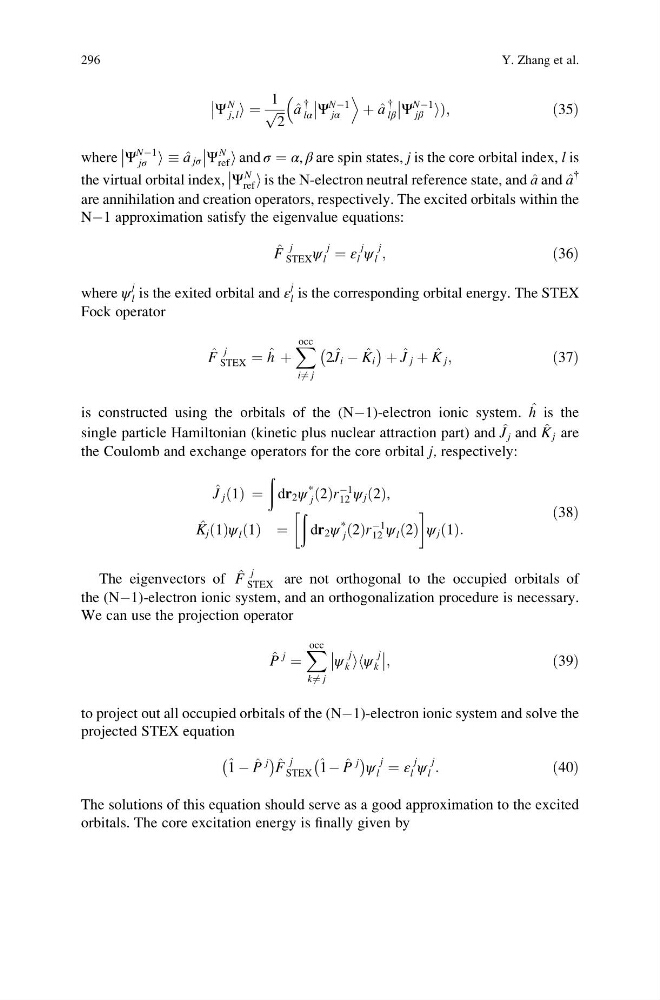
Ψ
N
j, l i ¼
1
ffiffi ffi
2
p ^
a
{
lα
Ψ
NÀ1
jα
E
þ ^
a
{
lβ
Ψ
NÀ1
jβ iÞ;
ð35Þ
where
Ψ
NÀ1
jσ i ^
a jσ
Ψ
N
ref i and σ ¼ α, β are spin states, j is the core orbital index, l is
the virtual orbital index,
Ψ
N
ref i is the N-electron neutral reference state, and ^
a and ^
a
{
are annihilation and creation operators, respectively. The excited orbitals within the
NÀ1 approximation satisfy the eigenvalue equations:
^
F
j
STEX ψ
j
l ¼ ε
j
l ψ
j
l ;
ð36Þ
where ψ
j
l is the exited orbital and ε
j
l is the corresponding orbital energy. The STEX
Fock operator
^
F
j
STEX ¼ ^
h þ
X occ
i6 ¼ j
2 ^
J i À ^
K i
À
Á þ ^
J j þ ^
K j ;
ð37Þ
is constructed using the orbitals of the (NÀ1)-electron ionic system. ^
h is the
single particle Hamiltonian (kinetic plus nuclear attraction part) and ^
J j and ^
K j are
the Coulomb and exchange operators for the core orbital j, respectively:
^
J j 1
ð Þ ¼
ð
dr 2 ψ
*
j 2
ð Þr
À1
12 ψ j 2
ð Þ,
^
K j 1
ð Þψ l 1
ð Þ ¼
ð
dr 2 ψ
*
j 2
ð Þr
À1
12 ψ l 2
ð Þ
!
ψ j 1
ð Þ:
ð38Þ
The eigenvectors of ^
F
j
STEX are not orthogonal to the occupied orbitals of
the (NÀ1)-electron ionic system, and an orthogonalization procedure is necessary.
We can use the projection operator
^
P
j
¼
X occ
k6 ¼ j
ψ
j
k ihψ
j
k
;
ð39Þ
to project out all occupied orbitals of the (NÀ1)-electron ionic system and solve the
projected STEX equation
^ 1 À ^
P
j
À
Á ^
F
j
STEX
^ 1À ^
P
j
À
Á ψ
j
l ¼ ε
j
l ψ
j
l :
ð40Þ
The solutions of this equation should serve as a good approximation to the excited
orbitals. The core excitation energy is finally given by
296
Y. Zhang et al.
N
j, l i ¼
1
ffiffi ffi
2
p ^
a
{
lα
Ψ
NÀ1
jα
E
þ ^
a
{
lβ
Ψ
NÀ1
jβ iÞ;
ð35Þ
where
Ψ
NÀ1
jσ i ^
a jσ
Ψ
N
ref i and σ ¼ α, β are spin states, j is the core orbital index, l is
the virtual orbital index,
Ψ
N
ref i is the N-electron neutral reference state, and ^
a and ^
a
{
are annihilation and creation operators, respectively. The excited orbitals within the
NÀ1 approximation satisfy the eigenvalue equations:
^
F
j
STEX ψ
j
l ¼ ε
j
l ψ
j
l ;
ð36Þ
where ψ
j
l is the exited orbital and ε
j
l is the corresponding orbital energy. The STEX
Fock operator
^
F
j
STEX ¼ ^
h þ
X occ
i6 ¼ j
2 ^
J i À ^
K i
À
Á þ ^
J j þ ^
K j ;
ð37Þ
is constructed using the orbitals of the (NÀ1)-electron ionic system. ^
h is the
single particle Hamiltonian (kinetic plus nuclear attraction part) and ^
J j and ^
K j are
the Coulomb and exchange operators for the core orbital j, respectively:
^
J j 1
ð Þ ¼
ð
dr 2 ψ
*
j 2
ð Þr
À1
12 ψ j 2
ð Þ,
^
K j 1
ð Þψ l 1
ð Þ ¼
ð
dr 2 ψ
*
j 2
ð Þr
À1
12 ψ l 2
ð Þ
!
ψ j 1
ð Þ:
ð38Þ
The eigenvectors of ^
F
j
STEX are not orthogonal to the occupied orbitals of
the (NÀ1)-electron ionic system, and an orthogonalization procedure is necessary.
We can use the projection operator
^
P
j
¼
X occ
k6 ¼ j
ψ
j
k ihψ
j
k
;
ð39Þ
to project out all occupied orbitals of the (NÀ1)-electron ionic system and solve the
projected STEX equation
^ 1 À ^
P
j
À
Á ^
F
j
STEX
^ 1À ^
P
j
À
Á ψ
j
l ¼ ε
j
l ψ
j
l :
ð40Þ
The solutions of this equation should serve as a good approximation to the excited
orbitals. The core excitation energy is finally given by
296
Y. Zhang et al.