

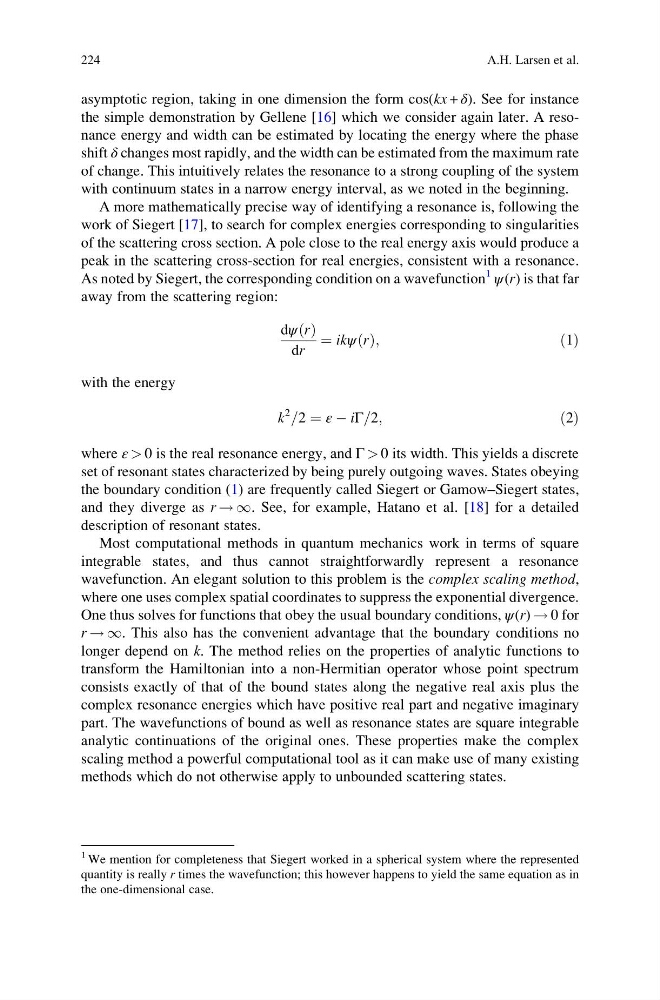
asymptotic region, taking in one dimension the form cos(kx + δ). See for instance
the simple demonstration by Gellene [16] which we consider again later. A resonance energy and width can be estimated by locating the energy where the phase
shift δ changes most rapidly, and the width can be estimated from the maximum rate
of change. This intuitively relates the resonance to a strong coupling of the system
with continuum states in a narrow energy interval, as we noted in the beginning.
A more mathematically precise way of identifying a resonance is, following the
work of Siegert [17], to search for complex energies corresponding to singularities
of the scattering cross section. A pole close to the real energy axis would produce a
peak in the scattering cross-section for real energies, consistent with a resonance.
As noted by Siegert, the corresponding condition on a wavefunction
1
ψ(r) is that far
away from the scattering region:
dψ r
ð Þ
dr
¼ ikψ r
ð Þ;
ð1Þ
with the energy
k
2
=2 ¼ ε À iΓ=2;
ð2Þ
where ε > 0 is the real resonance energy, and Γ > 0 its width. This yields a discrete
set of resonant states characterized by being purely outgoing waves. States obeying
the boundary condition (1) are frequently called Siegert or Gamow–Siegert states,
and they diverge as r ! 1. See, for example, Hatano et al. [18] for a detailed
description of resonant states.
Most computational methods in quantum mechanics work in terms of square
integrable states, and thus cannot straightforwardly represent a resonance
wavefunction. An elegant solution to this problem is the complex scaling method,
where one uses complex spatial coordinates to suppress the exponential divergence.
One thus solves for functions that obey the usual boundary conditions, ψ(r) ! 0 for
r ! 1. This also has the convenient advantage that the boundary conditions no
longer depend on k. The method relies on the properties of analytic functions to
transform the Hamiltonian into a non-Hermitian operator whose point spectrum
consists exactly of that of the bound states along the negative real axis plus the
complex resonance energies which have positive real part and negative imaginary
part. The wavefunctions of bound as well as resonance states are square integrable
analytic continuations of the original ones. These properties make the complex
scaling method a powerful computational tool as it can make use of many existing
methods which do not otherwise apply to unbounded scattering states.
1 We mention for completeness that Siegert worked in a spherical system where the represented
quantity is really r times the wavefunction; this however happens to yield the same equation as in
the one-dimensional case.
224
A.H. Larsen et al.
the simple demonstration by Gellene [16] which we consider again later. A resonance energy and width can be estimated by locating the energy where the phase
shift δ changes most rapidly, and the width can be estimated from the maximum rate
of change. This intuitively relates the resonance to a strong coupling of the system
with continuum states in a narrow energy interval, as we noted in the beginning.
A more mathematically precise way of identifying a resonance is, following the
work of Siegert [17], to search for complex energies corresponding to singularities
of the scattering cross section. A pole close to the real energy axis would produce a
peak in the scattering cross-section for real energies, consistent with a resonance.
As noted by Siegert, the corresponding condition on a wavefunction
1
ψ(r) is that far
away from the scattering region:
dψ r
ð Þ
dr
¼ ikψ r
ð Þ;
ð1Þ
with the energy
k
2
=2 ¼ ε À iΓ=2;
ð2Þ
where ε > 0 is the real resonance energy, and Γ > 0 its width. This yields a discrete
set of resonant states characterized by being purely outgoing waves. States obeying
the boundary condition (1) are frequently called Siegert or Gamow–Siegert states,
and they diverge as r ! 1. See, for example, Hatano et al. [18] for a detailed
description of resonant states.
Most computational methods in quantum mechanics work in terms of square
integrable states, and thus cannot straightforwardly represent a resonance
wavefunction. An elegant solution to this problem is the complex scaling method,
where one uses complex spatial coordinates to suppress the exponential divergence.
One thus solves for functions that obey the usual boundary conditions, ψ(r) ! 0 for
r ! 1. This also has the convenient advantage that the boundary conditions no
longer depend on k. The method relies on the properties of analytic functions to
transform the Hamiltonian into a non-Hermitian operator whose point spectrum
consists exactly of that of the bound states along the negative real axis plus the
complex resonance energies which have positive real part and negative imaginary
part. The wavefunctions of bound as well as resonance states are square integrable
analytic continuations of the original ones. These properties make the complex
scaling method a powerful computational tool as it can make use of many existing
methods which do not otherwise apply to unbounded scattering states.
1 We mention for completeness that Siegert worked in a spherical system where the represented
quantity is really r times the wavefunction; this however happens to yield the same equation as in
the one-dimensional case.
224
A.H. Larsen et al.