

however, the implementation of meta-GGAs for the linear response in solids turns
out to be technically rather difficult.
5.4.5 The PGG Kernel
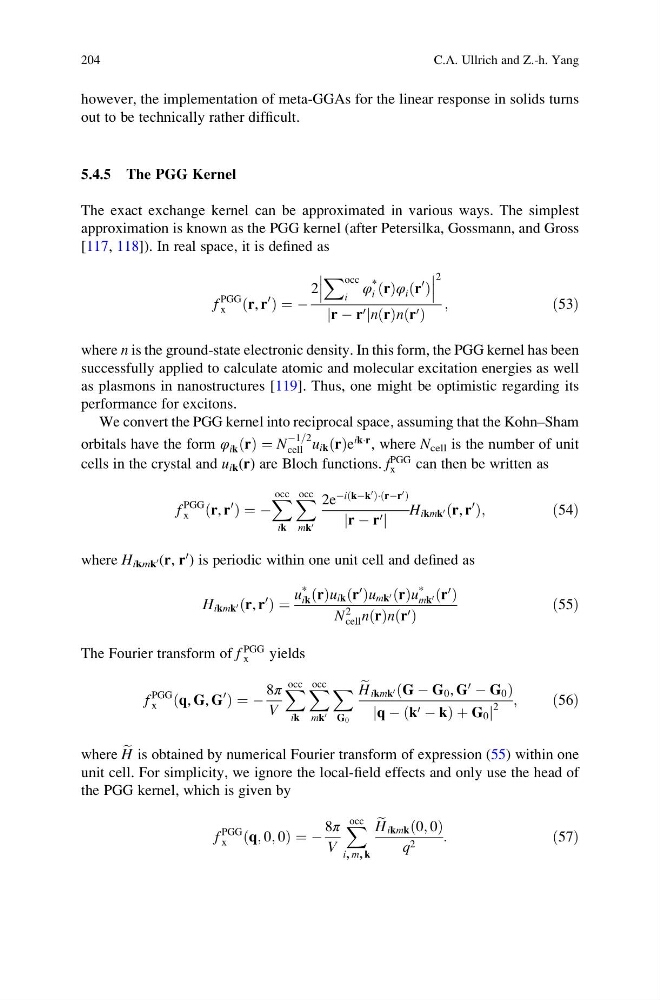
The exact exchange kernel can be approximated in various ways. The simplest
approximation is known as the PGG kernel (after Petersilka, Gossmann, and Gross
[117, 118]). In real space, it is defined as
f
PGG
x
r, r
0
ð
Þ ¼ À
2
X occ
i
φ
*
i r
ð Þφ i r
0
ð Þ
2
r À r 0
j
jn r
ð Þn r 0
ð Þ
;
ð53Þ
where n is the ground-state electronic density. In this form, the PGG kernel has been
successfully applied to calculate atomic and molecular excitation energies as well
as plasmons in nanostructures [119]. Thus, one might be optimistic regarding its
performance for excitons.
We convert the PGG kernel into reciprocal space, assuming that the Kohn–Sham
orbitals have the form φ ik r
ð Þ ¼ N
À1=2
cell u ik r
ð Þe
ikÁr , where N cell is the number of unit
cells in the crystal and u ik (r) are Bloch functions. f
PGG
x
can then be written as
f
PGG
x
r, r
0
ð
Þ ¼ À
X occ
ik
X occ
mk 0
2e
Ài kÀk
0
ð
Þ ÁrÀr
0
ð
Þ
r À r 0
j
j
H ikmk 0 r, r
0
ð
Þ;
ð54Þ
where H ikmk
0 (r, r
0 ) is periodic within one unit cell and defined as
H ikmk 0 r, r
0
ð
Þ ¼
u
*
ik r
ð Þu ik r
0
ð Þu mk 0 r
ð Þu
*
mk 0 r
0
ð Þ
N
2
cell n r
ð Þn r 0
ð Þ
ð55Þ
The Fourier transform of f
PGG
x
yields
f
PGG
x
q, G, G
0
ð
޼8π
V
X occ
ik
X occ
mk 0
X
G 0
e
H ikmk 0 G À G 0 , G
0
À G 0
ð
Þ
q À k 0 À k
ð
ÞþG 0
j
j
2
;
ð56Þ
where e
H is obtained by numerical Fourier transform of expression (55) within one
unit cell. For simplicity, we ignore the local-field effects and only use the head of
the PGG kernel, which is given by
f
PGG
x
q; 0; 0
ð
޼8π
V
X occ
i, m, k
e
H ikmk 0; 0
ð Þ
q 2
:
ð57Þ
204
C.A. Ullrich and Z.-h. Yang
out to be technically rather difficult.
5.4.5 The PGG Kernel
The exact exchange kernel can be approximated in various ways. The simplest
approximation is known as the PGG kernel (after Petersilka, Gossmann, and Gross
[117, 118]). In real space, it is defined as
f
PGG
x
r, r
0
ð
Þ ¼ À
2
X occ
i
φ
*
i r
ð Þφ i r
0
ð Þ
2
r À r 0
j
jn r
ð Þn r 0
ð Þ
;
ð53Þ
where n is the ground-state electronic density. In this form, the PGG kernel has been
successfully applied to calculate atomic and molecular excitation energies as well
as plasmons in nanostructures [119]. Thus, one might be optimistic regarding its
performance for excitons.
We convert the PGG kernel into reciprocal space, assuming that the Kohn–Sham
orbitals have the form φ ik r
ð Þ ¼ N
À1=2
cell u ik r
ð Þe
ikÁr , where N cell is the number of unit
cells in the crystal and u ik (r) are Bloch functions. f
PGG
x
can then be written as
f
PGG
x
r, r
0
ð
Þ ¼ À
X occ
ik
X occ
mk 0
2e
Ài kÀk
0
ð
Þ ÁrÀr
0
ð
Þ
r À r 0
j
j
H ikmk 0 r, r
0
ð
Þ;
ð54Þ
where H ikmk
0 (r, r
0 ) is periodic within one unit cell and defined as
H ikmk 0 r, r
0
ð
Þ ¼
u
*
ik r
ð Þu ik r
0
ð Þu mk 0 r
ð Þu
*
mk 0 r
0
ð Þ
N
2
cell n r
ð Þn r 0
ð Þ
ð55Þ
The Fourier transform of f
PGG
x
yields
f
PGG
x
q, G, G
0
ð
޼8π
V
X occ
ik
X occ
mk 0
X
G 0
e
H ikmk 0 G À G 0 , G
0
À G 0
ð
Þ
q À k 0 À k
ð
ÞþG 0
j
j
2
;
ð56Þ
where e
H is obtained by numerical Fourier transform of expression (55) within one
unit cell. For simplicity, we ignore the local-field effects and only use the head of
the PGG kernel, which is given by
f
PGG
x
q; 0; 0
ð
޼8π
V
X occ
i, m, k
e
H ikmk 0; 0
ð Þ
q 2
:
ð57Þ
204
C.A. Ullrich and Z.-h. Yang