

5.4 Alternative Adiabatic Approximation
Because the standard adiabatic approximation used in TD-RDMFT has the undesirable features of stationary occupation numbers and a mismatch with the static
response equations (Sect. 3.1) in the ω ! 0 limit, an alternative adiabatic approximation has been proposed. The idea is to replace the dynamic equation for the
occupation numbers (96b) by its static counterpart and to make the perturbed
quantities frequency-dependent, which leads to the following equation
0 ¼ 2
X
r>s
C
T
p, rs δγ
R
rs ω
ð Þ þ 2
X
r
W p, r δn r ω
ð Þ þ δv pp ω
ð Þ;
ð114Þ
where we use
C
T
p, rs ¼ C rs, p and W p, q ¼
1
2
∂
2 W
∂n p ∂n q
:
ð115Þ
Though the occupation numbers are not determined by an equation of motion, but
follow instantaneously from δγ
R (ω) and the diagonal elements of the potential
δv
D (ω), there is at least a response of the occupation numbers. The fact that this
alternative adiabatic approximation is an instantaneous relaxation of the natural
occupation numbers at each time t has been stressed in [149] where the more
descriptive name “instantaneous occupation number relaxation” was introduced.
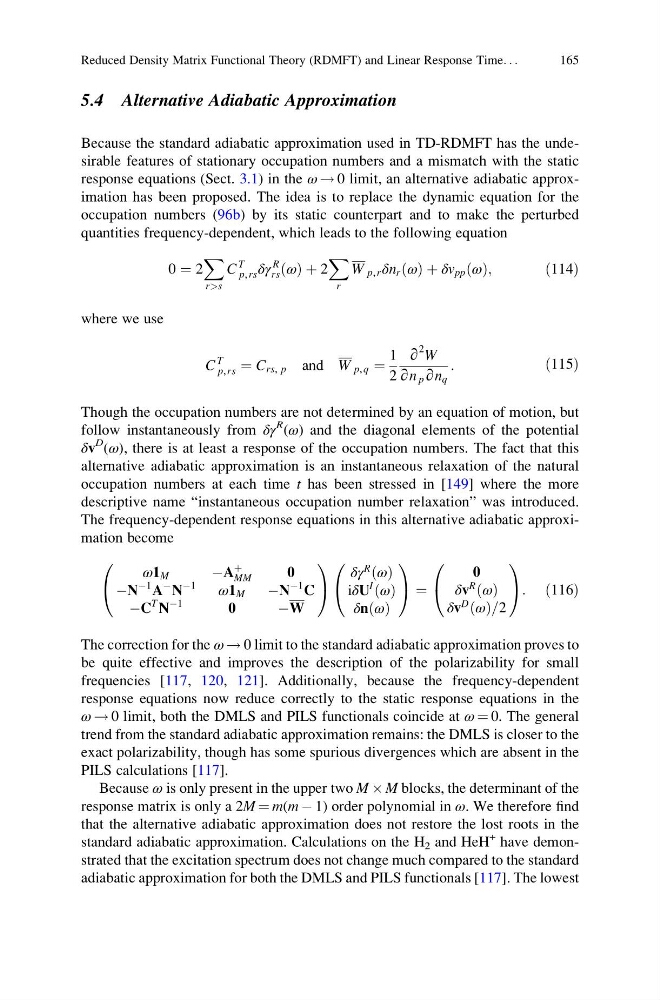
The frequency-dependent response equations in this alternative adiabatic approximation become
ω1 M
ÀA
þ
MM
0
ÀN
À1 A
À N
À1
ω1 M
ÀN
À1 C
ÀC
T N
À1
0
ÀW
0
@
1
A
δγ
R
ω
ð Þ
iδU
I
ω
ð Þ
δn ω
ð Þ
0
@
1
A ¼
0
δv
R
ω
ð Þ
δv
D
ω
ð Þ=2
0
@
1
A : ð116Þ
The correction for the ω ! 0 limit to the standard adiabatic approximation proves to
be quite effective and improves the description of the polarizability for small
frequencies [117, 120, 121]. Additionally, because the frequency-dependent
response equations now reduce correctly to the static response equations in the
ω ! 0 limit, both the DMLS and PILS functionals coincide at ω ¼ 0. The general
trend from the standard adiabatic approximation remains: the DMLS is closer to the
exact polarizability, though has some spurious divergences which are absent in the
PILS calculations [117].
Because ω is only present in the upper two M Â M blocks, the determinant of the
response matrix is only a 2M ¼ m(m À 1) order polynomial in ω. We therefore find
that the alternative adiabatic approximation does not restore the lost roots in the
standard adiabatic approximation. Calculations on the H 2 and HeH
+ have demonstrated that the excitation spectrum does not change much compared to the standard
adiabatic approximation for both the DMLS and PILS functionals [117]. The lowest
Reduced Density Matrix Functional Theory (RDMFT) and Linear Response Time. . .
165
Because the standard adiabatic approximation used in TD-RDMFT has the undesirable features of stationary occupation numbers and a mismatch with the static
response equations (Sect. 3.1) in the ω ! 0 limit, an alternative adiabatic approximation has been proposed. The idea is to replace the dynamic equation for the
occupation numbers (96b) by its static counterpart and to make the perturbed
quantities frequency-dependent, which leads to the following equation
0 ¼ 2
X
r>s
C
T
p, rs δγ
R
rs ω
ð Þ þ 2
X
r
W p, r δn r ω
ð Þ þ δv pp ω
ð Þ;
ð114Þ
where we use
C
T
p, rs ¼ C rs, p and W p, q ¼
1
2
∂
2 W
∂n p ∂n q
:
ð115Þ
Though the occupation numbers are not determined by an equation of motion, but
follow instantaneously from δγ
R (ω) and the diagonal elements of the potential
δv
D (ω), there is at least a response of the occupation numbers. The fact that this
alternative adiabatic approximation is an instantaneous relaxation of the natural
occupation numbers at each time t has been stressed in [149] where the more
descriptive name “instantaneous occupation number relaxation” was introduced.
The frequency-dependent response equations in this alternative adiabatic approximation become
ω1 M
ÀA
þ
MM
0
ÀN
À1 A
À N
À1
ω1 M
ÀN
À1 C
ÀC
T N
À1
0
ÀW
0
@
1
A
δγ
R
ω
ð Þ
iδU
I
ω
ð Þ
δn ω
ð Þ
0
@
1
A ¼
0
δv
R
ω
ð Þ
δv
D
ω
ð Þ=2
0
@
1
A : ð116Þ
The correction for the ω ! 0 limit to the standard adiabatic approximation proves to
be quite effective and improves the description of the polarizability for small
frequencies [117, 120, 121]. Additionally, because the frequency-dependent
response equations now reduce correctly to the static response equations in the
ω ! 0 limit, both the DMLS and PILS functionals coincide at ω ¼ 0. The general
trend from the standard adiabatic approximation remains: the DMLS is closer to the
exact polarizability, though has some spurious divergences which are absent in the
PILS calculations [117].
Because ω is only present in the upper two M Â M blocks, the determinant of the
response matrix is only a 2M ¼ m(m À 1) order polynomial in ω. We therefore find
that the alternative adiabatic approximation does not restore the lost roots in the
standard adiabatic approximation. Calculations on the H 2 and HeH
+ have demonstrated that the excitation spectrum does not change much compared to the standard
adiabatic approximation for both the DMLS and PILS functionals [117]. The lowest
Reduced Density Matrix Functional Theory (RDMFT) and Linear Response Time. . .
165