

correlation effects. Because approximate 1-RDM functionals have been quite
successful in dealing with static correlation effects on the ground state level, we
also expect an improvement for the calculation of excitations when using the full
1-RDM in our formalism instead of only the density. It turns out, however, that the
formulation of a satisfactory adiabatic approximation in TD-RDMFT is not as
straightforward as in TDDFT. Most of the research has therefore been done on
formulating an adequate adiabatic approximation, so the formulation of an adiabatic approximation forms the major content of this TD-RDMFT section.
5.1 Equation of Motion of the 1-RDM
The time-dependent 1-RDM is obtained by using the time-dependent wavefunction
in the definition of the 1-RDM (1)
γ x, x
0
; t
ð
Þ¼N
ð
Á Á Á
ð
Ψ
À
x, x 2 , . . . , x N ; t
Á Ψ
∗ x
0
; x; . . . ; x N ; t
ð
Þ dx 2 Á Á Ádx N :
ð93Þ
The equation of motion for the 1-RDM is readily obtained from the time-dependent
Schr€ odinger equation
i∂ t γ x; x
0
; t
ð
Þ¼ ^
h x; t
ð Þ À ^
h x
0
; t
ð Þ
À
Á
γ x; x
0
; t
ð
Þþ
ð
1
r À r 2
j
j
À
1
r 0 À r 2
j
j
Γ xx 2 , x
0 x 2 ; t
ð
Þ dx 2 ;
ð94Þ
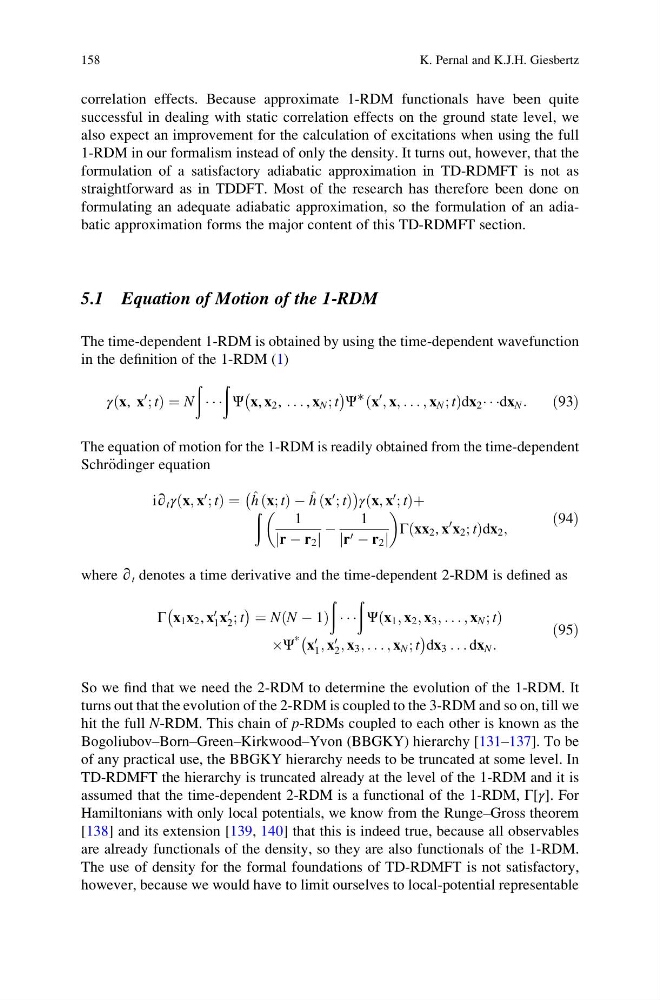
where ∂ t denotes a time derivative and the time-dependent 2-RDM is defined as
Γ x 1 x 2 , x
0
1 x
0
2 ; t
À
Á ¼ N N À 1
ð
Þ
ð
Á Á Á
ð
Ψ x 1 ; x 2 ; x 3 ; . . . ; x N ; t
ð
Þ
ÂΨ
* x
0
1 ; x
0
2 ; x 3 ; . . . ; x N ; t
À
Á
dx 3 . . . dx N :
ð95Þ
So we find that we need the 2-RDM to determine the evolution of the 1-RDM. It
turns out that the evolution of the 2-RDM is coupled to the 3-RDM and so on, till we
hit the full N-RDM. This chain of p-RDMs coupled to each other is known as the
Bogoliubov–Born–Green–Kirkwood–Yvon (BBGKY) hierarchy [131–137]. To be
of any practical use, the BBGKY hierarchy needs to be truncated at some level. In
TD-RDMFT the hierarchy is truncated already at the level of the 1-RDM and it is
assumed that the time-dependent 2-RDM is a functional of the 1-RDM, Γ[γ]. For
Hamiltonians with only local potentials, we know from the Runge–Gross theorem
[138] and its extension [139, 140] that this is indeed true, because all observables
are already functionals of the density, so they are also functionals of the 1-RDM.
The use of density for the formal foundations of TD-RDMFT is not satisfactory,
however, because we would have to limit ourselves to local-potential representable
158
K. Pernal and K.J.H. Giesbertz
successful in dealing with static correlation effects on the ground state level, we
also expect an improvement for the calculation of excitations when using the full
1-RDM in our formalism instead of only the density. It turns out, however, that the
formulation of a satisfactory adiabatic approximation in TD-RDMFT is not as
straightforward as in TDDFT. Most of the research has therefore been done on
formulating an adequate adiabatic approximation, so the formulation of an adiabatic approximation forms the major content of this TD-RDMFT section.
5.1 Equation of Motion of the 1-RDM
The time-dependent 1-RDM is obtained by using the time-dependent wavefunction
in the definition of the 1-RDM (1)
γ x, x
0
; t
ð
Þ¼N
ð
Á Á Á
ð
Ψ
À
x, x 2 , . . . , x N ; t
Á Ψ
∗ x
0
; x; . . . ; x N ; t
ð
Þ dx 2 Á Á Ádx N :
ð93Þ
The equation of motion for the 1-RDM is readily obtained from the time-dependent
Schr€ odinger equation
i∂ t γ x; x
0
; t
ð
Þ¼ ^
h x; t
ð Þ À ^
h x
0
; t
ð Þ
À
Á
γ x; x
0
; t
ð
Þþ
ð
1
r À r 2
j
j
À
1
r 0 À r 2
j
j
Γ xx 2 , x
0 x 2 ; t
ð
Þ dx 2 ;
ð94Þ
where ∂ t denotes a time derivative and the time-dependent 2-RDM is defined as
Γ x 1 x 2 , x
0
1 x
0
2 ; t
À
Á ¼ N N À 1
ð
Þ
ð
Á Á Á
ð
Ψ x 1 ; x 2 ; x 3 ; . . . ; x N ; t
ð
Þ
ÂΨ
* x
0
1 ; x
0
2 ; x 3 ; . . . ; x N ; t
À
Á
dx 3 . . . dx N :
ð95Þ
So we find that we need the 2-RDM to determine the evolution of the 1-RDM. It
turns out that the evolution of the 2-RDM is coupled to the 3-RDM and so on, till we
hit the full N-RDM. This chain of p-RDMs coupled to each other is known as the
Bogoliubov–Born–Green–Kirkwood–Yvon (BBGKY) hierarchy [131–137]. To be
of any practical use, the BBGKY hierarchy needs to be truncated at some level. In
TD-RDMFT the hierarchy is truncated already at the level of the 1-RDM and it is
assumed that the time-dependent 2-RDM is a functional of the 1-RDM, Γ[γ]. For
Hamiltonians with only local potentials, we know from the Runge–Gross theorem
[138] and its extension [139, 140] that this is indeed true, because all observables
are already functionals of the density, so they are also functionals of the 1-RDM.
The use of density for the formal foundations of TD-RDMFT is not satisfactory,
however, because we would have to limit ourselves to local-potential representable
158
K. Pernal and K.J.H. Giesbertz