

• Viscosity
• Cold properties
• Flashpoint
Most of these parameters have been defined elsewhere in this book. This section
then deals with the effect these parameters have on the performance of the diesel
engine or the emission of undesirable components from the engine or both. Where
the definition of the parameter is not dealt with in detail elsewhere in the book, then
definition is included here.
Cetane number. This is the result of an engine test that compares the ignition
delay for a fuel. For this test, two reference fuels are chosen. The first is normal
cetane (n-C 16 ) and the second is an isomer of cetane which is heptamethylnonane.
The normal cetane is arbitrarily given the cetane number of 100, while the isomer as
the second reference fuel is assigned a cetane number of 15. The fuel being tested is
run in a standard test engine. The cetane number is derived by comparing the
ignition delay of the test diesel with a blend of the two reference fuels. The cetane
number is then calculated using the equation:
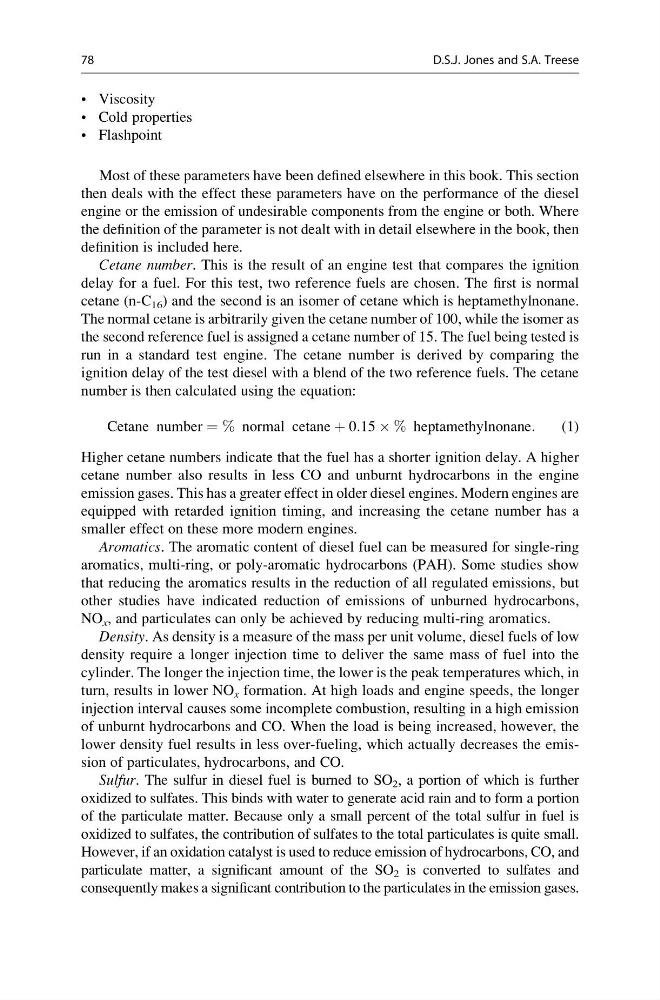
Cetane number ¼ % normal cetane þ 0:15 Â % heptamethylnonane:
(1)
Higher cetane numbers indicate that the fuel has a shorter ignition delay. A higher
cetane number also results in less CO and unburnt hydrocarbons in the engine
emission gases. This has a greater effect in older diesel engines. Modern engines are
equipped with retarded ignition timing, and increasing the cetane number has a
smaller effect on these more modern engines.
Aromatics. The aromatic content of diesel fuel can be measured for single-ring
aromatics, multi-ring, or poly-aromatic hydrocarbons (PAH). Some studies show
that reducing the aromatics results in the reduction of all regulated emissions, but
other studies have indicated reduction of emissions of unburned hydrocarbons,
NO x , and particulates can only be achieved by reducing multi-ring aromatics.
Density. As density is a measure of the mass per unit volume, diesel fuels of low
density require a longer injection time to deliver the same mass of fuel into the
cylinder. The longer the injection time, the lower is the peak temperatures which, in
turn, results in lower NO x formation. At high loads and engine speeds, the longer
injection interval causes some incomplete combustion, resulting in a high emission
of unburnt hydrocarbons and CO. When the load is being increased, however, the
lower density fuel results in less over-fueling, which actually decreases the emission of particulates, hydrocarbons, and CO.
Sulfur. The sulfur in diesel fuel is burned to SO 2 , a portion of which is further
oxidized to sulfates. This binds with water to generate acid rain and to form a portion
of the particulate matter. Because only a small percent of the total sulfur in fuel is
oxidized to sulfates, the contribution of sulfates to the total particulates is quite small.
However, if an oxidation catalyst is used to reduce emission of hydrocarbons, CO, and
particulate matter, a significant amount of the SO 2 is converted to sulfates and
consequently makes a significant contribution to the particulates in the emission gases.
78
D.S.J. Jones and S.A. Treese
• Cold properties
• Flashpoint
Most of these parameters have been defined elsewhere in this book. This section
then deals with the effect these parameters have on the performance of the diesel
engine or the emission of undesirable components from the engine or both. Where
the definition of the parameter is not dealt with in detail elsewhere in the book, then
definition is included here.
Cetane number. This is the result of an engine test that compares the ignition
delay for a fuel. For this test, two reference fuels are chosen. The first is normal
cetane (n-C 16 ) and the second is an isomer of cetane which is heptamethylnonane.
The normal cetane is arbitrarily given the cetane number of 100, while the isomer as
the second reference fuel is assigned a cetane number of 15. The fuel being tested is
run in a standard test engine. The cetane number is derived by comparing the
ignition delay of the test diesel with a blend of the two reference fuels. The cetane
number is then calculated using the equation:
Cetane number ¼ % normal cetane þ 0:15 Â % heptamethylnonane:
(1)
Higher cetane numbers indicate that the fuel has a shorter ignition delay. A higher
cetane number also results in less CO and unburnt hydrocarbons in the engine
emission gases. This has a greater effect in older diesel engines. Modern engines are
equipped with retarded ignition timing, and increasing the cetane number has a
smaller effect on these more modern engines.
Aromatics. The aromatic content of diesel fuel can be measured for single-ring
aromatics, multi-ring, or poly-aromatic hydrocarbons (PAH). Some studies show
that reducing the aromatics results in the reduction of all regulated emissions, but
other studies have indicated reduction of emissions of unburned hydrocarbons,
NO x , and particulates can only be achieved by reducing multi-ring aromatics.
Density. As density is a measure of the mass per unit volume, diesel fuels of low
density require a longer injection time to deliver the same mass of fuel into the
cylinder. The longer the injection time, the lower is the peak temperatures which, in
turn, results in lower NO x formation. At high loads and engine speeds, the longer
injection interval causes some incomplete combustion, resulting in a high emission
of unburnt hydrocarbons and CO. When the load is being increased, however, the
lower density fuel results in less over-fueling, which actually decreases the emission of particulates, hydrocarbons, and CO.
Sulfur. The sulfur in diesel fuel is burned to SO 2 , a portion of which is further
oxidized to sulfates. This binds with water to generate acid rain and to form a portion
of the particulate matter. Because only a small percent of the total sulfur in fuel is
oxidized to sulfates, the contribution of sulfates to the total particulates is quite small.
However, if an oxidation catalyst is used to reduce emission of hydrocarbons, CO, and
particulate matter, a significant amount of the SO 2 is converted to sulfates and
consequently makes a significant contribution to the particulates in the emission gases.
78
D.S.J. Jones and S.A. Treese