

Paraffinic lubes – These are all grades, both neutral and bright stock, with a finished
viscosity index of more than 75.
Naphthenic lubes – These are all grades with finished viscosity index of less than 75.
The important properties of lube oils are:
• Kinetic viscosity (centistokes)
• Color
• Pour point
• Flashpoint
• Volatility
• Oxidation stability
• Thermal stability
Although kinematic viscosity is measured in centistokes, it is usually specified in
Saybolt Seconds (SS). Specifications for lube oils are established by the Society of
Automotive Engineers who also perform research on a wide range of automotive
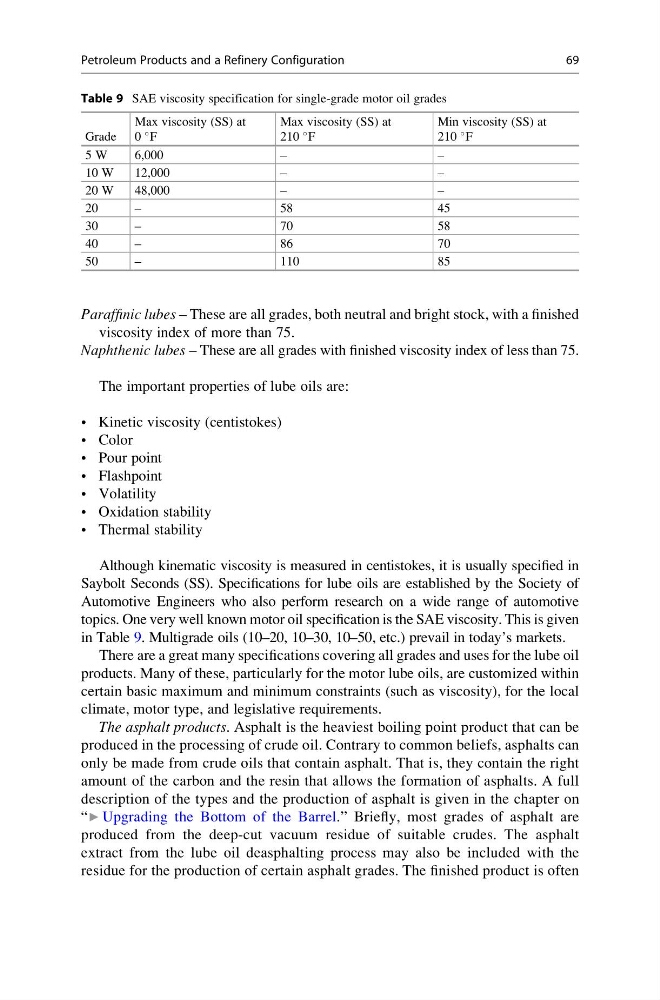
topics. One very well known motor oil specification is the SAE viscosity. This is given
in Table 9. Multigrade oils (10–20, 10–30, 10–50, etc.) prevail in today’s markets.
There are a great many specifications covering all grades and uses for the lube oil
products. Many of these, particularly for the motor lube oils, are customized within
certain basic maximum and minimum constraints (such as viscosity), for the local
climate, motor type, and legislative requirements.
The asphalt products. Asphalt is the heaviest boiling point product that can be
produced in the processing of crude oil. Contrary to common beliefs, asphalts can
only be made from crude oils that contain asphalt. That is, they contain the right
amount of the carbon and the resin that allows the formation of asphalts. A full
description of the types and the production of asphalt is given in the chapter on
“▶ Upgrading the Bottom of the Barrel.” Briefly, most grades of asphalt are
produced from the deep-cut vacuum residue of suitable crudes. The asphalt
extract from the lube oil deasphalting process may also be included with the
residue for the production of certain asphalt grades. The finished product is often
Table 9 SAE viscosity specification for single-grade motor oil grades
Grade
Max viscosity (SS) at
0
F
Max viscosity (SS) at
210
F
Min viscosity (SS) at
210
F
5 W
6,000
–
–
10 W
12,000
–
–
20 W
48,000
–
–
20
–
58
45
30
–
70
58
40
–
86
70
50
–
110
85
Petroleum Products and a Refinery Configuration
69
viscosity index of more than 75.
Naphthenic lubes – These are all grades with finished viscosity index of less than 75.
The important properties of lube oils are:
• Kinetic viscosity (centistokes)
• Color
• Pour point
• Flashpoint
• Volatility
• Oxidation stability
• Thermal stability
Although kinematic viscosity is measured in centistokes, it is usually specified in
Saybolt Seconds (SS). Specifications for lube oils are established by the Society of
Automotive Engineers who also perform research on a wide range of automotive
topics. One very well known motor oil specification is the SAE viscosity. This is given
in Table 9. Multigrade oils (10–20, 10–30, 10–50, etc.) prevail in today’s markets.
There are a great many specifications covering all grades and uses for the lube oil
products. Many of these, particularly for the motor lube oils, are customized within
certain basic maximum and minimum constraints (such as viscosity), for the local
climate, motor type, and legislative requirements.
The asphalt products. Asphalt is the heaviest boiling point product that can be
produced in the processing of crude oil. Contrary to common beliefs, asphalts can
only be made from crude oils that contain asphalt. That is, they contain the right
amount of the carbon and the resin that allows the formation of asphalts. A full
description of the types and the production of asphalt is given in the chapter on
“▶ Upgrading the Bottom of the Barrel.” Briefly, most grades of asphalt are
produced from the deep-cut vacuum residue of suitable crudes. The asphalt
extract from the lube oil deasphalting process may also be included with the
residue for the production of certain asphalt grades. The finished product is often
Table 9 SAE viscosity specification for single-grade motor oil grades
Grade
Max viscosity (SS) at
0
F
Max viscosity (SS) at
210
F
Min viscosity (SS) at
210
F
5 W
6,000
–
–
10 W
12,000
–
–
20 W
48,000
–
–
20
–
58
45
30
–
70
58
40
–
86
70
50
–
110
85
Petroleum Products and a Refinery Configuration
69