

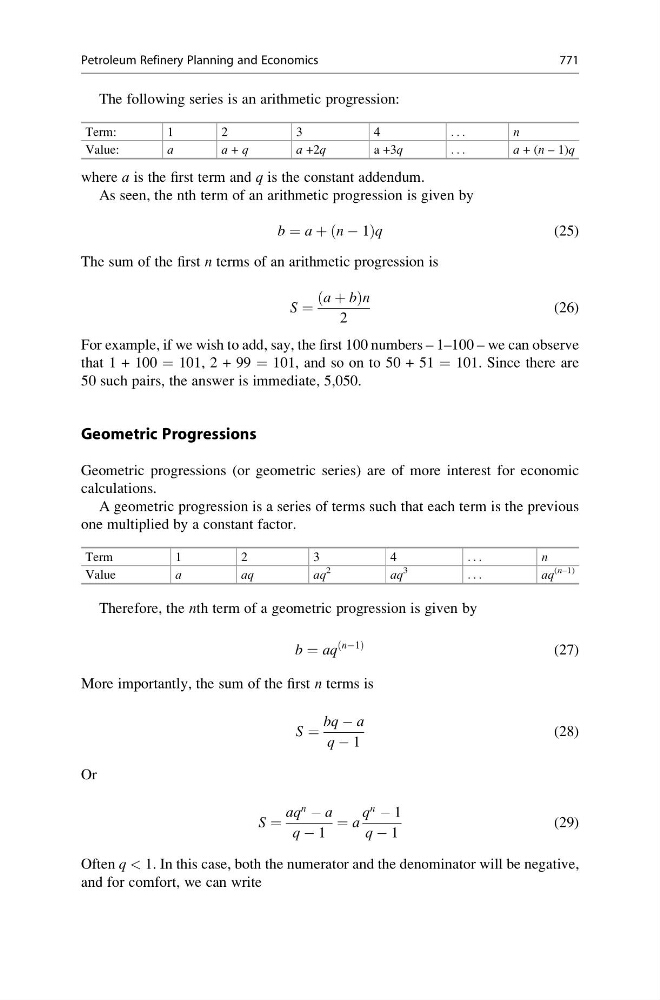
The following series is an arithmetic progression:
Term:
1
2
3
4
. . .
n
Value:
a
a+ q
a+2q
a +3q
. . .
a + (n – 1)q
where a is the first term and q is the constant addendum.
As seen, the nth term of an arithmetic progression is given by
b ¼ a þ n À 1
ð
Þq
(25)
The sum of the first n terms of an arithmetic progression is
S ¼
a þ b
ð
Þn
2
(26)
For example, if we wish to add, say, the first 100 numbers – 1–100 – we can observe
that 1 + 100 = 101, 2 + 99 = 101, and so on to 50 + 51 = 101. Since there are
50 such pairs, the answer is immediate, 5,050.
Geometric Progressions
Geometric progressions (or geometric series) are of more interest for economic
calculations.
A geometric progression is a series of terms such that each term is the previous
one multiplied by a constant factor.
Term
1
2
3
4
. . .
n
Value
a
a q
a q
2
aq
3
. . .
aq
(n–1)
Therefore, the nth term of a geometric progression is given by
b ¼ aq
nÀ1
ð
Þ
(27)
More importantly, the sum of the first n terms is
S ¼
bq À a
q À 1
(28)
Or
S ¼
aq
n
À a
q À 1
¼ a
q
n
À 1
q À 1
(29)
Often q < 1. In this case, both the numerator and the denominator will be negative,
and for comfort, we can write
Petroleum Refinery Planning and Economics
771