

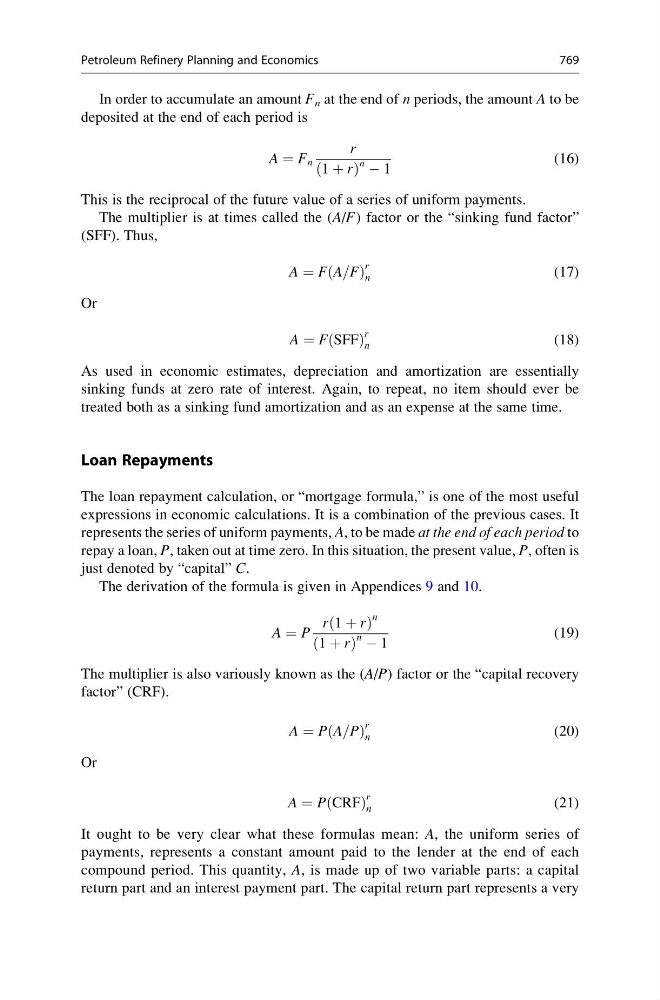
In order to accumulate an amount F n at the end of n periods, the amount A to be
deposited at the end of each period is
A ¼ F n
r
1 þ r
ð
Þ
n À 1
(16)
This is the reciprocal of the future value of a series of uniform payments.
The multiplier is at times called the (A/F) factor or the “sinking fund factor”
(SFF). Thus,
A ¼ F A=F
ð
Þ
r
n
(17)
Or
A ¼ F SFF
ð
Þ
r
n
(18)
As used in economic estimates, depreciation and amortization are essentially
sinking funds at zero rate of interest. Again, to repeat, no item should ever be
treated both as a sinking fund amortization and as an expense at the same time.
Loan Repayments
The loan repayment calculation, or “mortgage formula,” is one of the most useful
expressions in economic calculations. It is a combination of the previous cases. It
represents the series of uniform payments, A, to be made at the end of each period to
repay a loan, P, taken out at time zero. In this situation, the present value, P, often is
just denoted by “capital” C.
The derivation of the formula is given in Appendices 9 and 10.
A ¼ P
r 1 þ r
ð
Þ
n
1 þ r
ð
Þ
n À 1
(19)
The multiplier is also variously known as the (A/P) factor or the “capital recovery
factor” (CRF).
A ¼ P A=P
ð
Þ
r
n
(20)
Or
A ¼ P CRF
ð
Þ
r
n
(21)
It ought to be very clear what these formulas mean: A, the uniform series of
payments, represents a constant amount paid to the lender at the end of each
compound period. This quantity, A, is made up of two variable parts: a capital
return part and an interest payment part. The capital return part represents a very
Petroleum Refinery Planning and Economics
769