

average of 4.2 operators/shift. This value is often seen in economic estimates, but is
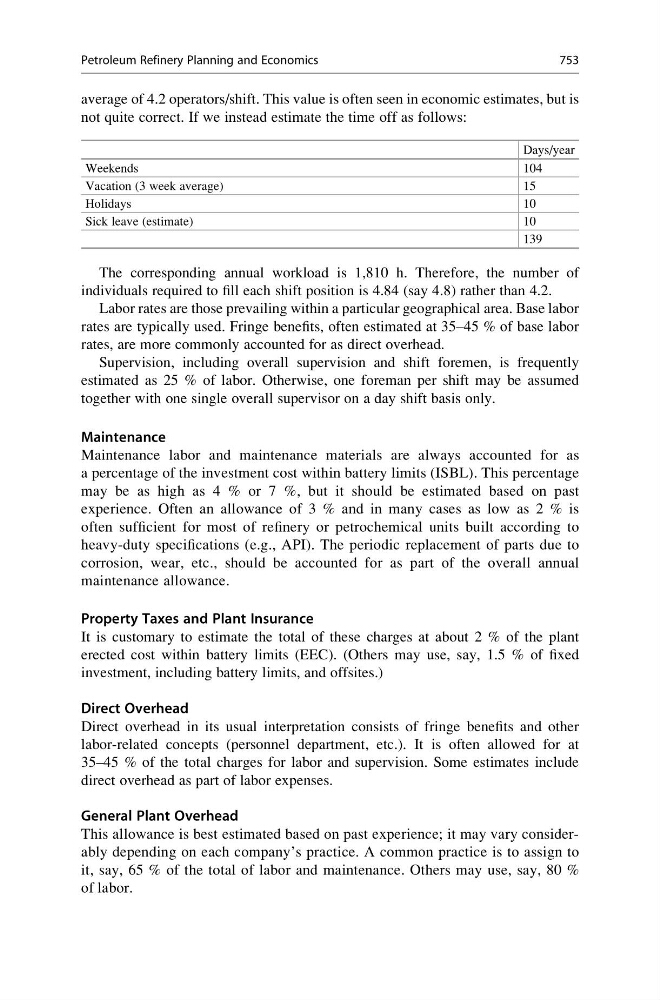
not quite correct. If we instead estimate the time off as follows:
Days/year
Weekends
104
Vacation (3 week average)
15
Holidays
10
Sick leave (estimate)
10
139
The corresponding annual workload is 1,810 h. Therefore, the number of
individuals required to fill each shift position is 4.84 (say 4.8) rather than 4.2.
Labor rates are those prevailing within a particular geographical area. Base labor
rates are typically used. Fringe benefits, often estimated at 35–45 % of base labor
rates, are more commonly accounted for as direct overhead.
Supervision, including overall supervision and shift foremen, is frequently
estimated as 25 % of labor. Otherwise, one foreman per shift may be assumed
together with one single overall supervisor on a day shift basis only.
Maintenance
Maintenance labor and maintenance materials are always accounted for as
a percentage of the investment cost within battery limits (ISBL). This percentage
may be as high as 4 % or 7 %, but it should be estimated based on past
experience. Often an allowance of 3 % and in many cases as low as 2 % is
often sufficient for most of refinery or petrochemical units built according to
heavy-duty specifications (e.g., API). The periodic replacement of parts due to
corrosion, wear, etc., should be accounted for as part of the overall annual
maintenance allowance.
Property Taxes and Plant Insurance
It is customary to estimate the total of these charges at about 2 % of the plant
erected cost within battery limits (EEC). (Others may use, say, 1.5 % of fixed
investment, including battery limits, and offsites.)
Direct Overhead
Direct overhead in its usual interpretation consists of fringe benefits and other
labor-related concepts (personnel department, etc.). It is often allowed for at
35–45 % of the total charges for labor and supervision. Some estimates include
direct overhead as part of labor expenses.
General Plant Overhead
This allowance is best estimated based on past experience; it may vary considerably depending on each company’s practice. A common practice is to assign to
it, say, 65 % of the total of labor and maintenance. Others may use, say, 80 %
of labor.
Petroleum Refinery Planning and Economics
753