

Conradson Carbon Residue of Petroleum Products
This test is used to determine the amount of carbon residue left after complete
evaporation and pyrolysis of an oil. The degree of this carbon content is indicative
of the coke-forming properties of the oil. The value of the Conradson carbon
content is important in most heavy oil hydrotreating and most cracking processes.
A number of modern catalysts used in heavy oil cracking have been developed to
withstand the adverse effect of carbon laydown. Still, excessive coke formation
remains a problem in most cracking processes. The apparatus used for this test is
shown in Fig. 11.
ASTM D189
The apparatus consists of a porcelain crucible containing a weighed sample of the
oil. This crucible is placed in the center of an iron crucible which is itself placed in a
larger iron crucible. Both iron crucibles are fitted with covers and are vented
through a metallic hood. This assembly is placed on a stand with a supporting
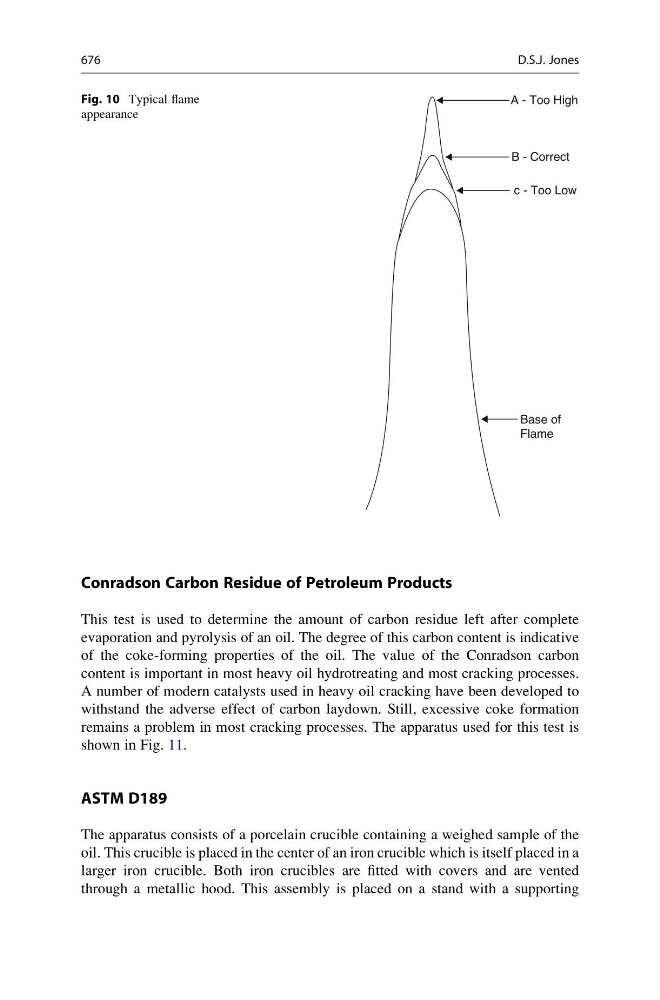
A - Too High
B - Correct
c - Too Low
Base of
Flame
Fig. 10 Typical flame
appearance
676
D.S.J. Jones