

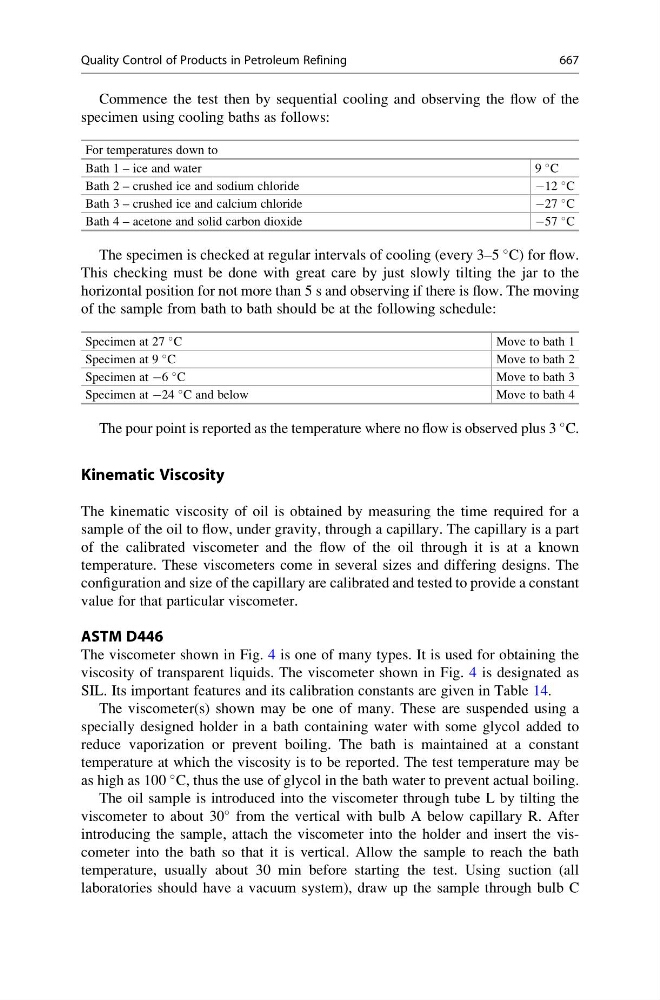
Commence the test then by sequential cooling and observing the flow of the
specimen using cooling baths as follows:
For temperatures down to
Bath 1 – ice and water
9
C
Bath 2 – crushed ice and sodium chloride
À12
C
Bath 3 – crushed ice and calcium chloride
À27
C
Bath 4 – acetone and solid carbon dioxide
À57
C
The specimen is checked at regular intervals of cooling (every 3–5
C) for flow.
This checking must be done with great care by just slowly tilting the jar to the
horizontal position for not more than 5 s and observing if there is flow. The moving
of the sample from bath to bath should be at the following schedule:
Specimen at 27
C
Move to bath 1
Specimen at 9
C
Move to bath 2
Specimen at À6
C
Move to bath 3
Specimen at À24
C and below
Move to bath 4
The pour point is reported as the temperature where no flow is observed plus 3
C.
Kinematic Viscosity
The kinematic viscosity of oil is obtained by measuring the time required for a
sample of the oil to flow, under gravity, through a capillary. The capillary is a part
of the calibrated viscometer and the flow of the oil through it is at a known
temperature. These viscometers come in several sizes and differing designs. The
configuration and size of the capillary are calibrated and tested to provide a constant
value for that particular viscometer.
ASTM D446
The viscometer shown in Fig. 4 is one of many types. It is used for obtaining the
viscosity of transparent liquids. The viscometer shown in Fig. 4 is designated as
SIL. Its important features and its calibration constants are given in Table 14.
The viscometer(s) shown may be one of many. These are suspended using a
specially designed holder in a bath containing water with some glycol added to
reduce vaporization or prevent boiling. The bath is maintained at a constant
temperature at which the viscosity is to be reported. The test temperature may be
as high as 100
C, thus the use of glycol in the bath water to prevent actual boiling.
The oil sample is introduced into the viscometer through tube L by tilting the
viscometer to about 30
from the vertical with bulb A below capillary R. After
introducing the sample, attach the viscometer into the holder and insert the viscometer into the bath so that it is vertical. Allow the sample to reach the bath
temperature, usually about 30 min before starting the test. Using suction (all
laboratories should have a vacuum system), draw up the sample through bulb C
Quality Control of Products in Petroleum Refining
667