

• Reformer outlet = 290 psig
• Shift converter outlet = 280 psig
• Product hydrogen from PSA = 260 psig
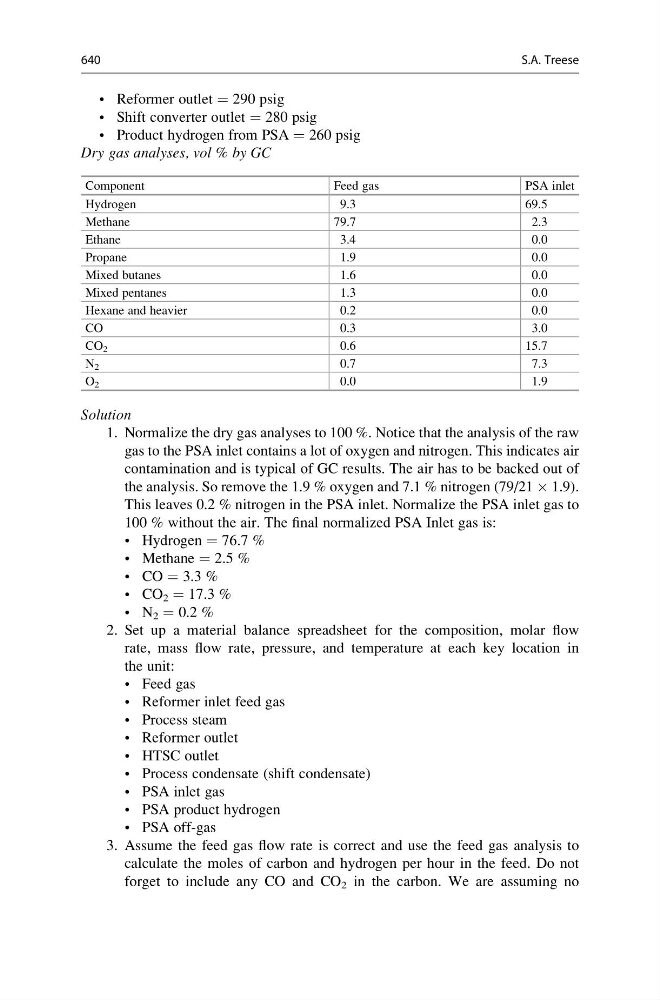
Dry gas analyses, vol % by GC
Component
Feed gas
PSA inlet
Hydrogen
9.3
69.5
Methane
79.7
2.3
Ethane
3.4
0.0
Propane
1.9
0.0
Mixed butanes
1.6
0.0
Mixed pentanes
1.3
0.0
Hexane and heavier
0.2
0.0
CO
0.3
3.0
CO 2
0.6
15.7
N 2
0.7
7.3
O 2
0.0
1.9
Solution
1. Normalize the dry gas analyses to 100 %. Notice that the analysis of the raw
gas to the PSA inlet contains a lot of oxygen and nitrogen. This indicates air
contamination and is typical of GC results. The air has to be backed out of
the analysis. So remove the 1.9 % oxygen and 7.1 % nitrogen (79/21 Â 1.9).
This leaves 0.2 % nitrogen in the PSA inlet. Normalize the PSA inlet gas to
100 % without the air. The final normalized PSA Inlet gas is:
• Hydrogen = 76.7 %
• Methane = 2.5 %
• CO = 3.3 %
• CO 2 = 17.3 %
• N 2 = 0.2 %
2. Set up a material balance spreadsheet for the composition, molar flow
rate, mass flow rate, pressure, and temperature at each key location in
the unit:
• Feed gas
• Reformer inlet feed gas
• Process steam
• Reformer outlet
• HTSC outlet
• Process condensate (shift condensate)
• PSA inlet gas
• PSA product hydrogen
• PSA off-gas
3. Assume the feed gas flow rate is correct and use the feed gas analysis to
calculate the moles of carbon and hydrogen per hour in the feed. Do not
forget to include any CO and CO 2 in the carbon. We are assuming no
640
S.A. Treese