

best at a steady, stable rate. They do not respond well to frequent rate changes.
Daily rate changes are usually tolerable; hourly changes make operation
difficult.
The most common adjustments to operating conditions are listed below. This is,
by no means, a comprehensive listing.
– Feed purification
Adjust temperatures and/or absorber flows and loadings to maintain
non-detectable H 2 S in the reformer feed.
– Reforming furnace
Maintain steam/carbon ratio at design. Slight changes may be needed,
depending on the feedstock.
Pressure is not normally changed.
Reformer process outlet temperature is controlled to maintain the target
methane slip.
Firebox-side control of the reforming furnace is similar to other furnaces,
with appropriate safety interlocks. The PSA gas may introduce fluctuations that must be managed by the controls.
Adjustments to manage methane slip can be estimated from the figures
included in the overall process discussion section. These figures relate
methane slip, steam/carbon ratio, temperature and pressure for methane,
and naphtha feedstocks. Essentially, they are graphical representations of
the SMR equilibrium with parameters in the normal operating ranges.
If the furnace has an SCR, the vaporizer and ammonia flows will be automatically controlled. They just need to be monitored.
– Shift conversion
Adjust the shift converter inlet temperature to obtain the target outlet CO slip.
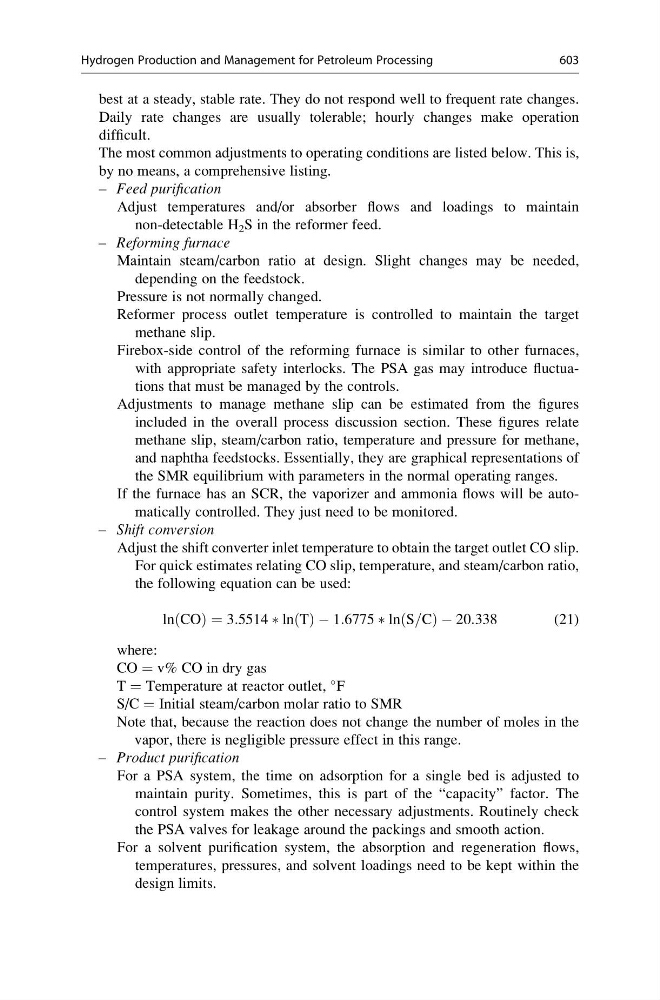
For quick estimates relating CO slip, temperature, and steam/carbon ratio,
the following equation can be used:
ln CO
ð Þ ¼ 3:5514 Ã ln T
ð Þ À 1:6775 Ã ln S=C
ð
ÞÀ20:338
(21)
where:
CO = v% CO in dry gas
T = Temperature at reactor outlet,
F
S/C = Initial steam/carbon molar ratio to SMR
Note that, because the reaction does not change the number of moles in the
vapor, there is negligible pressure effect in this range.
– Product purification
For a PSA system, the time on adsorption for a single bed is adjusted to
maintain purity. Sometimes, this is part of the “capacity” factor. The
control system makes the other necessary adjustments. Routinely check
the PSA valves for leakage around the packings and smooth action.
For a solvent purification system, the absorption and regeneration flows,
temperatures, pressures, and solvent loadings need to be kept within the
design limits.
Hydrogen Production and Management for Petroleum Processing
603