

The outlet temperature of the methanator is controlled by the inlet temperature
and the CO slip out of the last shift reactor. The final hydrogen from the methanator
is cooled and sent to the users.
Dry hydrogen after the methanator is typically 92–96 % hydrogen, with the
balance being methane. There will also normally be <10 vppm CO+CO 2 remaining
plus some water from saturation of the hydrogen from the absorber and the
methanation reaction.
Because the methanator is so highly exothermic, a methanator normally has an
automatic emergency shutdown system, which will bypass the reactor and send the
hydrogen to flare or vent on high-high temperature to avoid failing the reactor
vessel or piping.
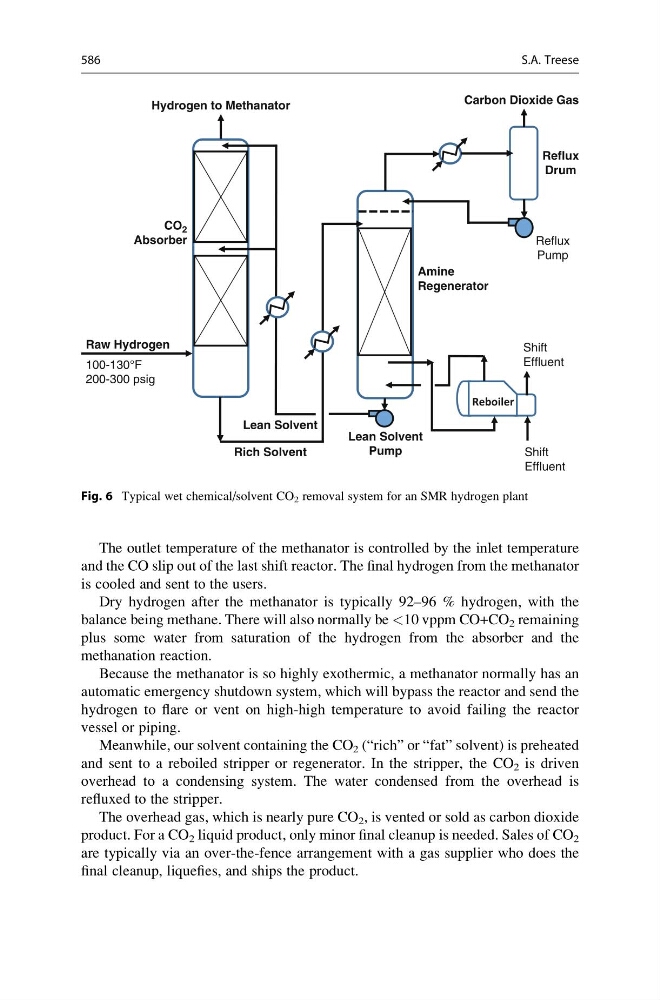
Meanwhile, our solvent containing the CO 2 (“rich” or “fat” solvent) is preheated
and sent to a reboiled stripper or regenerator. In the stripper, the CO 2 is driven
overhead to a condensing system. The water condensed from the overhead is
refluxed to the stripper.
The overhead gas, which is nearly pure CO 2 , is vented or sold as carbon dioxide
product. For a CO 2 liquid product, only minor final cleanup is needed. Sales of CO 2
are typically via an over-the-fence arrangement with a gas supplier who does the
final cleanup, liquefies, and ships the product.
Hydrogen to Methanator
Reflux
Drum
CO 2
Absorber
Reflux
Pump
Amine
Regenerator
Raw Hydrogen
Shift
Effluent
100-130°F
200-300 psig
Lean Solvent
Lean Solvent
Pump
Rich Solvent
Shift
Effluent
Carbon Dioxide Gas
Reboiler
Fig. 6 Typical wet chemical/solvent CO 2 removal system for an SMR hydrogen plant
586
S.A. Treese