

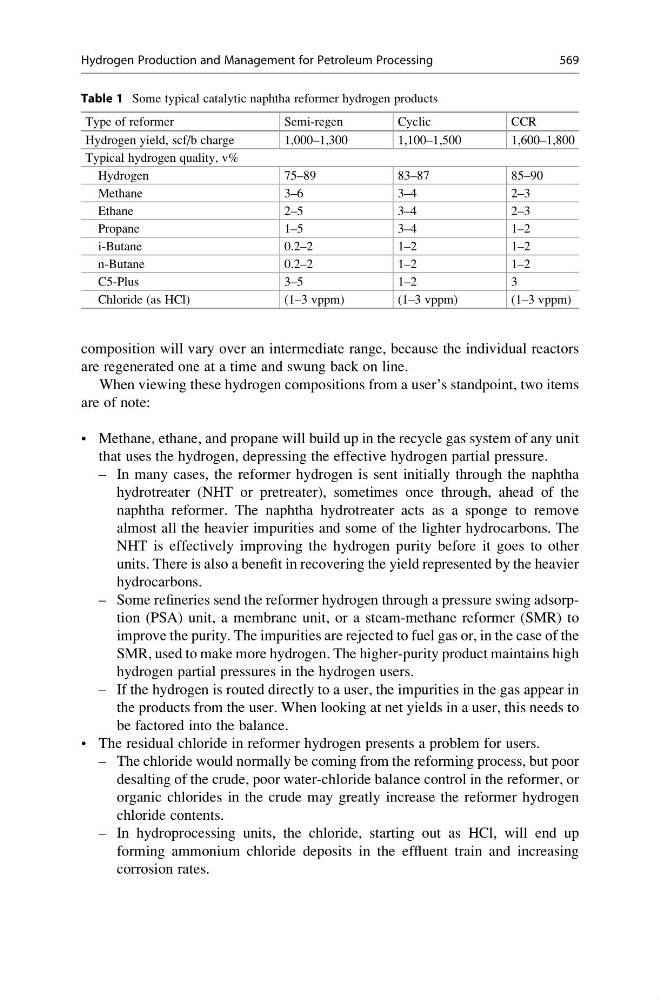
composition will vary over an intermediate range, because the individual reactors
are regenerated one at a time and swung back on line.
When viewing these hydrogen compositions from a user’s standpoint, two items
are of note:
• Methane, ethane, and propane will build up in the recycle gas system of any unit
that uses the hydrogen, depressing the effective hydrogen partial pressure.
– In many cases, the reformer hydrogen is sent initially through the naphtha
hydrotreater (NHT or pretreater), sometimes once through, ahead of the
naphtha reformer. The naphtha hydrotreater acts as a sponge to remove
almost all the heavier impurities and some of the lighter hydrocarbons. The
NHT is effectively improving the hydrogen purity before it goes to other
units. There is also a benefit in recovering the yield represented by the heavier
hydrocarbons.
– Some refineries send the reformer hydrogen through a pressure swing adsorption (PSA) unit, a membrane unit, or a steam-methane reformer (SMR) to
improve the purity. The impurities are rejected to fuel gas or, in the case of the
SMR, used to make more hydrogen. The higher-purity product maintains high
hydrogen partial pressures in the hydrogen users.
– If the hydrogen is routed directly to a user, the impurities in the gas appear in
the products from the user. When looking at net yields in a user, this needs to
be factored into the balance.
• The residual chloride in reformer hydrogen presents a problem for users.
– The chloride would normally be coming from the reforming process, but poor
desalting of the crude, poor water-chloride balance control in the reformer, or
organic chlorides in the crude may greatly increase the reformer hydrogen
chloride contents.
– In hydroprocessing units, the chloride, starting out as HCl, will end up
forming ammonium chloride deposits in the effluent train and increasing
corrosion rates.
Table 1 Some typical catalytic naphtha reformer hydrogen products
Type of reformer
Semi-regen
Cyclic
CCR
Hydrogen yield, scf/b charge
1,000–1,300
1,100–1,500
1,600–1,800
Typical hydrogen quality, v%
Hydrogen
75–89
83–87
85–90
Methane
3–6
3–4
2–3
Ethane
2–5
3–4
2–3
Propane
1–5
3–4
1–2
i-Butane
0.2–2
1–2
1–2
n-Butane
0.2–2
1–2
1–2
C5-Plus
3–5
1–2
3
Chloride (as HCl)
(1–3 vppm)
(1–3 vppm)
(1–3 vppm)
Hydrogen Production and Management for Petroleum Processing
569
are regenerated one at a time and swung back on line.
When viewing these hydrogen compositions from a user’s standpoint, two items
are of note:
• Methane, ethane, and propane will build up in the recycle gas system of any unit
that uses the hydrogen, depressing the effective hydrogen partial pressure.
– In many cases, the reformer hydrogen is sent initially through the naphtha
hydrotreater (NHT or pretreater), sometimes once through, ahead of the
naphtha reformer. The naphtha hydrotreater acts as a sponge to remove
almost all the heavier impurities and some of the lighter hydrocarbons. The
NHT is effectively improving the hydrogen purity before it goes to other
units. There is also a benefit in recovering the yield represented by the heavier
hydrocarbons.
– Some refineries send the reformer hydrogen through a pressure swing adsorption (PSA) unit, a membrane unit, or a steam-methane reformer (SMR) to
improve the purity. The impurities are rejected to fuel gas or, in the case of the
SMR, used to make more hydrogen. The higher-purity product maintains high
hydrogen partial pressures in the hydrogen users.
– If the hydrogen is routed directly to a user, the impurities in the gas appear in
the products from the user. When looking at net yields in a user, this needs to
be factored into the balance.
• The residual chloride in reformer hydrogen presents a problem for users.
– The chloride would normally be coming from the reforming process, but poor
desalting of the crude, poor water-chloride balance control in the reformer, or
organic chlorides in the crude may greatly increase the reformer hydrogen
chloride contents.
– In hydroprocessing units, the chloride, starting out as HCl, will end up
forming ammonium chloride deposits in the effluent train and increasing
corrosion rates.
Table 1 Some typical catalytic naphtha reformer hydrogen products
Type of reformer
Semi-regen
Cyclic
CCR
Hydrogen yield, scf/b charge
1,000–1,300
1,100–1,500
1,600–1,800
Typical hydrogen quality, v%
Hydrogen
75–89
83–87
85–90
Methane
3–6
3–4
2–3
Ethane
2–5
3–4
2–3
Propane
1–5
3–4
1–2
i-Butane
0.2–2
1–2
1–2
n-Butane
0.2–2
1–2
1–2
C5-Plus
3–5
1–2
3
Chloride (as HCl)
(1–3 vppm)
(1–3 vppm)
(1–3 vppm)
Hydrogen Production and Management for Petroleum Processing
569