

most of the nitrogen and sulfur content of the feed to ammonia and hydrogen
sulfide, respectively.
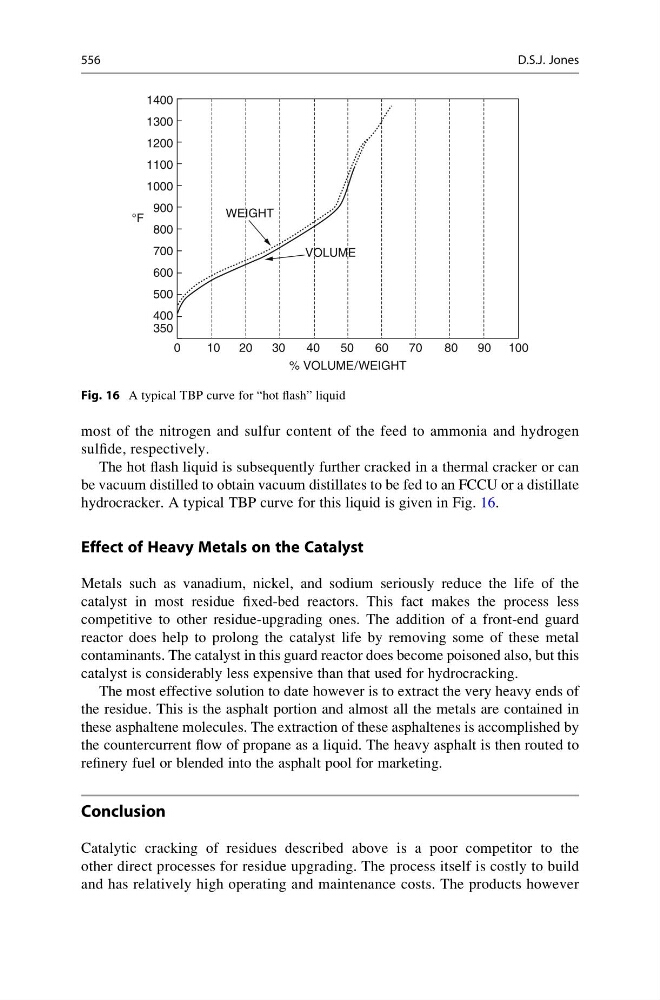
The hot flash liquid is subsequently further cracked in a thermal cracker or can
be vacuum distilled to obtain vacuum distillates to be fed to an FCCU or a distillate
hydrocracker. A typical TBP curve for this liquid is given in Fig. 16.
Effect of Heavy Metals on the Catalyst
Metals such as vanadium, nickel, and sodium seriously reduce the life of the
catalyst in most residue fixed-bed reactors. This fact makes the process less
competitive to other residue-upgrading ones. The addition of a front-end guard
reactor does help to prolong the catalyst life by removing some of these metal
contaminants. The catalyst in this guard reactor does become poisoned also, but this
catalyst is considerably less expensive than that used for hydrocracking.
The most effective solution to date however is to extract the very heavy ends of
the residue. This is the asphalt portion and almost all the metals are contained in
these asphaltene molecules. The extraction of these asphaltenes is accomplished by
the countercurrent flow of propane as a liquid. The heavy asphalt is then routed to
refinery fuel or blended into the asphalt pool for marketing.
Conclusion
Catalytic cracking of residues described above is a poor competitor to the
other direct processes for residue upgrading. The process itself is costly to build
and has relatively high operating and maintenance costs. The products however
1400
1300
1200
1100
1000
900
WEIGHT
VOLUME
800
°F
700
600
500
400
350
0
10
20
30
40
50
% VOLUME/WEIGHT
60
70
80
90 100
Fig. 16 A typical TBP curve for “hot flash” liquid
556
D.S.J. Jones
sulfide, respectively.
The hot flash liquid is subsequently further cracked in a thermal cracker or can
be vacuum distilled to obtain vacuum distillates to be fed to an FCCU or a distillate
hydrocracker. A typical TBP curve for this liquid is given in Fig. 16.
Effect of Heavy Metals on the Catalyst
Metals such as vanadium, nickel, and sodium seriously reduce the life of the
catalyst in most residue fixed-bed reactors. This fact makes the process less
competitive to other residue-upgrading ones. The addition of a front-end guard
reactor does help to prolong the catalyst life by removing some of these metal
contaminants. The catalyst in this guard reactor does become poisoned also, but this
catalyst is considerably less expensive than that used for hydrocracking.
The most effective solution to date however is to extract the very heavy ends of
the residue. This is the asphalt portion and almost all the metals are contained in
these asphaltene molecules. The extraction of these asphaltenes is accomplished by
the countercurrent flow of propane as a liquid. The heavy asphalt is then routed to
refinery fuel or blended into the asphalt pool for marketing.
Conclusion
Catalytic cracking of residues described above is a poor competitor to the
other direct processes for residue upgrading. The process itself is costly to build
and has relatively high operating and maintenance costs. The products however
1400
1300
1200
1100
1000
900
WEIGHT
VOLUME
800
°F
700
600
500
400
350
0
10
20
30
40
50
% VOLUME/WEIGHT
60
70
80
90 100
Fig. 16 A typical TBP curve for “hot flash” liquid
556
D.S.J. Jones