

Step 4. Carry out a heat balance over the contactor with the rich amine temperature
being the unknown. Equate and solve for this.
Step 5. From plant data (or the Design Spec), apply the temperatures and flow in and
out of the exchanger to calculate its heat duty in Btu/h.
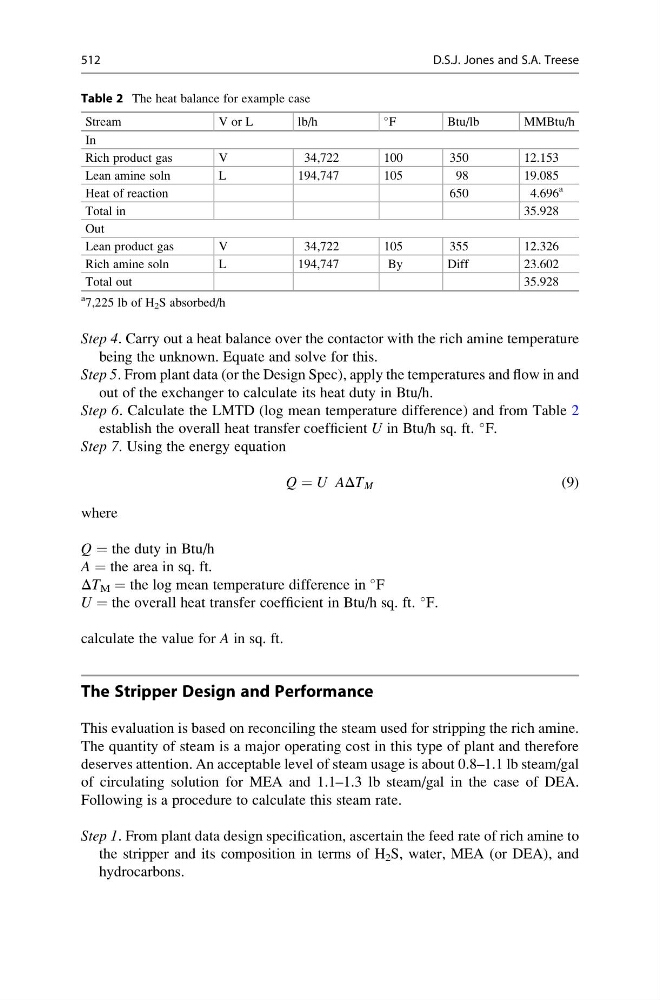
Step 6. Calculate the LMTD (log mean temperature difference) and from Table 2
establish the overall heat transfer coefficient U in Btu/h sq. ft.
F.
Step 7. Using the energy equation
Q ¼ U AΔT M
(9)
where
Q = the duty in Btu/h
A = the area in sq. ft.
ΔT M = the log mean temperature difference in
F
U = the overall heat transfer coefficient in Btu/h sq. ft.
F.
calculate the value for A in sq. ft.
The Stripper Design and Performance
This evaluation is based on reconciling the steam used for stripping the rich amine.
The quantity of steam is a major operating cost in this type of plant and therefore
deserves attention. An acceptable level of steam usage is about 0.8–1.1 lb steam/gal
of circulating solution for MEA and 1.1–1.3 lb steam/gal in the case of DEA.
Following is a procedure to calculate this steam rate.
Step 1. From plant data design specification, ascertain the feed rate of rich amine to
the stripper and its composition in terms of H 2 S, water, MEA (or DEA), and
hydrocarbons.
Table 2 The heat balance for example case
Stream
V or L
lb/h
F
Btu/lb
MMBtu/h
In
Rich product gas
V
34,722
100
350
12.153
Lean amine soln
L
194,747
105
98
19.085
Heat of reaction
650
4.696
a
Total in
35.928
Out
Lean product gas
V
34,722
105
355
12.326
Rich amine soln
L
194,747
By
Diff
23.602
Total out
35.928
a
7,225 lb of H 2 S absorbed/h
512
D.S.J. Jones and S.A. Treese
being the unknown. Equate and solve for this.
Step 5. From plant data (or the Design Spec), apply the temperatures and flow in and
out of the exchanger to calculate its heat duty in Btu/h.
Step 6. Calculate the LMTD (log mean temperature difference) and from Table 2
establish the overall heat transfer coefficient U in Btu/h sq. ft.
F.
Step 7. Using the energy equation
Q ¼ U AΔT M
(9)
where
Q = the duty in Btu/h
A = the area in sq. ft.
ΔT M = the log mean temperature difference in
F
U = the overall heat transfer coefficient in Btu/h sq. ft.
F.
calculate the value for A in sq. ft.
The Stripper Design and Performance
This evaluation is based on reconciling the steam used for stripping the rich amine.
The quantity of steam is a major operating cost in this type of plant and therefore
deserves attention. An acceptable level of steam usage is about 0.8–1.1 lb steam/gal
of circulating solution for MEA and 1.1–1.3 lb steam/gal in the case of DEA.
Following is a procedure to calculate this steam rate.
Step 1. From plant data design specification, ascertain the feed rate of rich amine to
the stripper and its composition in terms of H 2 S, water, MEA (or DEA), and
hydrocarbons.
Table 2 The heat balance for example case
Stream
V or L
lb/h
F
Btu/lb
MMBtu/h
In
Rich product gas
V
34,722
100
350
12.153
Lean amine soln
L
194,747
105
98
19.085
Heat of reaction
650
4.696
a
Total in
35.928
Out
Lean product gas
V
34,722
105
355
12.326
Rich amine soln
L
194,747
By
Diff
23.602
Total out
35.928
a
7,225 lb of H 2 S absorbed/h
512
D.S.J. Jones and S.A. Treese