

DEA is a weaker base (less reactive) than MEA. This has allowed DEA to be
circulated at about twice the solution strength of MEA without corrosion problems.
DEA systems are commonly operated at strengths up to 30 wt% in water, and it is not
unusual to see them as high as 35 wt%. This results in the DEA solution circulation
rate usually being a little less than MEA for the same system design parameters.
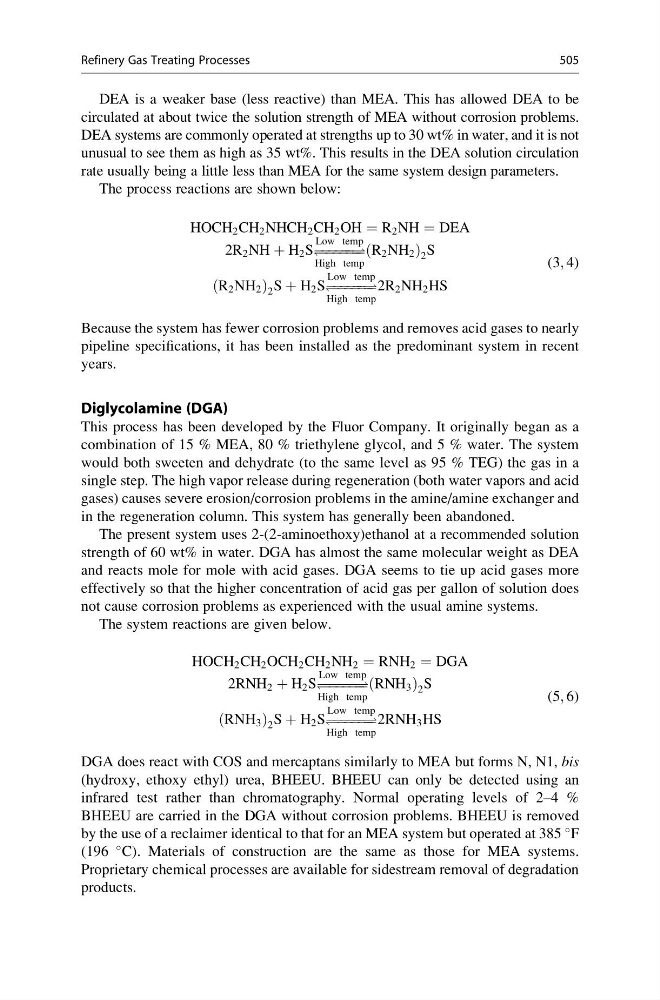
The process reactions are shown below:
HOCH 2 CH 2 NHCH 2 CH 2 OH ¼ R 2 NH ¼ DEA
2R 2 NH þ H 2 SÀ À À À À À*
)À À À À À À
Low temp
High temp
R 2 NH 2
ð
Þ 2 S
R 2 NH 2
ð
Þ 2 S þ H 2 SÀ À À À À À*
)À À À À À À
Low temp
High temp
2R 2 NH 2 HS
(3; 4)
Because the system has fewer corrosion problems and removes acid gases to nearly
pipeline specifications, it has been installed as the predominant system in recent
years.
Diglycolamine (DGA)
This process has been developed by the Fluor Company. It originally began as a
combination of 15 % MEA, 80 % triethylene glycol, and 5 % water. The system
would both sweeten and dehydrate (to the same level as 95 % TEG) the gas in a
single step. The high vapor release during regeneration (both water vapors and acid
gases) causes severe erosion/corrosion problems in the amine/amine exchanger and
in the regeneration column. This system has generally been abandoned.
The present system uses 2-(2-aminoethoxy)ethanol at a recommended solution
strength of 60 wt% in water. DGA has almost the same molecular weight as DEA
and reacts mole for mole with acid gases. DGA seems to tie up acid gases more
effectively so that the higher concentration of acid gas per gallon of solution does
not cause corrosion problems as experienced with the usual amine systems.
The system reactions are given below.
HOCH 2 CH 2 OCH 2 CH 2 NH 2 ¼ RNH 2 ¼ DGA
2RNH 2 þ H 2 SÀ À À À À À*
)À À À À À À
Low temp
High temp
RNH 3
ð
Þ 2 S
RNH 3
ð
Þ 2 S þ H 2 SÀ À À À À À*
)À À À À À À
Low temp
High temp
2RNH 3 HS
(5; 6)
DGA does react with COS and mercaptans similarly to MEA but forms N, N1, bis
(hydroxy, ethoxy ethyl) urea, BHEEU. BHEEU can only be detected using an
infrared test rather than chromatography. Normal operating levels of 2–4 %
BHEEU are carried in the DGA without corrosion problems. BHEEU is removed
by the use of a reclaimer identical to that for an MEA system but operated at 385
F
(196
C). Materials of construction are the same as those for MEA systems.
Proprietary chemical processes are available for sidestream removal of degradation
products.
Refinery Gas Treating Processes
505
circulated at about twice the solution strength of MEA without corrosion problems.
DEA systems are commonly operated at strengths up to 30 wt% in water, and it is not
unusual to see them as high as 35 wt%. This results in the DEA solution circulation
rate usually being a little less than MEA for the same system design parameters.
The process reactions are shown below:
HOCH 2 CH 2 NHCH 2 CH 2 OH ¼ R 2 NH ¼ DEA
2R 2 NH þ H 2 SÀ À À À À À*
)À À À À À À
Low temp
High temp
R 2 NH 2
ð
Þ 2 S
R 2 NH 2
ð
Þ 2 S þ H 2 SÀ À À À À À*
)À À À À À À
Low temp
High temp
2R 2 NH 2 HS
(3; 4)
Because the system has fewer corrosion problems and removes acid gases to nearly
pipeline specifications, it has been installed as the predominant system in recent
years.
Diglycolamine (DGA)
This process has been developed by the Fluor Company. It originally began as a
combination of 15 % MEA, 80 % triethylene glycol, and 5 % water. The system
would both sweeten and dehydrate (to the same level as 95 % TEG) the gas in a
single step. The high vapor release during regeneration (both water vapors and acid
gases) causes severe erosion/corrosion problems in the amine/amine exchanger and
in the regeneration column. This system has generally been abandoned.
The present system uses 2-(2-aminoethoxy)ethanol at a recommended solution
strength of 60 wt% in water. DGA has almost the same molecular weight as DEA
and reacts mole for mole with acid gases. DGA seems to tie up acid gases more
effectively so that the higher concentration of acid gas per gallon of solution does
not cause corrosion problems as experienced with the usual amine systems.
The system reactions are given below.
HOCH 2 CH 2 OCH 2 CH 2 NH 2 ¼ RNH 2 ¼ DGA
2RNH 2 þ H 2 SÀ À À À À À*
)À À À À À À
Low temp
High temp
RNH 3
ð
Þ 2 S
RNH 3
ð
Þ 2 S þ H 2 SÀ À À À À À*
)À À À À À À
Low temp
High temp
2RNH 3 HS
(5; 6)
DGA does react with COS and mercaptans similarly to MEA but forms N, N1, bis
(hydroxy, ethoxy ethyl) urea, BHEEU. BHEEU can only be detected using an
infrared test rather than chromatography. Normal operating levels of 2–4 %
BHEEU are carried in the DGA without corrosion problems. BHEEU is removed
by the use of a reclaimer identical to that for an MEA system but operated at 385
F
(196
C). Materials of construction are the same as those for MEA systems.
Proprietary chemical processes are available for sidestream removal of degradation
products.
Refinery Gas Treating Processes
505