

octenes. These octenes are fairly linear, have a poor octane number, and are
unsuited for gasoline applications. Heptenes and octenes obtained from the
Dimersol X process are feedstocks for the production of plasticizer alcohols.
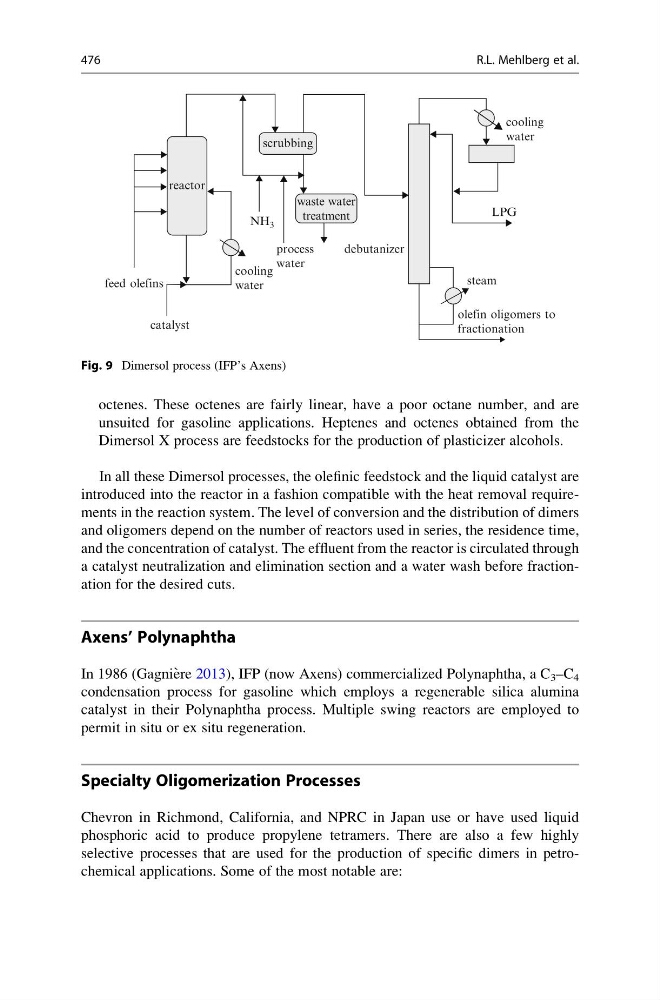
In all these Dimersol processes, the olefinic feedstock and the liquid catalyst are
introduced into the reactor in a fashion compatible with the heat removal requirements in the reaction system. The level of conversion and the distribution of dimers
and oligomers depend on the number of reactors used in series, the residence time,
and the concentration of catalyst. The effluent from the reactor is circulated through
a catalyst neutralization and elimination section and a water wash before fractionation for the desired cuts.
Axens’ Polynaphtha
In 1986 (Gagnie `re 2013), IFP (now Axens) commercialized Polynaphtha, a C 3 –C 4
condensation process for gasoline which employs a regenerable silica alumina
catalyst in their Polynaphtha process. Multiple swing reactors are employed to
permit in situ or ex situ regeneration.
Specialty Oligomerization Processes
Chevron in Richmond, California, and NPRC in Japan use or have used liquid
phosphoric acid to produce propylene tetramers. There are also a few highly
selective processes that are used for the production of specific dimers in petrochemical applications. Some of the most notable are:
scrubbing
cooling
water
reactor
NH 3
waste water
treatment
LPG
feed olefins
cooling
water
process
water
debutanizer
steam
catalyst
olefin oligomers to
fractionation
Fig. 9 Dimersol process (IFP’s Axens)
476
R.L. Mehlberg et al.
unsuited for gasoline applications. Heptenes and octenes obtained from the
Dimersol X process are feedstocks for the production of plasticizer alcohols.
In all these Dimersol processes, the olefinic feedstock and the liquid catalyst are
introduced into the reactor in a fashion compatible with the heat removal requirements in the reaction system. The level of conversion and the distribution of dimers
and oligomers depend on the number of reactors used in series, the residence time,
and the concentration of catalyst. The effluent from the reactor is circulated through
a catalyst neutralization and elimination section and a water wash before fractionation for the desired cuts.
Axens’ Polynaphtha
In 1986 (Gagnie `re 2013), IFP (now Axens) commercialized Polynaphtha, a C 3 –C 4
condensation process for gasoline which employs a regenerable silica alumina
catalyst in their Polynaphtha process. Multiple swing reactors are employed to
permit in situ or ex situ regeneration.
Specialty Oligomerization Processes
Chevron in Richmond, California, and NPRC in Japan use or have used liquid
phosphoric acid to produce propylene tetramers. There are also a few highly
selective processes that are used for the production of specific dimers in petrochemical applications. Some of the most notable are:
scrubbing
cooling
water
reactor
NH 3
waste water
treatment
LPG
feed olefins
cooling
water
process
water
debutanizer
steam
catalyst
olefin oligomers to
fractionation
Fig. 9 Dimersol process (IFP’s Axens)
476
R.L. Mehlberg et al.